How to get a class B driving licence – complete guide
A complete guide to the entire process of getting a class B driving licence.
Getting a class B driving licence is a multi-step process where the steps build on each other, so it pays to know the order before you start. Class B lets you drive an ordinary passenger car, and the road there runs through the basic traffic course, supervised practice, mandatory courses, the theory test and finally the driving test. This guide takes you through the whole journey step by step, so you know what is required, when – and why.
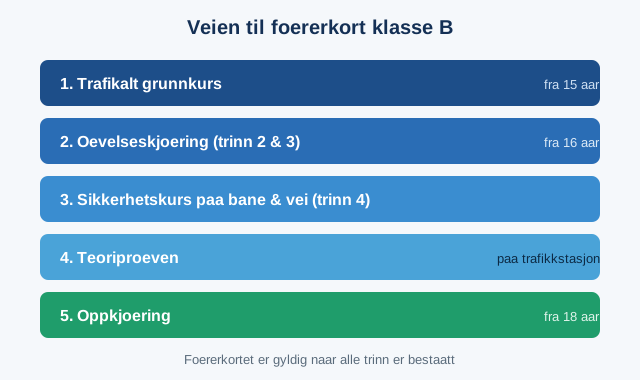
Table of contents
- Step 1: Basic traffic course
- Step 2: Supervised practice
- Step 3: Mandatory courses
- Step 4: The theory test
- Step 5: The driving test
- Age limits and timeline
- How to prepare
Step 1: Basic traffic course
It all starts with the basic traffic course (trafikalt grunnkurs). This is a mandatory introductory course that gives you a foundation in traffic awareness, risk and what it means to be a driver. The course must be completed before you can begin supervised practice, and it includes, among other things, an evening of night-driving training during the winter season. Once completed you receive a certificate valid for a set period, which you must carry during all supervised practice.
You can start the basic traffic course from the age of 15. Read more about what the course covers in our overview of the basic traffic course and what you need to know before moving on.
Step 2: Supervised practice
Once the basic course is passed, you can start supervised practice – either privately with an accompanying driver or at a driving school. For private practice the accompanying driver must meet certain requirements, and you yourself must have turned 16. It is wise to combine lessons at a school with plenty of private practice, because spread-out practice over time builds the best and safest routine.
The rules for who can be an accompanying driver and what is required are explained in the article on supervised practice . Along the way you should also work on the traffic rules in practice, for example:
Step 3: Mandatory courses
The training is divided into four stages, where some parts are mandatory no matter how skilled you are. The most important mandatory courses are the skid course on a track (often called slippery-driving) and the safety course on the road (stage 4). The skid course teaches you how the car behaves when the road is slippery, and how little it takes to lose control.
You can read more about the skid course on a practice track and about the safety course on the road (stage 4). These courses must be completed before you can register for the driving test.
Step 4: The theory test
The theory test is a multiple-choice exam you take at a traffic station run by the Norwegian Public Roads Administration. The test checks whether you know the traffic rules, the road signs, risk awareness and vehicle knowledge. You must pass the theory test before you can take the driving test, but you can take it in parallel with supervised practice.
Learn more about the theory test and about how many questions and the pass mark that apply. Good preparation is the key to passing on the first attempt.
Step 5: The driving test
The final step is the driving test, the practical exam. Here you show that you can drive independently, safely and in line with the traffic rules. An examiner sits with you and assesses everything from technique and observation to how you make decisions in traffic. You must have turned 18 to take the driving test, and both the theory test and the mandatory courses must be passed first.
See our step-by-step guide to the driving test to know exactly what the examiner is looking for.
Age limits and timeline
The table below shows the typical order and the earliest you can take each step.
| Step | What | Earliest |
|---|---|---|
| 1 | Basic traffic course | Age 15 |
| 2 | Supervised practice | Age 16 |
| 3 | Mandatory courses (track and road) | During training |
| 4 | Theory test | When you feel ready |
| 5 | Driving test | Age 18 |
How to prepare
The best preparation is a combination of practical driving and solid theory. While you practise driving, you should work steadily on the theory so it sticks by the time you take the theory test. That way you avoid stress right before the exam, and you also become a safer driver.
You can practise completely free: try a free theory test and keep training in the Eteo app, where you get realistic questions and explanations that get you ready for the theory test. Steady practice over time gives the best results – and makes the whole road to a class B driving licence safer and easier.
Next step
Continue with free car questions
Go straight from the article to free car questions and check what actually sticks before you keep reading more theory.
Try for free