First aid at a traffic accident – step by step
Secure, alert, save lives – the right order at the accident scene.
If you are first to reach a traffic accident, you decide what happens in the first and most important minutes. First aid at a traffic accident is about staying calm and doing things in the right order: first secure, then alert, then save lives. This knowledge is part of the class B curriculum, but above all it is something you may need in real life – perhaps before you even have your licence.
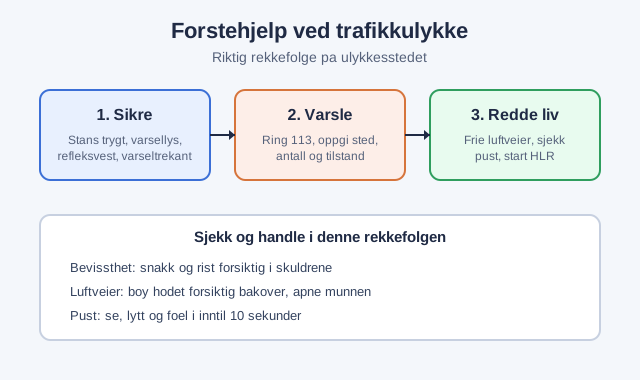
Table of contents
- The correct order
- Step 1: Secure the accident scene
- Step 2: Alert the emergency services
- Step 3: Give life-saving first aid
- Common mistakes to avoid
The correct order
Your instinct is often to rush straight to an injured person, but that can put both you and others in danger. Always follow the fixed order secure – alert – save lives. That way you avoid causing further accidents, and you make sure help is on the way while you work.
| Step | What you do | Why |
|---|---|---|
| 1. Secure | Stop safely, switch on hazard lights, put on a hi-vis vest, set out a warning triangle | Prevent collisions and new accidents |
| 2. Alert | Call 113, give the exact location, number and condition | Get professional help on the way fast |
| 3. Save lives | Check consciousness, clear airways and breathing – start CPR if needed | Keep people alive until the ambulance arrives |
Step 1: Secure the accident scene
The very first thing you do is make sure the situation does not get worse.
- Stop in a safe place with good distance to the accident, ideally a little before the scene itself.
- Switch on the hazard lights and use dipped headlights to stay visible.
- Put on a hi-vis vest before you get out of the car.
- Set out a warning triangle at a good distance – further on high-speed roads.
- Get an overview: how many are involved, is there a risk of car fire, and is traffic approaching?
When you approach an accident others have already stopped at, special considerations apply to how you behave. Read more about how to drive past an accident scene safely. If there is a fire risk, you should know how to handle car fire and evacuation .
Step 2: Alert the emergency services
Once the scene is secure, you call 113 (medical emergency number). The shared emergency numbers 112 (police) and 110 (fire) also exist, but with personal injury 113 is the right number to call first – the operator connects you to other services as needed.
Be ready to give:
- Where the accident happened – road number, direction and landmarks in the terrain
- What happened – number of vehicles and whether anyone is trapped
- How many are injured, and what condition they are in
- Whether there is a risk of fire, leakage or landslide
Do not hang up before the operator says you may. As a road user you also have a legal duty to help; read more about your duties at a traffic incident . If you are revising for the test, it helps to know such questions can come up – see how many questions you must answer in the article on number of questions and the pass mark .
Step 3: Give life-saving first aid
Only now do you go to the injured person. Think consciousness – airway – breathing in this order:
- Consciousness: Speak to the person and shake their shoulders gently. If they do not respond, it is serious.
- Airway: Gently tilt the head back and lift the chin so the airways are clear.
- Breathing: Look, listen and feel for breathing for up to 10 seconds.
If the person breathes normally but is unconscious, place them in the recovery position so the airways stay clear. If the person is not breathing normally, you start cardiopulmonary resuscitation (CPR): 30 chest compressions followed by 2 rescue breaths, repeated until help arrives. Always stop heavy bleeding by pressing directly on the wound.
As a rule, an injured person should not be moved, unless there is immediate danger such as fire. You will find a more thorough walkthrough in the article on first aid and conduct at accidents . How to stay calm under pressure is covered in handling emergencies .
Common mistakes to avoid
- Running straight to the injured without securing the scene first
- Forgetting the hi-vis vest and warning triangle
- Moving an injured person without reason
- Hanging up before 113 tells you to
- Underestimating your own role – your effort can be decisive
Many accidents are linked to human factors such as fatigue and microsleep and medicines and driving ability . A good understanding of risk makes you a safer driver.
Want to test how well you know this before the theory test? Take a free theory test and keep practising in the Eteo app, so you are well prepared for the theory test.
Next step
Continue with free car questions
Go straight from the article to free car questions and check what actually sticks before you keep reading more theory.
Try for free