CPR and the recovery position at a traffic accident
How to give CPR and place an injured person in the recovery position.
When someone is unconscious after an accident, the first few minutes decide everything. CPR and the recovery position are the two simplest and most life-saving actions a driver can master. It is not about being a medical professional, but about keeping the airway open and the blood circulating until the ambulance arrives. This knowledge is part of the class B curriculum, and something you may actually need.
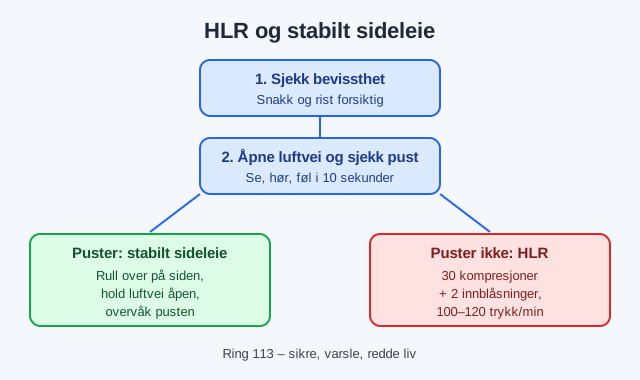
Table of contents
- First: secure and assess
- Check consciousness and breathing
- The recovery position for unconscious people who are breathing
- CPR when the person is not breathing
- Common mistakes to avoid
First: secure and assess
Before you even touch the casualty, you must think about your own and others’ safety. An accident scene is dangerous: traffic, glass and leaking fuel are real threats. Read more about how to secure the accident scene and about the correct order of first aid at a traffic accident . The main rule is simple: secure, alert, save lives – in that order.
Once the scene is secured and you have alerted the emergency services, or asked someone else to call, you can start the actual life-saving.
Check consciousness and breathing
Always start by checking whether the person responds:
- Speak loudly and ask if the person can hear you.
- Shake gently on the shoulders.
- If there is no response, the person is considered unconscious.
Next you must check the breathing. Tilt the head gently backwards with a grip under the chin so the airway opens. Place your cheek near the mouth and look towards the chest for up to 10 seconds:
- Look at whether the chest rises and falls.
- Listen for breathing sounds.
- Feel for air against your cheek.
The result of this check determines everything that follows.
| Condition | What you see | What you do |
|---|---|---|
| Conscious | Responds, speaks | Stay calm, observe, prevent cooling |
| Unconscious, breathing normally | No response, but breathing | Place in the recovery position |
| Unconscious, not breathing | No response, no breathing | Start CPR immediately |
The recovery position for unconscious people who are breathing
An unconscious person lying on their back risks getting the tongue or vomit into the airway and choking. The recovery position keeps the airway clear and lets fluid drain from the mouth. Here is how to do it on a person lying on their back:
- Kneel beside the person.
- Place the arm nearest you straight out, angled up with the palm facing up.
- Lay the other arm across the chest so the back of the hand rests against the cheek on your side.
- Bend the far leg up at the knee with the foot on the ground.
- Pull gently on the knee and roll the person over towards you onto their side.
- Adjust the head slightly backwards so the airway is open, and check that the person is still breathing.
Keep monitoring the breathing the whole time. If the person stops breathing, you must roll them onto their back again and start CPR.
CPR when the person is not breathing
If the person is not breathing normally, you most likely have a cardiac arrest and must start cardiopulmonary resuscitation (CPR) at once. For adults the ratio is 30 chest compressions followed by 2 rescue breaths:
- Compressions: Place the heel of one hand in the middle of the breastbone, the other hand on top. Push straight down 5–6 cm deep, at a rate of around 100–120 compressions per minute. Let the chest rise fully between each compression.
- Rescue breaths: Tilt the head back, pinch the nose shut and blow calmly until the chest rises. Two breaths.
- Continue 30:2 without long pauses until the ambulance takes over, a defibrillator is ready, or the person starts breathing normally again.
If you are unsure about rescue breaths, pure compression-only CPR is far better than nothing. The operator on 113 will gladly guide you along the way – put the phone on speaker and keep your hands free.
Remember that both stress and fatigue affect how you think in a crisis; read about fatigue and microsleep and about conduct at accidents to understand how to best keep a clear head.
Common mistakes to avoid
- Not securing the scene first – you help no one if you get hit yourself.
- Waiting too long to start CPR because you are afraid of making mistakes.
- Pressing too gently during compressions; you must get deep enough.
- Forgetting cooling – put something over the casualty, especially in winter.
As a driver you also have duties at an accident scene; see what applies under duties at a traffic accident .
Want to feel confident about what you have learned for the theory test? Take a free theory test and keep practising in the Eteo app until you are ready for the class B theory test.
Next step
Continue with free car questions
Go straight from the article to free car questions and check what actually sticks before you keep reading more theory.
Try for free