Proof to start supervised driving practice – what do you need?
The requirements and proof you need before you can start supervised driving practice.
Before you get behind the wheel to practise privately, a few formal requirements must be in place. The most important is proof of supervised driving for class B, meaning documentation that you have completed the basic traffic course. Without this proof, private practice driving is illegal, and both you and your accompanying driver can be fined. Below we go through exactly what you need, where you get it and how to prove that stage 1 is completed.
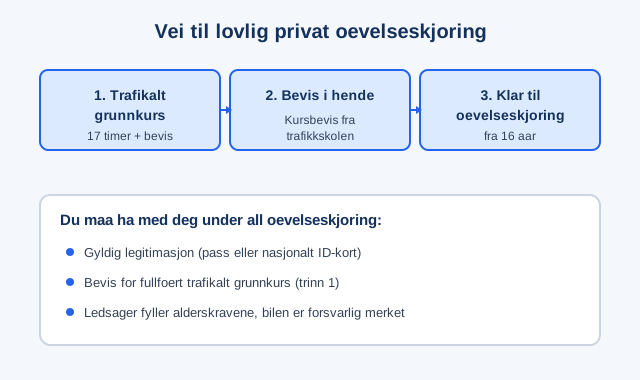
Table of contents
- What is “proof of supervised driving”?
- The basic traffic course – the foundation for the proof
- What you must carry when you drive
- Age limits and requirements for the accompanying driver
- What happens if you lack the proof?
What is “proof of supervised driving”?
The proof is simply a confirmation from the driving school that you have completed the basic traffic course, which corresponds to stage 1 of the training. Once the course is done, it is registered and you receive a physical or digital course certificate. This proof is the key that allows you to start practising outside the driving school.
It is important to distinguish between two things:
- The driver training itself at a driving school, where you can always drive with an instructor.
- Private practice driving with an approved accompanying driver (often parents), which requires that you have the proof in order.
The proof applies to private practice driving. With a driving instructor you do not need it in the same way, because the instructor carries their own responsibility. You can read more in the article on who is responsible during supervised driving .
The basic traffic course – the foundation for the proof
You will not get the proof without taking the basic traffic course . The course is mandatory and includes theory about traffic, the human in traffic, first aid and a demonstration of driving in the dark. It is a good idea to read up on what stage 1 contains before you sign up, so that you know what to expect.
Part of the course is the mandatory dark driving demonstration . During the summer this part can be postponed, but the rest of the course must be completed for you to receive proof to practise driving. The practice driving outside the school is described in more detail in the article on supervised driving .
The main content of the basic traffic course looks like this:
| Part of the course | What it covers | Mandatory |
|---|---|---|
| Traffic training and laws | Basic rules, attitudes, responsibility | Yes |
| The human in traffic | Risk, intoxication, fatigue, attention | Yes |
| First aid | Handling traffic accidents | Yes |
| Dark driving | Demonstration in the dark | Yes (can be postponed in summer) |
What you must carry when you drive
When you practise driving privately, certain things must always be in place. The diagram at the top sums this up, but here is a concrete checklist:
- Valid ID – passport or national ID card, so you can show who you are if the police stop the car.
- Proof of a completed basic traffic course – the course certificate from the driving school.
- An approved accompanying driver who meets the age requirements.
- The car must be properly marked, usually with a red “L” plate clearly visible at the rear.
It pays to keep your ID and proof in the car every time you drive. A check can come unexpectedly, and it is easy to leave the documents at home.
Age limits and requirements for the accompanying driver
For class B you can start practice driving from the age of 16, provided the proof is in place. The accompanying driver must be at least 25 years old, have held a licence in the class continuously for at least the last five years, and be sober and well rested. The accompanying driver is regarded as the driver in the legal sense, and therefore carries a large responsibility.
It is wise to prepare for the human side of driving early. Topics such as fatigue and microsleep and medicines and driving ability are relevant for both you and the accompanying driver. As you approach the end of the training, it is useful to know how many questions the theory test has and where the pass mark lies .
What happens if you lack the proof?
If you practise driving without having completed the basic traffic course, it counts as illegal driving. The consequences can be a fine and a record, and in the worst case it can delay the entire journey towards the licence. That is why the order matters: take the course first, get the proof, and then start practising.
In short, the path looks like this:
- Sign up for and complete the basic traffic course (stage 1).
- Have the course certificate registered with the driving school.
- Carry your ID and proof in the car, and drive with an approved accompanying driver.
Once the formalities are in place, the rest is about practice and theory. You can take a free theory test to see where you stand, and keep practising in the Eteo app until you feel confident and ready for the theory test. The more you practise along the way, the easier both the theory test and the practical driving become.
Next step
Continue with free car questions
Go straight from the article to free car questions and check what actually sticks before you keep reading more theory.
Try for free