Traffic basic course when you are over 25
Exemptions from the traffic basic course for those over 25.
If you are getting your driving licence as an adult, it is important to know that the traffic basic course over 25 follows different rules than for younger learners. Once you turn 25, you skip most of the classroom parts of the course. What you still have to deal with is the night-driving part and the requirement that you must have valid documentation before you start practice driving. This article explains what you actually have to complete, and what you are exempt from.
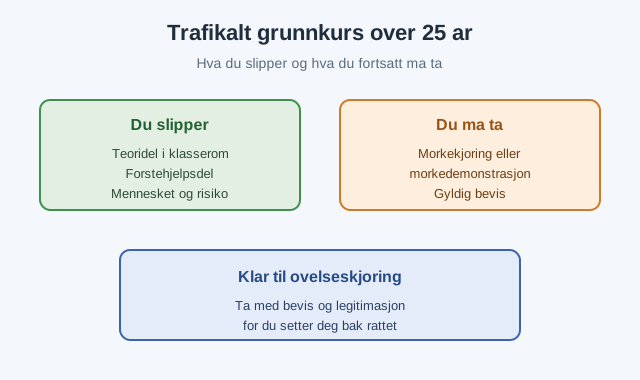
Table of contents
- The main exemption rule
- What you still have to take
- What you are exempt from
- Night driving or night demonstration
- How to get started with practice driving
The main exemption rule
The traffic basic course is normally mandatory for everyone who wants to get a driving licence in a light class, and it is the requirement you must meet before you can start practice driving. The course includes, among other things, traffic training, first aid and a section on the human being in traffic.
Once you have turned 25, an important exemption applies: you do not have to take the entire ordinary traffic basic course. The reasoning is that adults often have more traffic experience as passengers, pedestrians and cyclists, and that the theoretical part is therefore not considered equally necessary. You still have to deal with the rules on driving in the dark. If you want to read more about the content of the full course, you will find a thorough walkthrough in the article on the traffic basic course and a detailed overview in the article on step 1 and the traffic basic course .
What you still have to take
Even though you skip a lot, the exemption is not a release from everything. The practical part you must complete is tied to driving in the dark. The table below shows the main difference between being under and over 25:
| Course part | Under 25 | Over 25 |
|---|---|---|
| Theory part (traffic, first aid, the human being) | Mandatory | Normally falls away |
| Night driving / night demonstration | Mandatory | Must be completed |
| Proof of completed course | Required | Required |
In practice this means that the essential part you have to complete as an adult is night driving. You also need valid documentation in place before you start practice driving.
What you are exempt from
For those over 25, the following parts normally fall away:
- The theoretical traffic training in the classroom
- The mandatory first-aid part linked to the course
- The topic of the human being and risk in traffic as a classroom part
Even though you are formally exempt from these parts, that does not mean the knowledge is unnecessary. Topics such as risk and attention are a central part of the theory test itself. It pays off to understand how fatigue and microsleep affect your driving, and how medicines can impair driving ability . This is knowledge you need anyway to pass.
Night driving or night demonstration
The part most relevant for adults is driving in the dark. During the bright part of the year, this is often carried out as a demonstration instead of actual driving in the dark, simply because it does not get dark enough. The purpose is the same: to understand how vision, light and distance judgement change when it is dark.
You learn, among other things, about the use of low and high beam, how to spot vulnerable road users, and how the dark affects your speed. You will find a complete walkthrough in the article on night driving . The dark is closely connected to other risk topics, such as vision in traffic .
How to get started with practice driving
Even with the exemption, you must have your documentation in order before you sit behind the wheel to practise. You must bring valid proof that the requirements are met, together with identification. You can read more about this in the article on practice driving and about which proof of practice driving you should bring.
Once the practical side is in place, most of it comes down to practising enough – both behind the wheel and on the theory. If you are going to use a driving school, it is wise to read about how to choose the right driving school . If you are wondering about the price, the article on the traffic basic course and price gives an overview.
When it comes to theory, the best preparation is to practise on realistic questions. Take a free theory test and practise regularly in the Eteo app, so you are well prepared for the theory test and the practical exam.
Next step
Continue with free car questions
Go straight from the article to free car questions and check what actually sticks before you keep reading more theory.
Try for free