Step 1 – what the traffic basic course covers, hour by hour
A walkthrough of the topics and hours in step 1 and the traffic basic course.
The traffic basic course (trafikalt grunnkurs) is the very first step toward a class B driving licence, and it makes up the main part of step 1 in the four-step training model. The course is mandatory and lets you start practice driving from the age of 16. Here you get an introduction to what it means to be a road user, which rules apply, and how people function behind the wheel. This article walks through the content hour by hour, so you know exactly what to expect.
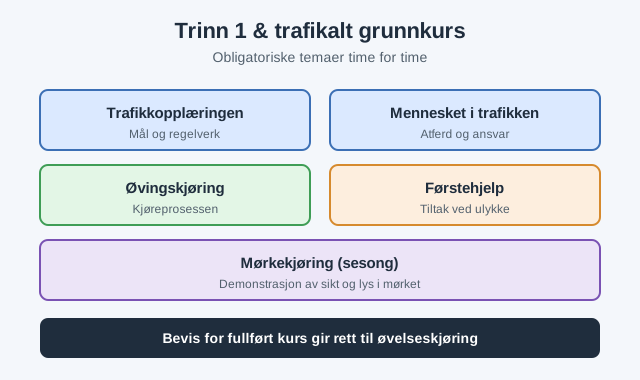
Table of contents
- What step 1 is and why it is mandatory
- The hours in the traffic basic course
- First aid and night driving
- What you take away from the course
What step 1 is and why it is mandatory
Class B training is divided into four steps. Step 1 is about understanding traffic and building basic attitudes, and it consists mainly of the mandatory traffic basic course. The goal is for you to understand what it takes to become a safe driver before you even sit in the driver’s seat.
The course is required by law for everyone taking a driving licence for the first time. Without a completed traffic basic course you may neither begin practice driving nor take your practical test. The certificate of completion therefore acts as a key to the rest of your training. If you are over 25 years old, you can skip the theoretical parts of the course, but you must still complete the first aid and night driving sessions.
An important point is that the traffic basic course has a period of validity. The certificate is normally valid for several years, but if you wait too long to finish your licence you may have to retake parts of it. It therefore pays to plan your training as a continuous process.
The hours in the traffic basic course
The traffic basic course is built up from several mandatory topics, each with a fixed minimum time. The driving school may use more time, but never less. The overview below shows the usual blocks:
| Topic | Content | Approximate scope |
|---|---|---|
| The driver training system | Goals, rules and the road ahead | 1 hour |
| People in traffic | Behaviour, interaction and responsibility | several hours |
| Practice driving and the driving process | How learning and driving connect | several hours |
| Duties in a traffic accident | What the law requires after a crash | part of first aid |
| First aid | Practical and theoretical first aid | own block |
| Action at an accident scene | Securing and alerting at a scene | own block |
| Night driving | Demonstration in the dark | own block (seasonal) |
The theoretical topics deal with how traffic is an interplay between people, and how much attitudes, attention and risk matter. This lays the foundation for what you later learn about attitudes and driving style and understanding risk in traffic.
First aid and night driving
Two of the blocks stand out because they are practical and are often run together:
- First aid: You learn how to act at an accident scene, how to secure the area, alert the emergency services and give life-saving first aid. Much of this is expanded later in the topics on securing the accident scene and CPR and the recovery position .
- Night driving: A mandatory demonstration that shows how visibility, light and distance judgement change in the dark. This block is seasonal and usually has to be taken during the winter half of the year. Read more in the article on night driving .
These parts give you a realistic understanding that traffic is not only about rules, but also about your senses, reaction time and the ability to handle the unexpected.
What you take away from the course
When you have completed the entire traffic basic course, you receive a certificate that gives you the right to start practice driving. You can then drive privately with a supervisor, or continue your training at a driving school through the next steps, including step 3 with assessment and maintenance and step 4 with the on-road safety course.
It is also wise to think about your choice of driving school early. A good school follows you through all four steps, and our guide to choosing a driving school helps you compare. If you want to dig deeper into the course itself, you will find more in the detailed article on the traffic basic course .
Alongside your training it is smart to start on the theory. You can practise completely free with a free theory test and use the Eteo app to train regularly, so you are well prepared for the theory test when the time comes.
Next step
Continue with free car questions
Go straight from the article to free car questions and check what actually sticks before you keep reading more theory.
Try for free