Parallel parking step by step – reference points that work
Step-by-step parallel parking with reference points that work every time.
Parallel parking means parking alongside the kerb in a gap between two cars. It is the manoeuvre many people dread the most, both in everyday driving and on the practical test. The secret is not luck, but fixed reference points: when you turn the wheel at the same points every time, the car ends up in the right place with a consistent result. This guide gives you a method that works in most spaces.
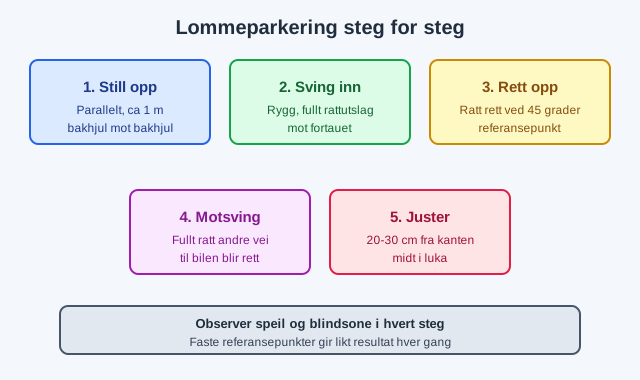
Table of contents
- How big a gap you need
- The steps with reference points
- How to use the mirrors
- Common mistakes and what the examiner looks for
- Practice before test day
How big a gap you need
You do not need a huge gap, but you must be able to tell the difference between a gap that works and one that is too tight. The rule of thumb is that the opening should be around 1.3–1.5 times the length of your car.
| Car size | Recommended gap | Tight but possible |
|---|---|---|
| Small car (3.8–4.0 m) | 5.5 m | 4.8 m |
| Mid-size (4.3–4.6 m) | 6.2 m | 5.4 m |
| Large SUV (4.7–4.9 m) | 6.8 m | 6.0 m |
When practising, pick a roomy gap. Once the technique sticks, you can gradually try tighter spaces.
The steps with reference points
Follow the five steps in the same order every time. The reference points below are a starting point – adjust them slightly to suit your car.
- Line up parallel. Drive past the car you will park behind and pull up parallel to it with about 1 metre of side clearance. Stop when your rear wheel is level with the rear wheel of the other car.
- Turn in. Check mirrors and blind spot, signal towards the kerb, and reverse slowly while turning full lock towards the kerb.
- Straighten the wheel. When the car sits at roughly a 45-degree angle to the kerb, straighten the wheel. A good reference point is when the other car’s left tail light appears in the middle of your window.
- Counter-steer. As your rear wheel nears the kerb, turn full lock the other way and reverse gently until the car is straight.
- Adjust. Straighten the wheels and roll forward or back until you sit in the middle of the gap, with 20–30 cm to the kerb.
You are allowed to adjust in several stages. You will find more on control and observation in the guide to reversing and parking .
How to use the mirrors
The mirrors are your main source of information throughout the manoeuvre. Set them correctly before you start.
- Right side mirror: watch the kerb and how close your rear wheel is to it.
- Left side mirror: keep an eye on traffic approaching from behind.
- Turn your head: look out the rear window before the first steering input, not just in the mirrors.
Some drivers tilt the right side mirror slightly down to see the kerb better. If the car has a camera, it can help, but it does not replace the mirrors – see reversing camera and parking sensors .
Common mistakes and what the examiner looks for
| Mistake | Consequence | Fix |
|---|---|---|
| Steering too early | The car ends up angled into the road | Wait until rear wheels are level |
| Counter-steering too late | The car hits the kerb | Follow the reference point in step 3 |
| Little mirror use | The examiner misses observation | Check mirrors and blind spot at every step |
| Forgetting to straighten the wheels | Hard to pull out afterwards | Reset the wheel in the last metre |
| Rushing and driving fast | Inconsistent result | Drive slowly, take the time you need |
On the practical test, the examiner assesses both the result and how you observe. Correct signalling towards the kerb, steady speed and safe adaptation to other road users all count. You should be well in place within a reasonable time; if the car still sits crooked, it is better to correct it than to leave it. Remember the securing routine afterwards too: handbrake, gear in reverse or P, and lights off. On a slope, turn the wheels towards the kerb when facing downhill.
Practice before test day
Practise systematically so the reference points become automatic.
- First practise with cones or markers without other cars.
- Ask someone to set out test cars so you practise between two objects.
- Practise on a quiet road where you avoid stress from traffic.
- Say out loud what you are doing so you remember the order.
If you want to expand your repertoire with angle parking and tight spaces, see parking for advanced drivers and reversing into a bay and angle parking . Many parking mistakes are linked to stress – read about stress and time pressure .
Once the theory sticks, it is smart to test yourself. Take a free theory test and practise regularly in the Eteo app, so you are confident and ready for the theory test.
Next step
Continue with free car questions
Go straight from the article to free car questions and check what actually sticks before you keep reading more theory.
Try for free