Reversing into a parking bay and angle parking
Technique for reversing into a bay and angle parking safely.
Reversing into a parking bay is one of the most useful skills you learn while training for class B. When you reverse in and drive straight out again, you get far better visibility of crossing pedestrians and cars than if you reverse out into the road afterwards. This article shows you the reference points, the right mirror use and how to handle both perpendicular bays and angle parking.
Contents
- Why reverse in rather than drive in
- Step by step: reversing into a perpendicular bay
- Reference points and mirror use
- Angle parking: reversing in at an angle
- Common mistakes and tips
Why reverse in rather than drive in
The main argument is visibility. When the car is parked nose-out, you can see the whole situation as you leave, and you drive forward – something most people handle better than reversing. If you instead reverse out of a bay, you have poor visibility of cyclists, children and cars approaching from the side.
| Situation | Reversing in | Driving in (reversing out later) |
|---|---|---|
| Visibility when leaving | Good, facing forward | Poor, reversing blind |
| Control during manoeuvre | Needs practice going in | Easy in, hard out |
| Time on a busy lot | Calm exit | Risk when backing out |
| Recommendation | Preferred | Avoid where it is tight |
Many car parks and workplaces recommend reversing in for exactly this reason. A reversing camera can help, but you still have to use your mirrors and your eyes – read more about reversing cameras and parking sensors .
Step by step: reversing into a perpendicular bay
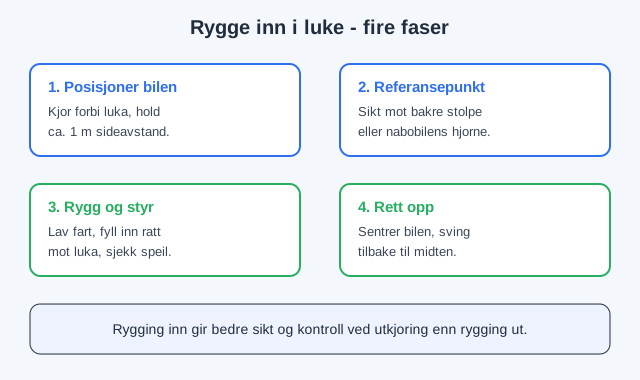
- Position the car. Drive slowly past the empty bay and keep about one metre of side clearance from the row of cars.
- Stop when your rear wheel is level with the back edge of the bay. Now you have enough length to swing in.
- Choose a reference point. Aim for the rear post or the corner of the car on the far side of the bay.
- Reverse slowly and feed in steering towards the side the bay is on. Low speed gives you time to correct.
- Watch both mirrors and over your shoulder. Use the mirrors actively, the same way as in pocket parking step by step .
- Straighten the wheel once the car is parallel with the markings, and reverse in to the correct depth.
A good principle is to do everything at low speed: the slower you roll, the more time you have to read the situation. This is the core of good reversing and parking .
Reference points and mirror use
Reference points are fixed points you see from the driver’s seat and use to know where the car is. When you reverse in:
- The side mirrors show the distance to the markings and neighbouring cars – tilt them down slightly to see the rear wheel.
- The interior mirror and a glance over your shoulder cover the area directly behind.
- When the line between the bays hits a specific point in the side mirror, you know you are turning correctly.
Practise on the same spot several times so the reference points settle in. For the more advanced technique, see parking for the advanced and read about safe following distance and the three-second rule .
Angle parking: reversing in at an angle
With angle parking the bays sit at an angle, often 45 or 60 degrees, making the entry shorter. Reversing in at an angle is easier than a perpendicular bay because you need less steering lock:
- Drive past the bay in the same direction the angle “points”.
- Stop a little past it, turn in and reverse along the angle.
- Follow the markings in the side mirror and straighten up when the car sits in the middle of the bay.
Be aware that many angle-parking areas are one-way. You then have to approach from the correct side. Also remember the rules for where you are allowed to stop – see the difference between no stopping and no parking and what a parking zone sign means.
Common mistakes and tips
- Too much speed. Steering and eyes can’t keep up – roll slowly.
- Forgetting to check for pedestrians. When you reverse you must give way; be especially alert when exiting across a pavement .
- Starting the turn too early and clipping the neighbouring car – wait until the rear wheel passes the back edge.
- Trusting the camera blindly. Use it as an aid, not a replacement for mirrors and a shoulder check.
Want to test how well you know the rules around parking and manoeuvring? Take a free theory test and keep practising in the Eteo app until you are ready for the theory exam.
Next step
Continue with free car questions
Go straight from the article to free car questions and check what actually sticks before you keep reading more theory.
Try for free