Edge line and centre line – what does the road marking mean?
What edge lines and centre lines mean and how they guide your position.
The edge line and the centre line are two of the most important markings on the road, and together they control where you place the car. The edge line marks where the carriageway ends, while the centre line separates the two directions of traffic. Once you understand the meaning of these white lines, you drive more safely and correctly – and you answer road-marking questions correctly on the class B theory test.
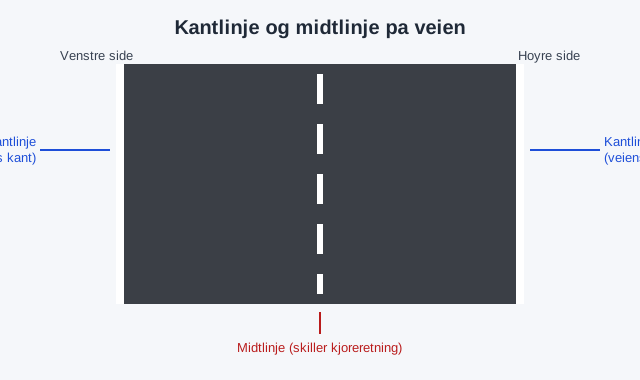
Table of contents
- What is the edge line?
- What is the centre line?
- Broken or solid
- Correct position between the lines
- Common misunderstandings
What is the edge line?
The edge line is the white line that marks the outer edge of the road – the boundary between the carriageway and the shoulder. It helps you keep the car in the right place, especially in the dark, in rain and in poor visibility, because it gives a clear reference point far ahead.
The edge line is normally solid, but it can be broken where there are exits, bus bays or other places where traffic is meant to cross it. The area outside the edge line, the shoulder, is not part of the ordinary carriageway and must not be used for normal driving or overtaking.
- The edge line shows where the carriageway ends.
- It is an important reference for rural driving and in poor visibility.
- Keep the car inside the edge line, but do not push right up against it.
For more on how the road is built up, see the parts of the road and the full overview of road markings .
What is the centre line?
The centre line runs down the middle of the road and separates traffic moving in opposite directions. On an ordinary two-lane road you have one lane on each side of the centre line. You must keep to the right-hand side of the centre line in your direction of travel.
The centre line is usually a broken line. When the line is broken, you may cross it to overtake or to turn – as long as it is safe and legal. Where the centre line changes to a solid line (a barrier line) or a combined line, stricter rules apply. You will find the details in the article on barrier line and warning line .
| Line | Position | Function | Form |
|---|---|---|---|
| Edge line | Outer edge of the road | Marks where the carriageway ends | Usually solid, broken at exits |
| Centre line | Middle of the road | Separates opposite directions | Usually broken, solid as a barrier line |
Broken or solid
The difference between a broken and a solid line decides what you are allowed to do:
- Broken line – you may cross it when it is safe, for example to overtake or turn.
- Solid line – as a rule you must not cross it; it is used where crossing is dangerous or forbidden.
- Combined lines – a solid and a broken line side by side. The nearest line on your side decides what you may do.
A solid centre line is typically used on blind bends and crests, or ahead of dangerous bends with poor visibility . Always keep a good safety distance so you have time to read the lines and the traffic ahead.
Correct position between the lines
Good lane positioning is about staying midway between the edge line and the centre line, so you keep an even clearance to both sides. That reduces the risk of ending up on the shoulder or drifting into the oncoming lane.
- Look far ahead and use the edge line as a reference.
- Keep an even distance to the centre line without pushing against it.
- In bends, adjust your position for the best possible visibility and safety.
- Slow down if the lines are unclear because of snow, slush or worn marking.
You can read more in the article on lane positioning and on rural driving .
Common misunderstandings
Many people think all road markings mean the same thing, but it is precisely the form and the position that give the meaning. A common mistake is to use the shoulder outside the edge line for driving or overtaking – you must not do that. Another is to cross a solid centre line because you only went over it “slightly”; that is wrong too.
Remember that the marking can be hard to see in winter conditions. Then you must adjust your speed and use the edge line actively where it is visible. When you practise for the theory test, it pays to read the lines together with signs and speed, not in isolation.
Want to test how well you know road markings? Take a free theory test and keep practising in the Eteo app, so you are well prepared for the class B theory test.
Related articles
Next step
Continue with free car questions
Go straight from the article to free car questions and check what actually sticks before you keep reading more theory.
Try for free