Solid line and warning line – when can you cross?
The difference between a solid line and a warning line, and when you may legally cross them.
The white or yellow stripe in the middle of the road tells you when it is safe and legal to pass. A solid line (sperrelinje) is a continuous line you generally must not cross, while a warning line (varsellinje) is dashed and warns that visibility will soon get worse. Understand the difference between the two and you avoid both dangerous situations and demerit points on a fresh licence. Here we go through what the lines mean and when you may actually cross them.
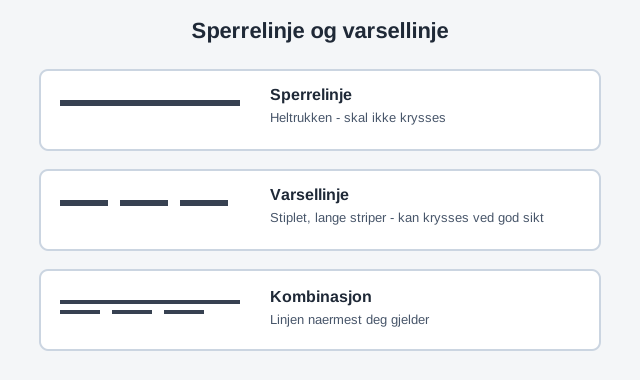
Table of contents
- What is a solid line?
- What is a warning line?
- The combination of warning line and solid line
- When can you cross the lines?
- Common misunderstandings
What is a solid line?
A solid line is a continuous centre line. It splits the carriageway in two and is used where overtaking is prohibited or where it is otherwise dangerous to move into the oncoming lane. Typical locations are before blind crests, ahead of bends with poor visibility and approaching junctions.
The main rule is simple: you must not cross or drive on a solid line. You should not even run your wheels along the top of it. Break this and you risk a fine and demerit points, and during the probationary period every point counts double. The solid line is closely tied to the rules for overtaking, so you should know them well before attempting to pass a vehicle. Read more about how edge lines and centre lines divide the road, so you recognise the different stripes.
What is a warning line?
A warning line is a dashed line where the stripes are longer than the gaps. It is precisely this ratio of stripe to gap that distinguishes it from an ordinary centre line. The ordinary, short-striped centre line only separates the directions of travel, while the warning line says something more: it warns that a solid line is coming up because visibility is getting worse.
You may cross a warning line when you have enough visibility and it is otherwise safe and legal, for example when overtaking or turning left. But the name is a call for caution: a warning line often means you are approaching a place where overtaking is prohibited, and that you should complete or abandon the manoeuvre while you still have a clear view. The difference between the white lines is described in more detail in the article on road markings .
The combination of warning line and solid line
You often see the two lines side by side: a continuous solid line and a dashed warning line next to each other. In that case the line that applies is the one closest to you in your direction of travel.
| Line on your side | Type | May you cross? |
|---|---|---|
| Dashed (long stripes) | Warning line | Yes, when it is safe and legal |
| Continuous | Solid line | No, as a main rule |
This means two cars meeting on the same stretch can have completely different rules: one has a warning line on its side and may pass, while the oncoming car has a solid line and must wait. The logic is that the driver with the best visibility is allowed to complete the overtaking first.
When can you cross the lines?
The rules can be summed up like this:
- Warning line: may be crossed when overtaking, turning left or making another necessary manoeuvre when visibility is good.
- Solid line: must not be crossed in order to overtake.
- Driveways and property: you are allowed to cross a solid line to enter or leave a property or driveway when it is safe, because you have no alternative.
- Obstacles: if there is an obstruction in the road, you may carefully pass over the line if it is necessary and you have a full view of oncoming traffic.
Always think safety before law. Even where crossing is allowed, you must keep a sufficient safety distance and a clear view. A good starting point for distance is the three-second rule . If you are actually going to overtake, you should revise the procedure for overtaking and lane changes .
In winter the lines may be covered by snow and salt. Then signs and general rules apply, and you must drive according to conditions. Remember that the speed limit and visibility matter more than a stripe you cannot see.
Common misunderstandings
- “A yellow line is stricter than a white one.” The colour says nothing about how strict the prohibition is. Yellow is used to separate directions of travel, but a dashed yellow line can also be crossed. A solid yellow line works the same way as a white solid line.
- “I can cross the solid line if I am quick.” No. Speed does not make overtaking across a solid line legal.
- “A solid line only concerns overtaking.” It prevents all crossing of the line into the oncoming lane, not just overtaking.
For a more thorough review of the exceptions, see the article on when you can cross a solid line . Overtaking is also linked to speed limits and priority rules; it can be useful to revise where a priority road starts and ends .
Want to test whether you have the lines under control before the theory test? Take a free theory test and keep practising in the Eteo app, so you are well prepared for the class B theory test.
Next step
Continue with free car questions
Go straight from the article to free car questions and check what actually sticks before you keep reading more theory.
Try for free