Aggressive driving and road rage
What triggers road rage, and how do you handle aggressive drivers safely?
Road rage and aggressive driving are among the most dangerous states a driver can be in. When anger takes over, attention narrows, the sense of speed disappears and the ability to judge risk weakens. The result is closer following, higher speed and poorer decisions – exactly when the margins are smallest. Understanding what triggers anger in traffic, and practising how to calm down, is an important part of the attitude work you meet both in your training and on the theory test.
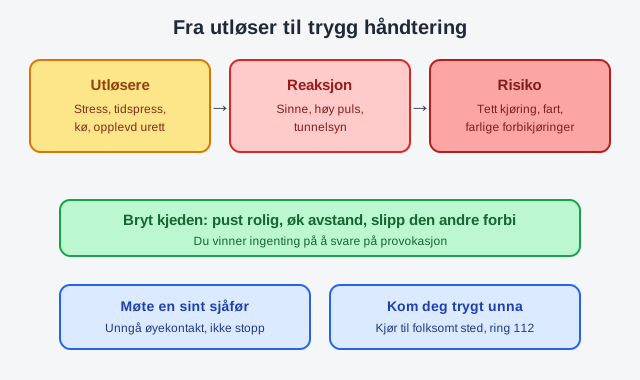
Table of contents
- What road rage and aggressive driving are
- Why we get angry in traffic
- How to calm yourself down
- How to deal with an aggressive driver
- Attitudes that prevent it
What road rage and aggressive driving are
Aggressive driving means using the car to push, punish or assert yourself against other road users. Road rage is the emotional state behind it: a mix of frustration, anger and perceived unfairness aimed at a specific fellow driver. The typical expressions are easy to recognise:
- Following the car ahead far too closely (tailgating)
- Frequent, unnecessary lane changes and dangerous overtaking
- Using the horn, lights and gestures to provoke
- Blocking someone or “teaching another driver a lesson”
What they all have in common is that the action is no longer governed by the traffic situation, but by emotion. At that point you are already heading into the dangerous zone shown in the diagram above.
Why we get angry in traffic
Anger in traffic rarely comes out of nowhere. It often builds up beforehand and is set off by a specific event. Inside the car we also feel anonymous and protected, so the threshold for reacting strongly drops below what it would be face to face.
| Trigger | What happens | Safe counterweight |
|---|---|---|
| Time pressure and stress | Every delay feels like a threat | Build in a good margin, accept arriving a little late |
| Perceived unfairness | “He cut into the queue” feels personal | Interpret charitably – mistakes are usually accidents |
| Tiredness and hunger | Lower tolerance for irritation | Break, food and rest before driving |
| Anonymity | You say things you never would otherwise | Remind yourself you are facing a person |
This is closely tied to the mental shortcuts we all use. Read more about psychological traps in traffic and about how the human in traffic easily lets stress and time pressure weaken judgement behind the wheel.
How to calm yourself down
The most important principle is to break the chain before anger controls your driving. Once you feel your pulse rise and your shoulders tense up, you have already lost some of your overview. The key is to act deliberately:
- Breathe calmly and ease off the throttle – nothing is as urgent as it feels.
- Increase the distance to the car ahead. More distance gives more time and lowers tension.
- Let the other driver pass. You gain nothing by answering a provocation.
- Remind yourself of the goal: arriving safely, not being “right”.
- Take a short break if you notice the irritation will not settle.
These steps go hand in hand with defensive driving and good cooperation in traffic , where the aim is always to reduce conflict rather than create it.
How to deal with an aggressive driver
You cannot control how others drive, only how you react yourself. If you meet a clearly angry driver, the rule is simple: do not feed the conflict.
- Avoid eye contact and do not respond to gestures or the horn.
- Do not brake suddenly to “punish” a tailgater – it increases the risk of being rear-ended.
- Let them pass as soon as it is safe, ideally by moving further to the right.
- Never stop to confront someone by the roadside.
- If you feel threatened, drive to a busy place such as a petrol station, and call 112 if there is danger.
A driver in a state of road rage has worse risk assessment than usual. Practising calm risk assessment in practice makes it easier to spot the danger early and stay clear of it.
Attitudes that prevent it
Aggressive driving is ultimately about attitudes. A driver who sees traffic as a collaboration is rarely governed by anger. One who sees it as a competition often is. This is at the heart of how the human in traffic affects safety, and attitudes are exactly what the examiner assesses throughout your training.
Good habits you can practise on every trip:
- Give yourself plenty of time, so small delays do not feel like attacks.
- Interpret others’ mistakes charitably – most are accidents, not malice.
- Forgive quickly and let go of irritation, so it does not build up.
Want to test how well you know the material on the human and risk? Take a free theory test and keep practising in the Eteo app, so you are safely prepared for the theory test.
Next step
Continue with free car questions
Go straight from the article to free car questions and check what actually sticks before you keep reading more theory.
Try for free