Expectation and misinterpretation in traffic
Why do we see what we expect – and how do you avoid dangerous misinterpretations?
Expectation is one of the most powerful forces in your brain when you drive. The brain is not a passive camera that records everything that is actually out there. It constantly builds models of what is likely to happen, and fills in details it does not have time to see. Most of the time this is useful and efficient. But sometimes you see what you expect to see, not what is actually there – and that is when misinterpretation arises, which can become dangerous in traffic.
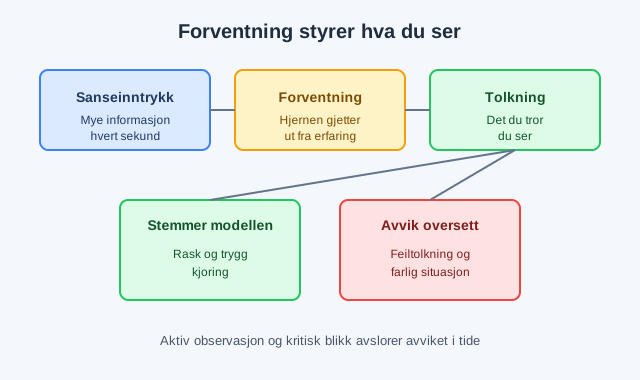
Table of contents
- Why the brain takes shortcuts
- When expectation becomes a trap
- Typical misinterpretations on the road
- How to counter expectation errors
- Practice gives a safer gaze
Why the brain takes shortcuts
Your senses take in an enormous amount of information every second, but consciousness can only process a small part of it. To save capacity, the brain uses patterns and experience to guess the rest. When you approach a junction you have driven through a hundred times, the brain assumes it will look and behave the way it did last time. This is often called bias or expectation-driven perception.
The shortcuts are not a flaw – they are a precondition for you being able to drive at all. The problem arises when reality differs from the model, and you fail to notice the deviation because you have already “decided” what you see. You can read more about how perception can fail in the article on the sense of sight in traffic .
When expectation becomes a trap
Expectation becomes dangerous in situations that resemble the usual, but contain one unexpected element. An example is the pedestrian crossing the road somewhere you did not anticipate, or the motorcyclist who is there – but whom you do not “see” because you are looking for cars. This is closely connected to other psychological traps in traffic .
Expectation errors particularly affect:
- Experienced drivers on familiar routes, where routine overrides active observation.
- Tired or stressed drivers, who have less capacity to detect deviations.
- Drivers under time pressure, who unconsciously “see” what they hope for, such as a green light.
When driving becomes fully automatic, or when you are tired and under time pressure, you stop looking actively. You can read more about this in the article on stress and time pressure .
Typical misinterpretations on the road
The table below shows common situations where expectation creates misinterpretation, and what actually happens.
| What you expect | What actually happens | Possible consequence |
|---|---|---|
| The car ahead drives on at green | The car stays still, driver is on the phone | Rear-end collision |
| The junction is empty as usual | A cyclist comes from the right | Collision in junction |
| The other driver has seen you | The driver does not see you | Right-of-way conflict |
| The road continues straight ahead | A sharp bend hidden behind a crest | Run-off-road crash |
A classic example is “looked but failed to see”: a driver can look straight at a motorcyclist and still pull out in front of them, because the brain was set to look for cars. That is why active, systematic observation is so important. Read how to build good scanning routines in the five seeing rules .
How to counter expectation errors
You cannot switch off expectation, but you can train yourself to be critical of it. The goal is to make observation active instead of passive.
- Ask yourself “what if?” – what if the car does not brake, what if someone comes from the side.
- Actively search for the unexpected, not just the usual – let your gaze wander instead of locking in place.
- Be extra alert on familiar routes, where routine is strongest.
- Do not assume others have seen you – make eye contact or keep distance.
- Slow down in unclear situations, so you have time to correct a misinterpretation.
Good interaction with other road users also reduces the risk of misunderstandings. More on this in the article on attention and interaction . Understanding how humans function behind the wheel is a central part of the human in traffic , and forms part of a holistic risk assessment in practice .
Practice gives a safer gaze
Expectation and misinterpretation are an important topic on the class B theory test, because they concern the core of safe traffic behaviour: detecting dangers in time. The more you practise recognising these mechanisms, the better prepared you are both for the test and for real driving.
Test yourself with a free theory test and keep practising in the Eteo app, so you are confident and well prepared for the theory test.
Next step
Continue with free car questions
Go straight from the article to free car questions and check what actually sticks before you keep reading more theory.
Try for free