Peer pressure and passengers – risk for young drivers
Why does risk rise with friends in the car, and how do you set boundaries?
Peer pressure is one of the most underestimated risk factors for young drivers. When you have just passed your test and drive with same-age passengers in the car, both your attention and your driving style change – often without you noticing. Research from several countries shows the same pattern: young drivers have a clearly higher crash risk with friends in the car than when they drive alone or with an adult. This article explains why it happens, and how to set boundaries that make the trip safer.
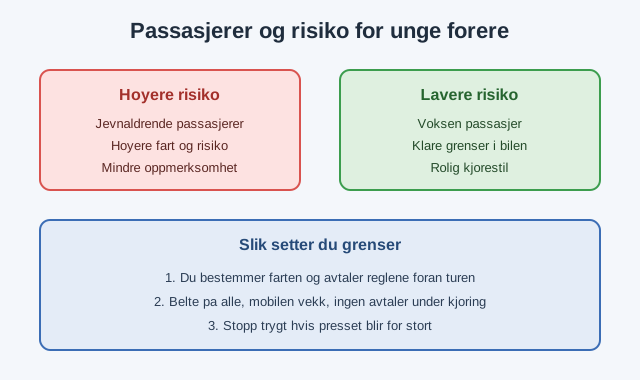
Table of contents
- Why does risk rise with friends in the car?
- What does peer pressure do to your brain?
- Risk by passenger type
- How to set boundaries
- What does the theory test say?
Why does risk rise with friends in the car?
As a new driver you still spend a lot of attention on the driving itself: gears, speed, distance and what is happening around you. When the car fills up with friends, your brain has to split its attention between driving and the social interaction. Conversation, music, laughter and comments from the back seat take attention away from the traffic picture at exactly the moments you need it most.
In addition, many young drivers change their driving style when they have an audience. The urge to impress or appear confident can lead to higher speed, shorter following distance and riskier overtaking. This is closely linked to attitudes and driving style and to the psychological mechanisms we describe in psychological traps in traffic .
What does peer pressure do to your brain?
Peer pressure is rarely direct. Few friends say “drive faster.” The pressure more often lies in expectations, glances and atmosphere. You interpret what the others want and adjust to fit in. The brain of young adults is still developing in the parts that control impulse control and thinking about consequences, while the reward of social acceptance feels strong. The combination makes it easier to make bad choices you otherwise would not have made.
Common forms of peer pressure behind the wheel:
- Speed pressure – someone thinks it is “boringly slow,” and you speed up so as not to seem timid.
- Distraction pressure – you get pulled into an intense conversation or asked to find a song.
- Time pressure – “we will make it if you just drive a bit faster,” which is tied to stress and time pressure .
- Risk pressure – being urged to run an amber light, overtake or take a shortcut you are unsure about.
Risk by passenger type
Who is sitting in the car matters a great deal for how high the risk is. The table below sums up the general pattern for young, new drivers:
| Situation | Typical effect on risk | Why |
|---|---|---|
| Driving alone | Low to moderate | Full attention on driving |
| One adult passenger | Lower | An adult has a calming effect |
| One same-age passenger | Higher | Social focus and pressure rise |
| Several same-age friends | Clearly higher | Strong group dynamics and distraction |
The pattern is clear: the more same-age friends, the more attention and driving style pull in the wrong direction. An adult passenger has the opposite, often calming, effect. This is part of what we describe in risk factors for young people in traffic and in the overview of statistics and accidents .
How to set boundaries
You are the driver, and responsibility for the car is yours alone. Speaking up does not have to ruin the mood – it is about agreeing on the rules before you drive:
- Agree the rules in advance. Calmly say that you decide the speed and that seat belts are mandatory for everyone.
- Make the car a distraction-free zone. Ask one passenger to handle music and navigation so you do not have to use your phone.
- Do not negotiate while driving. If something needs sorting out, do it before you set off or when the car is stationary.
- Stop safely if the pressure gets too much. It is always allowed to pull over and take a break.
- Stick to your own limits. If you are unsure, drive calmly – it is your judgement that counts, not the back seat’s.
You build these habits during your first years as a driver. You will find more concrete advice in safety tips for new drivers in the first years and in how to do risk assessment in practice .
What does the theory test say?
Topics such as peer pressure, passengers and young driver risk are a fixed part of the syllabus on the human in traffic. On the class B theory test you may meet questions about how passengers affect attention and driving behaviour, and about how you as a driver take responsibility. The understanding ties in with the basic view of the human in traffic .
Want to test how well you know the material? Take a free theory test and practise regularly in the Eteo app, so you are well prepared for the theory test – both for questions on risk and the rest of the syllabus.
Next step
Continue with free car questions
Go straight from the article to free car questions and check what actually sticks before you keep reading more theory.
Try for free