Attitudes and driving style – your risk profile
How your attitudes shape your driving style and your risk in traffic.
Attitudes are the values and beliefs that steer the choices you make behind the wheel. Two drivers can have exactly the same technical skills, yet different attitudes produce very different risk. Your attitudes decide whether you keep to the speed limit when no one is watching, whether you yield without pushing, and whether you drive carefully on an evening when you are tired. On the class B theory test, the interplay between the human, attitude and risk is something you need to understand – not just memorise.
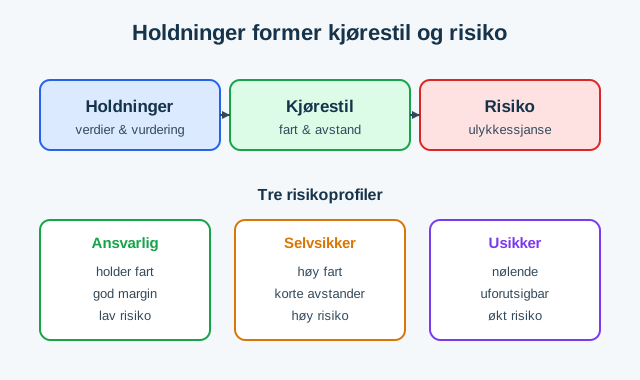
Table of contents
- What attitudes really are
- How attitudes shape your driving style
- Risk profiles: three typical driver types
- How to develop good attitudes
- Attitudes on the theory test
What attitudes really are
An attitude is a mindset you hold over time, and it shows most clearly when a situation becomes demanding. Many people think good drivers are simply skilled at handling the car, but research on road safety consistently shows that attitudes and judgement matter more for crash risk than pure driving technique. A driver with poor attitudes often compensates by taking bigger chances, because they overestimate their own ability.
Attitudes are about how you view yourself, other road users and the rules. Do you see the speed limit as something you can “really” stretch? Do you think others should watch out for you? Or do you take responsibility for making the road safer for everyone? This is closely tied to how the human functions in traffic and how we perceive and interpret situations.
How attitudes shape your driving style
Driving style is attitudes turned into action. As you approach a junction, a traffic light or a bend, your attitudes make the choice for you in half a second. Good attitudes produce a defensive driving style in which you plan ahead, keep a good distance and build in a margin for the unexpected. Poor attitudes produce an offensive style with high speed, short gaps and pressure on others.
The table shows how the same situation is handled differently depending on attitude:
| Situation | Good attitude | Poor attitude |
|---|---|---|
| The car ahead drives “too slowly” | Keeps distance, waits for a safe overtake | Tailgates, pushes and flashes |
| Amber light at a junction | Brakes when it is safe | Accelerates to “make it” |
| Slippery winter road | Slows down, increases distance | Drives as usual and trusts the tyres |
| Tired after a long day | Takes a break or postpones the drive | Drives on to save time |
A safe driving style builds on the principles in defensive driving , where the goal is to avoid dangerous situations before they arise, not to escape them at the last second.
Risk profiles: three typical driver types
Attitudes often cluster into recognisable patterns, or risk profiles. Most of us are a mix, but it helps to recognise the extremes:
- The responsible driver sees driving as cooperation. They keep to the speed limit, yield without pushing, and adjust to the conditions. This profile has the lowest risk.
- The overconfident driver overestimates their skills and underestimates the danger. Speed, short gaps and overtaking in doubtful places are typical. Risk rises because the margins disappear.
- The uncertain driver lacks confidence and can become hesitant, slow and unpredictable. This also creates risk, especially because other road users struggle to read what they intend to do.
Young and new drivers are over-represented in the crash statistics, partly because the combination of little experience and high risk-taking is especially dangerous. Read more about risk factors for young drivers and how aggressive driving and road rage connect to an offensive risk profile.
How to develop good attitudes
Attitudes are not innate, and they can be trained. The most important thing is honest self-awareness: are you willing to admit your own weaknesses? Here are concrete steps that move your risk profile in the right direction:
- Put safety before time. Accept that a few extra minutes is almost always better than pushing.
- Assess risk deliberately. Practise reading situations the way we describe in risk assessment in practice .
- Resist pressure. Do not let passengers or other drivers steer your driving. See how peer pressure and passengers influence your choices.
- Manage emotions. Stress, irritation and time pressure lower your judgement. Read about stress and time pressure and how to calm down before you drive.
- Learn from new experiences. The first years as a driver are critical, and good attitudes build on a shared goal of Vision Zero for road safety where no one should be killed or seriously injured.
In the end, good attitudes are about respect – for fellow road users, for the rules, and for the fact that one mistake can have serious consequences.
Attitudes on the theory test
On the class B theory test you will meet questions that test your understanding of attitudes, not just factual knowledge. You are often asked what the safest reaction is in a given situation, why young drivers have higher risk, and how speed, distance and attention connect. The answer is almost always the choice that gives the best margin and the lowest risk for everyone.
You can practise exactly this kind of question with a free theory test . Practise regularly in the Eteo app so that both the rules and the attitude questions are firmly in place before you sit the theory test.
Next step
Continue with free car questions
Go straight from the article to free car questions and check what actually sticks before you keep reading more theory.
Try for free