Vision Zero – Norway's Goal for Road Safety
What is Vision Zero, and how is responsibility for road safety shared?
Vision Zero (Norwegian: Nullvisjonen) is the guiding idea behind all road safety work in Norway: a vision that no one shall be killed or seriously injured in road traffic. The vision was adopted by the Norwegian Parliament in 1999 and underpins how roads are built, how vehicles are designed and how rules are enforced. If you are preparing for the class B theory test, Vision Zero is a topic you should both understand and be able to explain in your own words.
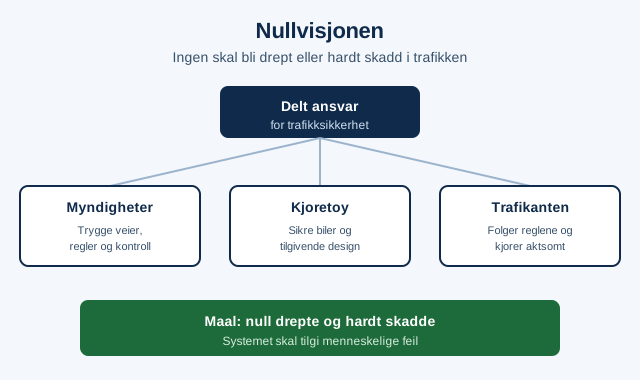
Table of contents
- What Vision Zero actually means
- The ethical and scientific basis
- The shared responsibility between society and driver
- What the vision means for you as a new driver
- Vision Zero on the theory test
What Vision Zero actually means
Vision Zero is not a concrete numerical target for a specific year, but a long-term direction for the work. The idea is at once simple and radical: we can accept that accidents happen, but we cannot accept that they lead to people being killed or permanently injured. The traffic system must therefore be designed so that a single human error does not have fatal consequences.
This means that every serious accident is seen as a signal that something in the system can be improved – the road, the vehicle, the rules or behaviour. In practice this has given Norway some of the world’s lowest figures for road deaths, even though the number of vehicles and kilometres driven has increased. You can read more about the trend in the article on traffic statistics and accidents in Norway .
The ethical and scientific basis
Vision Zero rests on three pillars that are useful to know:
- Ethics – People have the right to survive their own and others’ mistakes. No journey is so important that it justifies the loss of life.
- Science – Humans make mistakes, and the body can only tolerate limited forces. The system must be adapted to this knowledge, not the other way around.
- Shared responsibility – Those who design the traffic system and those who use it share responsibility for safety.
A key point is that people will make mistakes no matter how well trained they are. We get tired, distracted and misread situations. That is why the road system should be “forgiving”: central barriers, rumble strips, yielding lamp posts and lower speeds where people and cars meet. How we ourselves assess and handle hazards is described further in the article on risk assessment in practice .
The shared responsibility between society and driver
One of the most central points in Vision Zero is how responsibility is distributed. The diagram above shows this: the authorities, vehicle manufacturers and the road user each have their role, and none of them can reach the goal alone.
| Actor | Main responsibility | Examples of measures |
|---|---|---|
| Authorities | Safe infrastructure and clear rules | Central barriers, speed limits, checks |
| Vehicle manufacturers | Safe and forgiving vehicles | Airbags, ABS, automatic emergency braking |
| The road user | Follow the rules and drive carefully | Keep to the speed limit, use the seatbelt, be rested |
It is still important to understand that shared responsibility does not relieve you as a driver of your personal responsibility. Even the safest system assumes that you follow the basic rules. The very foundation of safe driving is described in the basic rule for all traffic , which requires you to be careful and cautious so that no danger or harm arises.
What the vision means for you as a new driver
As a new driver you are statistically more exposed to accidents than experienced drivers. Vision Zero is therefore not just about roads and cars, but very much about how you behave behind the wheel. Concretely, this means you should:
- Adapt your speed to conditions, visibility and your own experience
- Keep a good distance and clear margins
- Never drive impaired, tired or stressed
- Use the seatbelt on every single trip, even on short stretches
- Be extra attentive to vulnerable road users
The human factor is the one that most often fails in accidents, and this is exactly where you have the most to gain. You can read more about this in the article on the human in traffic . The first years after getting your licence are especially vulnerable, and good habits are formed early – see our safety tips for new drivers. It is also worth knowing the typical risk factors for young people in traffic .
Vision Zero on the theory test
Vision Zero often appears on the theory test, usually in the form of questions about what the vision means, who is responsible, and why the system should “forgive” human errors. A good answer shows that you understand that zero killed and seriously injured is the goal, and that responsibility is shared between society and the driver.
The easiest way to feel confident with such topics is to practise multiple-choice questions until you recognise the patterns. Try a free theory test and keep practising in the Eteo app until you are ready for the theory test itself. The attitudes you build now are a direct part of Vision Zero in practice.
Next step
Continue with free car questions
Go straight from the article to free car questions and check what actually sticks before you keep reading more theory.
Try for free