Why young people are overrepresented in accidents
Why are the first years behind the wheel the most dangerous for young drivers?
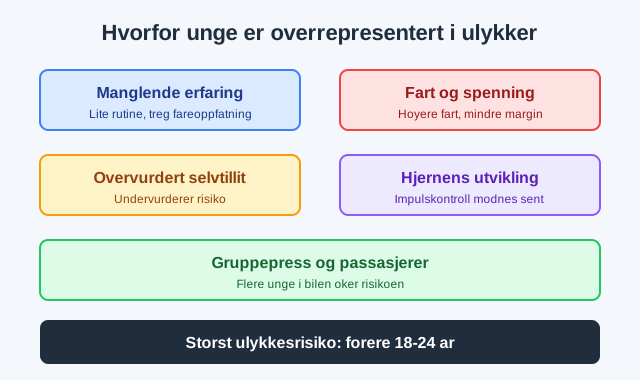
The statistics are clear: young drivers are heavily overrepresented in road accidents. Drivers between 18 and 24 have a markedly higher accident risk per kilometre driven than more experienced motorists, and the first months after getting the licence are the most dangerous of all. The causes are a complex mix of inexperience, high speed, overconfidence and a brain that is still developing. Understanding these risk factors is a central part of the syllabus for the class B theory test.
What the numbers say
Young people make up a small share of all drivers, but a disproportionately large share of those killed and seriously injured in traffic. The risk is highest just after passing the licence test, and falls gradually as the driver gains experience. Already after the first couple of years, accident risk drops sharply.
| Age group | Relative accident risk | Main explanation |
|---|---|---|
| 18-19 | Very high | New driver, little routine |
| 20-24 | High | Still little experience, much thrill-seeking |
| 25-44 | Moderate | Experience and calmer driving style |
| 45-64 | Low | Most experienced and careful |
The figures vary between years and sources, but the pattern is stable over time and similar in most countries. You will find a more thorough review in the article on road accident statistics .
Lack of experience
The single most important factor is simply lack of experience. An experienced driver has automated many actions and can use more attention on perceiving and interpreting the traffic picture. A new driver, by contrast, must spend a lot of capacity on the vehicle handling itself, and has less left to spot hazards in time.
Experience particularly affects:
- Hazard perception – the ability to see a dangerous situation before it develops.
- Visual scanning – how far ahead and how systematically the driver looks.
- Automation – gears, clutch, steering and gaze happen without conscious effort.
- Risk assessment – a realistic understanding of one’s own and others’ behaviour.
This is why the mandatory stages of training build experience step by step, right from the basic traffic course . The thinking behind the entire system for reducing accidents is described in the article on Vision Zero .
Speed, confidence and thrill-seeking
Young drivers on average drive faster and take more chances than older ones. High speed gives shorter reaction time, longer braking distance and far greater forces in a collision. At the same time, many young people have overconfidence: they believe they are more skilled than they actually are, and underestimate how quickly a situation can become dangerous.
Thrill-seeking also plays a part. Risky driving can feel fun and affirming, especially at an age when boundaries are being tested. The combination of high speed, little experience and low risk awareness is particularly dangerous. You can read more about how this connects to attitudes and mental traps in the article on psychological traps in traffic .
The brain is not fully developed
An important explanation is biological: the brain is not fully developed until well into the twenties. It is particularly the frontal lobe, which controls impulse control, consequence thinking and the ability to restrain oneself, that matures last. At the same time, the reward system is very active during the teenage years.
The result is that young people more often act on impulse, are influenced by the mood of the moment and weigh immediate reward higher than risk further ahead. This is not a sign of bad will, but a natural part of development – and one of the reasons the risk falls by itself with age.
Peer pressure and passengers
The risk increases clearly when a young driver has same-age passengers in the car. Several young people together can lead to more speed, more risk and less focus on the driving itself. Peer pressure can make it hard to say no to an encouragement to drive faster or more daringly.
Conversely, an adult passenger often has a calming effect on the driving style. More on this is found in the article on peer pressure and passengers .
What can reduce the risk
The good news is that the risk can be reduced considerably through conscious choices:
- Drive a lot and in varied conditions during the practice period to build experience.
- Keep to the speed limit and a good safety distance .
- Be extra careful with passengers and at night during the first period.
- Practise realistic risk assessment and hazard perception, not just manoeuvring.
A structured approach to assessing risk on the go is described in the article on risk assessment in practice . Understanding these mechanisms not only makes you a safer driver, but also helps you answer questions about the human and risk correctly on the test. See how many questions you must answer in the article on number of questions and pass mark .
Want to test what you know? Take a free theory test and keep practising in the Eteo app until you are confident and ready for the theory test.
Next step
Continue with free car questions
Go straight from the article to free car questions and check what actually sticks before you keep reading more theory.
Try for free