Day-after alcohol – residual alcohol and driving
How long does the alcohol last, and when is it safe to drive the day after?
Many believe that a good night’s sleep resets your blood alcohol level, but that is not true. Residual alcohol the day after is one of the most common reasons that otherwise law-abiding drivers end up driving while impaired without realising it. The body breaks down alcohol at a fixed and slow pace, and neither coffee, a shower, food nor fresh air can speed up the process. This article explains how the breakdown actually works, and when it is safe to get behind the wheel again.
Contents
- Why alcohol lingers
- How fast is alcohol broken down?
- A worked example for the day after
- Myths that do not work
- How to avoid driving with residual alcohol
Why alcohol lingers
When you drink alcohol in the evening, it takes time before all of it is absorbed into the blood, and even longer before it is gone. The liver breaks down alcohol at a nearly constant pace regardless of how badly you want to sober up. If you drink late at night, your blood alcohol level may still be rising while you sleep, and you wake up with more alcohol in your blood than you think.
The legal blood alcohol limit in Norway is 0.2. It takes very little to exceed this limit, and the limit applies around the clock – including at seven in the morning after a party. Read more about how the limits are structured in the article on alcohol, BAC limits and drugs .
How fast is alcohol broken down?
A common rule of thumb is that the body breaks down roughly 0.1 to 0.15 per mille per hour. This is an average – it varies with sex, weight, age, health and how much you have had to drink. So you cannot calculate yourself precisely down to zero, and you should always build in a good margin.
The table below shows a rough estimate of how long alcohol may last. The numbers are approximate and must not be used as a guarantee that you are sober:
| Number of units | Approximate peak BAC | Hours until below 0.2 |
|---|---|---|
| 2 units | about 0.4 | around 2–3 hours |
| 4 units | about 0.8 | around 5–6 hours |
| 6 units | about 1.1 | around 7–9 hours |
| 8 units | about 1.5 | around 10–12 hours |
If you drink into the early hours, you may still be over the limit in the middle of the morning. An evening with a lot of alcohol can mean that you are not legal to drive until well into the next day.
A worked example for the day after
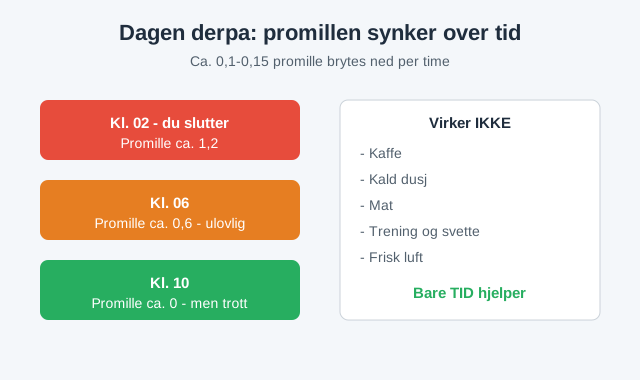
Imagine you stop drinking at 2 a.m. with a BAC of around 1.2. With a breakdown of about 0.15 per hour, the level will fall like this:
- 4 a.m.: around 0.9
- 6 a.m.: around 0.6
- 8 a.m.: around 0.3
- 10 a.m.: around zero, but still uncertain
Even though the calculation says you approach zero around 10 a.m., that does not mean you are ready to drive. You may still be tired, sluggish and have reduced reaction time. Tiredness and residual alcohol reinforce each other – which is why this is closely linked to sleep and road safety and the danger of fatigue and microsleep .
Myths that do not work
There are many stubborn myths about how to sober up faster. None of them work:
- Coffee makes you feel more alert, but does not remove alcohol from the blood.
- A cold shower wakes you up, but does not change your BAC.
- Food before or after drinking can affect absorption, but not the breakdown rate.
- Exercise and sweating remove only a negligible amount of alcohol.
- Fresh air helps how you feel, not your BAC.
The only thing that helps is time. The liver works at its own pace, and there is nothing you can do to speed it up. This also comes down to general fitness to drive : if you are in doubt, you are not fit.
How to avoid driving with residual alcohol
To stay on the safe side, you should plan the next day’s transport in advance. Some practical measures:
- Stop drinking well in advance if you know you have to drive the next morning.
- Build in extra margin – if you are in doubt, leave the car.
- Arrange alternative transport, such as public transit or being picked up.
- Remember that the BAC limit applies around the clock, not just in the evening.
For certain professional drivers and operators, stricter rules on mandatory abstinence apply. Drivers who have lost their licence due to drink-driving may in some cases have to use an alcohol interlock in the car to be allowed to drive again.
Residual alcohol is not only a legal problem – it is a real safety problem because your reaction time, judgement and attention are reduced long after the buzz feels gone. Just as medicines and driving ability can weaken you without your noticing, it is about being honest with yourself about your own condition.
Want to test how well you know the rules on intoxication and driving? Take a free theory test and keep practising in the Eteo app, so you are safely prepared for the theory test.
Next step
Continue with free car questions
Go straight from the article to free car questions and check what actually sticks before you keep reading more theory.
Try for free