Routine driving and inattention on familiar roads
Why does your attention fade on roads you drive every day?
Most people assume the most dangerous trips are the unfamiliar, demanding ones. The truth is often the opposite: routine driving on roads you know very well can be among the riskiest. When the route is familiar, the brain stops working actively, attention drops, and you drive almost on autopilot. As a result, you spot hazards too late.
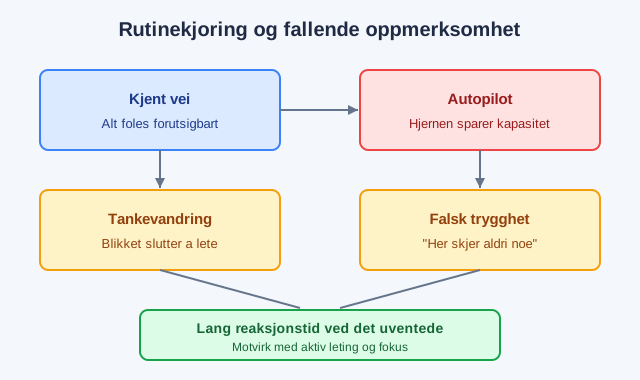
Table of contents
- What routine driving and autopilot are
- Why attention drops on familiar roads
- When and where crashes happen
- How to keep your focus on the everyday trip
- What you need to know for the theory test
What routine driving and autopilot are
Routine driving happens when an action has been repeated so many times that it becomes automatic. You no longer need to think consciously about every gear change, every turn or every junction. In principle this is an advantage – the brain saves capacity and you can spend energy on what matters. The problem is that this automation also makes it possible to drive inattentively without noticing it yourself.
On the daily trip to work or school you know every bend, every traffic light and every speed bump. The brain expects everything to be as usual and stops actively looking for anything out of place. This is often called driving on “autopilot”. Many people find they suddenly arrive without remembering anything of the trip – a clear sign that attention has been somewhere other than the road.
Why attention drops on familiar roads
The brain is built to save energy. On an unfamiliar road you are alert because everything is new and unpredictable. On a familiar road you lower your guard, because you expect nothing new to happen. This expectation is precisely the weakness: when something unusual does appear – a cyclist in the wrong lane, a car reversing out, a child between parked cars – it does not fit what you think you should see, and your reaction comes too late.
Several mechanisms pull attention away from the road:
- Mind wandering – you plan your day, mull over a conversation or daydream.
- Distractions in the car, such as the phone, music or passengers.
- Fatigue and a low activation level, especially on monotonous stretches.
- False sense of safety – “nothing has ever happened here before”.
These mechanisms are closely linked to the psychological traps in traffic and to how we form expectations that can be misread . When expectation steers your gaze more than what you actually see, the risk of overlooking something important rises.
When and where crashes happen
A sobering fact is that a large share of crashes happen close to home, on roads the driver knows well. This does not mean short trips are objectively more dangerous – it is partly because we drive most on these very stretches. But it underlines the point: knowing the road does not protect you against inattention.
The table below shows how familiar and unfamiliar roads affect the driver’s state.
| Factor | Unfamiliar road | Familiar/routine road |
|---|---|---|
| Activation level | High, alert | Low, relaxed |
| Active search for hazards | Yes, constantly | Decreases over time |
| Expectation of the unexpected | High | Low |
| Risk of mind wandering | Small | Large |
| Reaction time on surprise | Short | Can become long |
The point is not that you should be tense on every trip, but that you should be aware that the comfortable feeling of control on familiar roads can be misleading.
How to keep your focus on the everyday trip
You cannot remove automation entirely – nor should you. But you can counteract attention slipping away. Good habits are about actively “waking up” your gaze and mind along the way:
- Comment on the traffic scene to yourself – say in your head what you see and what could happen. This keeps attention directed outward.
- Search actively with your eyes far ahead, to the sides and in the mirrors, instead of staring straight ahead.
- Remove unnecessary distractions before you drive – put away the phone, a well-known distraction .
- Assess your own state – if you are tired, stressed or off form, you are extra exposed on the monotonous everyday trip.
- Keep a safety margin and following distance, so you have time if something unexpected happens.
This is part of good attention and interaction in practice , and it connects to how humans function in traffic . A new driver should also watch out for fatigue and the risk of microsleep and for stress and time pressure , which amplify inattention.
What you need to know for the theory test
For the class B theory test you may face questions about how attention is affected by routine and familiar surroundings. You should be able to explain that automation frees up capacity, but can also cause you to overlook important information, and that knowing a road does not in itself lower the risk. Understand the link between expectation, searching with your eyes and reaction time.
If you want to test how well you understand this, you can take a free theory test and keep practising in the Eteo app, so you are confidently prepared for the theory test.
Next step
Continue with free car questions
Go straight from the article to free car questions and check what actually sticks before you keep reading more theory.
Try for free