Stress and time pressure behind the wheel
How stress and time pressure shape the decisions you make behind the wheel.
Stress and time pressure are among the most underrated risk factors in traffic. When you are short on time, your brain changes the way it processes information: you notice less of what is happening around you, and you make faster and poorer decisions. The result is often higher speed, shorter following distances and driving that is far riskier than it feels. In this article we look at how stress affects your attention, and how to plan your trip so you stay calm behind the wheel.
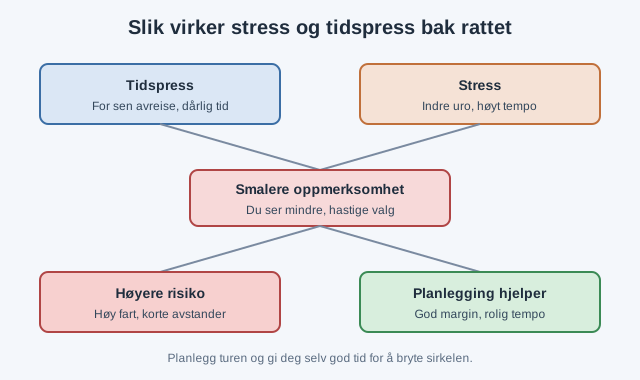
Table of contents
- What happens in your body when you get stressed
- How stress narrows your attention
- Time pressure and hasty decisions
- Signs that you are driving stressed
- How to plan your trip and avoid time pressure
What happens in your body when you get stressed
When you experience stress, your body triggers an automatic reaction. Your heart rate rises, your muscles tense, and your brain shifts to a faster, more impulsive pace. This is a useful survival mechanism in a dangerous situation, but behind the wheel it often works against you. You become more impatient, less tolerant of other road users and more inclined to take chances you would normally avoid.
Stress can come from many sources at once. It may be time pressure because you are running late, an argument before you got in the car, worries from work, or a combination of several things. What they all have in common is that they steal the mental capacity you need to drive safely. Your brain has a limited amount of attention, and when much of it is tied up in unease and thoughts, less is left for the driving itself.
How stress narrows your attention
One of the most important effects of stress is that your field of vision becomes narrower, often called tunnel vision. You focus on what is right in front of you and are less likely to catch what is happening at the edge of your vision: a cyclist moving into the road, a child by the kerb or a car braking in an adjacent lane. When you are also driving fast, this effect is amplified further.
Stress also reduces your ability to see several things in context. You can react to what is happening right now, but you find it harder to anticipate what will happen in a few seconds. This anticipatory, planning style of driving is exactly what characterises a safe driver. If you want to read more about how attention affects driving, you will find a thorough walkthrough in the article on the human in traffic .
| State | What happens to your driving | Consequence |
|---|---|---|
| Calm and rested | Broad attention, sees the whole picture | Plenty of time to react |
| Mildly stressed | Slightly narrower focus, faster choices | Smaller margin |
| Highly stressed | Tunnel vision, impulsive decisions | High accident risk |
Time pressure and hasty decisions
Time pressure is a special form of stress because it directly affects the choices you make. When you feel you have to make it somewhere, you unconsciously start to “save” seconds: you speed up a little, you take a chance at a traffic light that is about to change, you keep a shorter distance to the car ahead, or you make an overtake you really do not have the sight lines or space for.
The problem is that the gain is minimal while the risk is large. Even on a long trip you rarely save more than a few minutes by driving aggressively, but you significantly increase the chance of a serious mistake. A good example is the following distance: under time pressure many drivers creep closer to the car in front and keep too short a following distance. That gives you far less time to react if something happens. Time pressure also makes us more likely to misread what we see; read more about expectation and misinterpretation .
Time pressure is also closely linked to other risk factors. A driver who is already tired or inattentive copes worse with stress. Read more about how fatigue and microsleep affect your reaction ability, and how psychological traps in traffic make us underestimate risk.
Signs that you are driving stressed
The first step to managing stress is to recognise it. Many people do not notice they are stressed until it has already affected their driving. Here are some typical signs:
- You get annoyed with other road users and feel impatient.
- You grip the wheel tightly and sit tense in your shoulders.
- You take chances you normally would not, such as pushing through an amber light.
- You forget routines, such as checking mirrors or signalling in good time.
- You feel that time is “moving too slowly” and that everyone else is in your way.
If you recognise several of these, it is a signal to slow down. Stress can also intensify an already aggressive driving style, which you can read more about in the article on aggressive driving and road rage . The same goes for pressure from passengers, which often makes us more stressed; see how to handle peer pressure and passengers .
How to plan your trip and avoid time pressure
The best way to avoid stress is to remove the time pressure before you get in the car. Good planning gives you margin, and margin gives you calm. Think through this before you set off:
- Allow plenty of time. Build in extra minutes for traffic, parking and unexpected stops, so you do not feel that every red light is a disaster.
- Check your route in advance. Avoid hunting for exits along the way, which demands attention you should rather spend on the traffic.
- Prepare the car and yourself. Adjust mirrors, seat and navigation before you drive. You will find a good checklist in the article on preparing for a long drive .
- Accept that you might be delayed. A couple of minutes late is better than an accident. Letting go of the feeling that you have to make it somewhere is often the single most important measure.
Along the way you can lower your stress level with calm breathing, quiet music and a conscious decision to drive defensively. A defensive driving style gives you time and margins; read more in the article on defensive driving . Ultimately it comes down to attitudes and self-awareness: a safe driver knows when he or she is not in a fit state to drive. That is part of being fit to drive .
Stress and time pressure are an important topic on the theory test, because they concern how people function in traffic. If you want to test how well you know the material, you can take a free theory test and keep practising in the Eteo app until you feel confident and ready for the theory exam.
Next step
Continue with free car questions
Go straight from the article to free car questions and check what actually sticks before you keep reading more theory.
Try for free