Vision in traffic – central and peripheral sight
How central and peripheral vision work – and why using your gaze well is essential.
Vision in traffic is the most important source of information for a driver. It is common to estimate that around 90 percent of what we need to drive safely comes through our eyes. That is why good driving is largely about how you use your gaze – not just how well you see. In this article we look at the difference between central and peripheral vision, how high speed affects what we perceive, and how you can train the right use of your gaze.
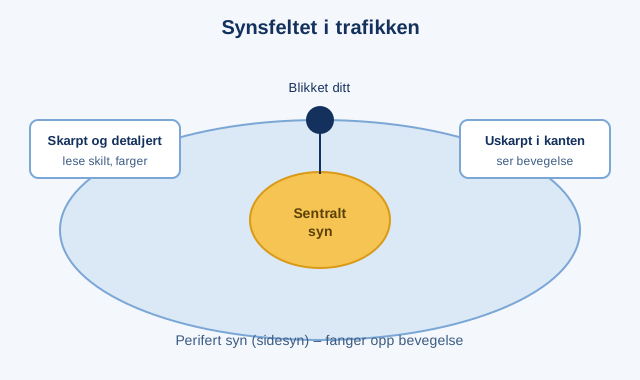
Table of contents
- Central vision: the sharp sight
- Peripheral vision: side vision
- Tunnel vision at high speed
- How to use your gaze correctly
- Vision requirements and health
Central vision: the sharp sight
Central vision is the small part of the visual field where we see sharply and can perceive details, colours and text. It covers only a few degrees around the point you are actually looking at. You use central vision to read road signs, perceive the colour of traffic lights and judge the distance to the vehicle ahead.
Because the sharp area is so small, you can really only read details in one place at a time. That is why your gaze must move constantly – from the mirror, to the road ahead, to crossing roads and back. A good driver shifts focus quickly and systematically instead of staring fixedly at one point.
Peripheral vision: side vision
Peripheral vision, or side vision, is the rest of the visual field outside the sharp area. Here you see blurred and do not perceive details well, but you are very sensitive to movement. It is side vision that warns you about a pedestrian who suddenly steps into the road, a cyclist coming from the side, or a vehicle in the next lane.
Peripheral vision is therefore an early warning system. When side vision picks up something moving, you automatically move your gaze there to use sharp central vision and assess the situation. This interplay between side vision and central vision is a major part of good attention in traffic, which we explore further in the article on attention and interaction .
| Property | Central vision | Peripheral vision (side vision) |
|---|---|---|
| Sharpness | High, sees detail | Low, blurred |
| Colours | Perceives well | Perceives poorly |
| Movement | Less sensitive | Very sensitive |
| Typical use | Reading signs, distance | Detecting danger from the side |
Tunnel vision at high speed
The visual field is not constant. As speed increases, you direct your gaze further ahead to react in time, and the field of view to the sides narrows. This is often called tunnel vision: at low speed you have a good overview to both sides, but at high speed you almost only see straight ahead, as if through a tube.
The consequence is that it becomes harder to spot pedestrians, cyclists and crossing traffic in your side vision the faster you drive. Together with the fact that reaction time also requires a longer distance at higher speed, this explains why small increases in speed give a much longer stopping distance. You can read more about the link between speed and reaction time and braking distance .
Other conditions that shrink or disturb the visual field:
- Darkness and poor visibility reduce how far and how clearly you see.
- Fatigue makes your gaze “stick” so you become less observant to the sides – read more about fatigue and microsleep .
- Stress and high mental load can cause a kind of mental tunnel vision where you overlook important information.
How to use your gaze correctly
Correct use of gaze is about looking far ahead, keeping your gaze moving and using the mirrors systematically. A well-known method is to combine good use of gaze with interaction, as we describe in the five looking rules .
Some rules of thumb for good use of gaze:
- Look far ahead – place your gaze where you want to drive, not just in front of the bonnet.
- Keep your gaze moving – shift between road, mirrors and crossing directions.
- Actively scan for hazards – junctions, exits, crossings and bus stops.
- Look where you want to go – the car often follows your gaze, especially in bends.
Good use of gaze reduces the risk of being surprised, and is a central part of being an attentive and anticipating driver – topics we cover in the article on the human in traffic . Medicines and driving ability can also affect how well you perceive your surroundings.
Vision requirements and health
To hold a class B driving licence you must meet certain requirements for your vision. There are requirements for visual acuity and for the visual field being sufficiently wide, among other things. Many people notice changes in their vision gradually without realising it themselves, which is why an eye examination is a natural part of staying fit to drive. You will find the details in the article on health and vision requirements .
Want to test how well you have understood vision and use of gaze? Try a free theory test and keep practising in the Eteo app, so you are well prepared for the theory test for class B.
Next step
Continue with free car questions
Go straight from the article to free car questions and check what actually sticks before you keep reading more theory.
Try for free