Fatigue and microsleep behind the wheel
Recognise the warning signs of fatigue and avoid microsleep on long drives.
Microsleep behind the wheel refers to short episodes of sleep lasting from one to a few seconds, often without the driver even noticing. While that may sound harmless, a car travelling at 80 km/h can cover more than 100 metres in four seconds with a sleeping driver at the wheel. Fatigue is one of the most underestimated risk factors in traffic, and it affects every driver regardless of experience. In this article you will learn to recognise the warning signs, know when you must stop, and how to stay awake on long drives.
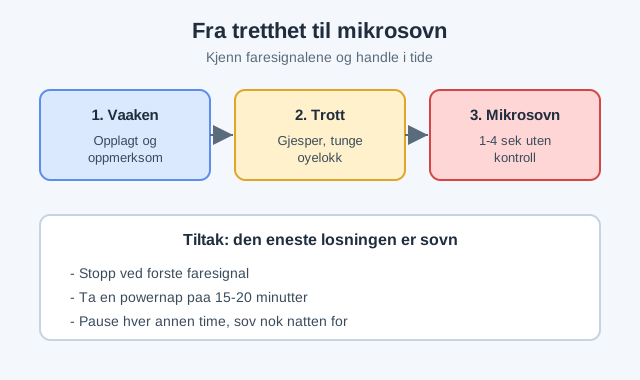
Table of contents
- What is microsleep?
- Warning signs of fatigue
- When you should stop
- How to stay awake
- Fatigue and the theory test
What is microsleep?
Microsleep occurs when the brain briefly shuts down because the need for sleep becomes too great. Your eyes may be open, but the brain does not register what it sees. You may “wake up” from a rumble strip, a small jolt in the car or because you have suddenly drifted into the oncoming lane. The frightening part is that many people do not remember the episode at all.
Fatigue impairs the same functions as alcohol. It lengthens your reaction time, reduces attention and worsens your judgement. Being awake for 17 hours straight causes roughly the same impairment as a blood alcohol level of 0.5. That is why knowledge about sleep is a central part of the topic sleep and traffic safety on the theory test.
Warning signs of fatigue
The body almost always sends warnings before microsleep sets in. The problem is that tired drivers often ignore or downplay the signals. Learn to recognise them:
- Repeated yawning and heavy eyelids
- Burning, stinging or dry eyes
- Difficulty holding your head up or focusing your gaze
- You cannot remember the last few kilometres you drove
- You drift out of your lane or lose your sense of speed
- Restlessness, irritability or wandering thoughts
When you notice several of these at once, microsleep is near. At that point it does not help to “just drive a little further”. A worsening condition also directly affects reaction time and braking distance , because the brain no longer processes information quickly enough.
When you should stop
The only effective solution to fatigue is sleep. Measures such as turning up the music, opening the window or talking only help for a few minutes and give a false sense of security. The table below shows how different levels of fatigue should be handled:
| Condition | Signs | Recommended action |
|---|---|---|
| Slightly tired | Occasional yawning | Plan your next break, drink water |
| Clearly tired | Heavy eyelids, restless | Stop at the first rest area |
| Danger zone | Cannot recall the road, drifting | Stop immediately, take a nap |
| Acute | Nodding off, microsleep | Do not drive on, sleep properly |
A good tip is a short power nap of 15-20 minutes combined with a cup of coffee right before. The caffeine takes effect after about 20 minutes, so you wake up more alert. Also consider whether you are fit to drive at all. This relates to your general fitness to drive .
How to stay awake
Most cases of fatigue behind the wheel can be avoided with good planning. Preparation is the key, especially before long drives:
- Get enough sleep the night before, at least 7-8 hours
- Avoid setting off when you would normally be asleep, such as in the middle of the night
- Schedule a break every two hours or every 100 kilometres
- Eat light; heavy meals make you drowsy
- Share the driving if there are several of you
- Cut the trip short rather than pushing through
Good planning of route, breaks and rest is a central part of preparing for a long drive . On monotonous roads with little traffic, such as during rural road driving , the risk of fatigue rises because the brain receives few stimuli. Be extra alert to this.
Remember too that other conditions amplify fatigue. Certain medicines and driving ability are closely connected, because many drugs cause drowsiness as a side effect. Stress can also drain your reserves; read more about stress and time pressure . For new drivers, the combination of little experience and fatigue is especially dangerous, as described in the article on risk factors for young drivers .
Fatigue and the theory test
Questions about fatigue, sleep and microsleep are common on the class B theory test, because the topic concerns your own ability to drive safely. You should be able to explain that tiredness cannot be “fought off”, that the only solution is sleep, and that the signals must be taken seriously. It is also important to understand that fatigue, like intoxication and distractions, gradually impairs your judgement without you noticing it yourself.
Want to test how well you know this and the rest of the theory syllabus? Try a free theory test and practise regularly in the Eteo app, so you are confident and well prepared for the theory test.
Next step
Continue with free car questions
Go straight from the article to free car questions and check what actually sticks before you keep reading more theory.
Try for free