Tunnel vision at high speed – how your sight narrows
How high speed narrows your field of view and creates tunnel vision.
When you increase your speed, something happens to your eyesight that you barely notice yourself. Tunnel vision at high speed means that your field of view narrows, so you see less and less to the sides and mostly straight ahead. It is a completely normal and automatic reaction in the brain, but it sharply increases risk because you more easily miss pedestrians, cyclists and vehicles approaching from the side. In this article we look at how this works, why it is dangerous, and what you can do about it.
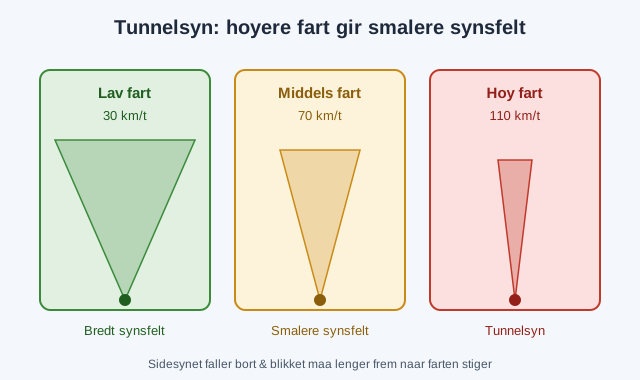
Table of contents
- What is tunnel vision?
- Why the field of view shrinks with speed
- Why tunnel vision is dangerous
- How to adjust your gaze and speed
- Tunnel vision on the theory test
What is tunnel vision?
The human field of view covers roughly 180 degrees in width when you stand still. This wide peripheral vision is what picks up movement at the edges – a child by the kerb or a car approaching from a side road. As speed increases, the eyes cannot perceive details at the edges as quickly, and the brain prioritises what is directly ahead of you. The result is that the sharp, usable field of view narrows into a thin “tunnel”.
At walking pace you have almost all of your peripheral vision available. At motorway speed the usable field of view can be reduced to a relatively narrow cone straight ahead. You still see the road and the car in front clearly, but you register far less of what is happening at the sides. This link between speed and your field of view is one of the reasons why speed itself is such an important risk factor.
Why the field of view shrinks with speed
Two main mechanisms work together:
- Physiology: Peripheral vision is poor at perceiving sharp details. At high speed the surroundings move past so quickly that the edge of the field of view becomes blurred and “blends together”. The brain therefore pulls attention inward toward what stays still in the visual image – the point far ahead on the road.
- Attention: High speed demands more mental capacity. You have to process information faster, and the brain saves resources by filtering out what seems less important. Peripheral vision is automatically deprioritised.
The table below gives a simplified indication of how the usable field of view narrows with increasing speed. The figures are approximate and illustrate a tendency, not exact measurements:
| Speed | Usable field of view (approximate) | Consequence |
|---|---|---|
| 30 km/h | Wide, almost full peripheral vision | Easy to spot crossing traffic |
| 70 km/h | Noticeably narrower | Side roads and edges become less visible |
| 110 km/h | Narrow cone straight ahead | Strong tunnel vision, little peripheral vision |
As the illustration at the top shows, the cone becomes narrower the higher the speed. At the same time you move your gaze further ahead, because you need more time to react – something you can read more about in the article on reaction time and braking distance.
Why tunnel vision is dangerous
Tunnel vision is dangerous because the most critical road users often appear from the side. A cyclist from a side road, a pedestrian at a crossing or a car that fails to yield – all of this happens at the edge of the field of view. When peripheral vision is weakened, you detect them later, and combined with high speed both reaction time and braking distance become too short relative to the hazard.
The risk is amplified by other factors that also narrow vision and attention:
- Fatigue: A tired mind fixes its gaze and stops scanning. Read more about fatigue and microsleep.
- Stress and time pressure: When you are in a hurry, attention narrows even further. See stress and time pressure.
- Expectation: You see what you expect to see, and miss the unexpected. More on this in expectation and misinterpretation.
Tunnel vision is therefore not an isolated phenomenon, but part of how the whole sense of sight in traffic works under strain.
How to adjust your gaze and speed
The most important antidote to tunnel vision is to keep your speed down where it is tight and hard to see, and to train your gaze to stay active. Some concrete steps:
- Lower your speed in town, at junctions, schools and crossings. Lower speed gives a wider field of view and more time.
- Scan actively from side to side. Do not lock your gaze on the car in front. Move your eyes deliberately outward toward the pavement, side roads and mirrors.
- Look far ahead. A high, long gaze gives early warning and gives your peripheral vision more to work with.
- Use a systematic method. The 5 look rules help you use your gaze in a structured way instead of staring.
- Match speed to distance. The relationship between speed and distance determines how much margin you have when something unexpected happens.
On high-speed roads, such as motorways, it becomes especially important to look far ahead and read the traffic picture early. You can read more about this in the article on motorway driving.
Tunnel vision on the theory test
The link between speed and field of view is a classic part of the topic of people and risk, and often appears on the theory test. Typical questions deal with why you should lower your speed at places with poor visibility, and how sight is affected by speed. If you understand the mechanism behind tunnel vision, you will answer these questions correctly – and you will drive more safely in practice.
Want to test how much you know? Take a free theory test and keep practising in the Eteo app, so you are well prepared for the class B theory test.
Next step
Continue with free car questions
Go straight from the article to free car questions and check what actually sticks before you keep reading more theory.
Try for free