EV vs petrol car – the environmental balance
How much greener is the EV really when the whole life cycle is counted?
The debate about the EV vs petrol car far too often focuses only on what comes out of the exhaust pipe. An honest answer requires a complete environmental balance that counts production, the battery, the energy source and what happens to the car at the end of its life. When you compare across the full life cycle, the picture is more nuanced than both sceptics and enthusiasts like to admit.
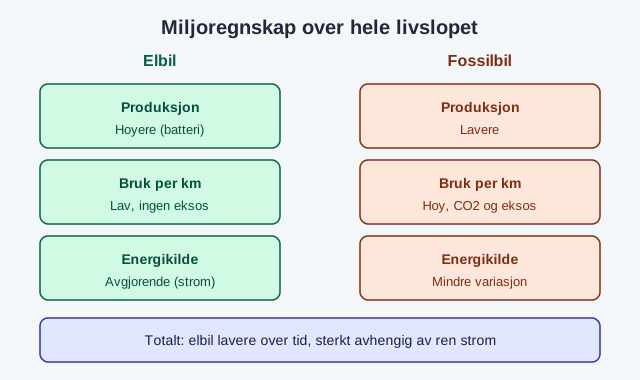
Table of contents
- What does life-cycle emissions mean?
- Emissions from production and the battery
- Emissions during use
- What does the total balance say?
- What matters for you on the theory test?
What does life-cycle emissions mean?
Life-cycle emissions are the sum of all the climate impact a car has from the moment raw materials are extracted until the car is scrapped. It is usually split into three phases:
- Production – extraction of metals, battery manufacturing and assembly
- Use – energy for driving, maintenance and tyre wear
- End of life – recycling or recovery of materials
A petrol car emits most during use, through combustion of petrol or diesel. An EV, on the other hand, has its centre of gravity early on: the production itself, and the battery in particular, causes higher emissions before the car has even rolled out of the factory. This is exactly where many misunderstandings arise. If you want to understand how the emissions occur physically, we have a dedicated guide on emissions and greenhouse gases from cars .
Emissions from production and the battery
An EV battery requires large amounts of energy and raw materials such as lithium, cobalt and nickel. As a result, the EV starts with a significant climate debt. How large that debt is depends strongly on where the battery is produced and what electricity the factory uses. A battery made with renewable power causes far lower emissions than one made with coal power.
Petrol cars also have production emissions, but since they lack the large battery, the starting point is lower. The difference in the production phase is therefore real – but it has to be weighed against what happens in the rest of the life cycle.
| Phase | EV | Petrol car |
|---|---|---|
| Production (incl. battery) | Higher | Lower |
| Use (per km) | Low to very low | High |
| Energy source decides | Yes, strongly | Less so |
| Local emissions while driving | No exhaust | Exhaust and particles |
Emissions during use
Here the equation turns around. An EV has no exhaust and emits no CO2 while driving. In Norway, where electricity largely comes from hydropower, the in-use emissions become very low. A petrol car, by contrast, emits greenhouse gases every single kilometre, and consumption depends on driving style, speed and maintenance. You can read more about the differences between the energy carriers in the article on fuel types: petrol, diesel and electricity .
It is still important to remember that the EV is not entirely emission-free locally. Particulate matter from tyres, brakes and road surface occurs regardless of the drivetrain, and heavy EVs can wear more on the tyres. You will find more on this in the article about studded tyres and particulate matter . If you use regenerative braking correctly, you reduce both brake wear and particles – read about regenerative braking .
What does the total balance say?
When you add up all the phases, most serious life-cycle analyses show that the EV beats the petrol car in the climate balance – but how big the lead is depends on the assumptions:
- Electricity mix: If the EV is charged with renewable power, the climate debt is paid down quickly. With coal power it takes longer.
- Mileage: The more kilometres the car drives, the faster the higher production debt is recovered.
- Battery lifetime: A long lifetime and good recycling improve the balance even further.
In Norway, with clean hydropower and high mileage over time, the EV is in most cases clearly better for the climate than an equivalent petrol car. If you charge smartly and efficiently, the gain becomes even greater – see our guide to charging an EV . The practical and economic advantages, as well as the rules, are described in the article on EV benefits and rules .
That does not mean an EV is a free pass. The most environmentally friendly car is often the one you already own and use for a long time, and regardless of drivetrain a calm and anticipatory driving style counts. Lower speed, smooth driving and correct tyre pressure reduce both energy use and wear.
What matters for you on the theory test?
For the class B theory test you do not need to know detailed figures, but you should understand the principles: that EVs and petrol cars have emissions in different phases, that the energy source is decisive, and that environmentally friendly driving is about more than the choice of drivetrain. The expected knowledge is that you understand the link between driving style, energy use and the environment.
If you want to test how well you have understood the environmental material and the rest of the syllabus, you can take a free theory test and keep practising in the Eteo app until you are confident and ready for the theory test.
Next step
Continue with free car questions
Go straight from the article to free car questions and check what actually sticks before you keep reading more theory.
Try for free