Studded Tyres, Particulate Matter and Air Quality
How studded tyres create particulate matter – and what the studded tyre fee involves.
Studded tyres provide good grip on ice and packed snow, but they have a downside that matters in the class B theory: the studs tear up the asphalt and create particulate matter that pollutes the city air. This is a topic you may meet on the theory test, and something every driver should understand – both for the sake of the environment and your own health.
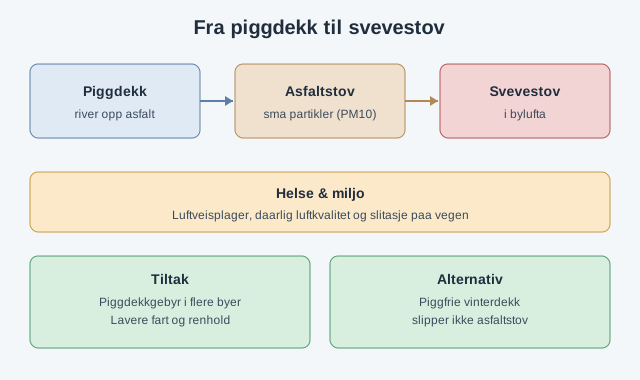
Table of contents
- How studded tyres create particulate matter
- Health and environmental consequences
- The studded tyre fee and local rules
- Studless tyres as an alternative
- How to choose correctly
How studded tyres create particulate matter
When a wheel with studs rolls over dry asphalt, the small metal studs strike the road surface and wear loose tiny particles. This asphalt dust is whirled up and becomes particulate matter – particles so small that they can stay airborne for a long time.
Particulate matter is often measured as PM10, meaning particles smaller than ten micrometres. Wear from studded tyres is one of the most important sources of this type of pollution in Norwegian cities during winter and spring. The problem is worst in dry weather, because the dust is then easily whirled up again from the road. Choosing the right tyre is closely linked to how driving affects the environment in more ways than just fuel.
Health and environmental consequences
Particulate matter is not just an aesthetic problem. The smallest particles can penetrate deep into the airways and worsen asthma, allergies and cardiovascular disease. On days with a lot of particulate matter, municipalities often warn sensitive groups against staying near heavily trafficked roads.
In addition to the health effects, the use of studded tyres causes:
- Increased road wear – the asphalt has to be replaced more often, which costs money and requires resources.
- More dust and dirt along the roads, which in turn ends up in ditches and waterways.
- Higher fuel consumption because studded tyres create more rolling resistance than summer tyres.
By comparison, emissions and greenhouse gases from cars contribute to the climate problem on a global scale, while particulate matter is first and foremost a local air quality problem that affects where people live.
The studded tyre fee and local rules
To limit particulate matter, several large cities have introduced a studded tyre fee. This means you have to pay a charge to drive with studded tyres in a given area during the winter season. The money is used, among other things, to improve air quality and promote the use of studless tyres.
| Topic | Key point |
|---|---|
| What the fee is | A charge for using studded tyres in selected city areas in winter |
| Why | Reduce particulate matter and improve air quality |
| Who decides | The municipality, with state authorisation |
| How it is paid | Per day, month or for the whole season |
| Exceptions | Rules vary locally, so always check your own municipality |
The actual requirements for when and how you may use studded tyres are regulated nationally. Read more about the rules for tyres and chains and how the deadlines work. A lower speed also reduces the whirling up of dust, and in some areas an environmental speed limit applies precisely to improve air quality.
Studless tyres as an alternative
Modern studless winter tyres have become very good and provide safe grip in most winter conditions without tearing up the asphalt. They create far less particulate matter and are usually exempt from the studded tyre fee. On pure ice, studs still give a small advantage, but the difference is smaller than many people think.
When you are considering tyres, these points can help:
- Do you drive a lot in the city? Then studless tyres are often the most environmentally sound choice.
- Do you drive a lot on ice and packed snow in sparsely populated areas? Then studs can provide extra safety.
- How long do you need winter tyres? Think about the season and when you should change to winter tyres .
For a more thorough comparison of properties and uses, see the article on studded tyres vs. studless winter tyres .
How to choose correctly
The right tyre choice is about balancing safety and the environment. If you live in a city with a studded tyre fee and well-plowed roads, much points towards studless tyres. If you travel a lot on winter roads without salting, studs can be justified. Whatever you choose, good driving technique and the right speed are important for both road safety and air quality. Remember too that safe starting and driving on ice is part of being a responsible driver.
Want to test how well you know the environment and tyre rules? Take a free theory test and keep practising in the Eteo app, so that you are well prepared for the theory test.
Next step
Continue with free car questions
Go straight from the article to free car questions and check what actually sticks before you keep reading more theory.
Try for free