How to reduce your fuel consumption
Concrete steps that lower your fuel consumption and costs.
How you drive often matters more for consumption than which car you own. With a little awareness about gear changes, speed and maintenance you can reduce your fuel consumption by ten to twenty percent without driving any slower from A to B. In this article you get concrete, well-documented tips that lower both your consumption and your costs, whether you drive petrol, diesel or electric.
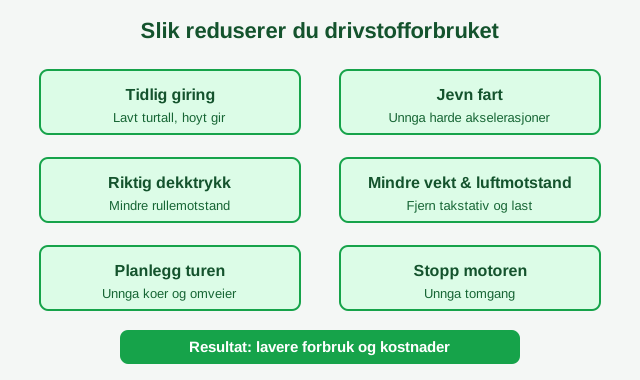
Table of contents
- Why driving technique matters most
- Gear changes and engine speed
- Speed, acceleration and planning
- Tyre pressure, weight and air resistance
- How to measure the effect
Why driving technique matters most
The engine uses the most fuel when it works hard – that is, during heavy acceleration and high engine speed. A smooth and anticipatory driving style is therefore the simplest and cheapest step you have. This is often called economical driving or eco-driving, and it is a key part of an environmentally friendly driving style. Read more about the bigger picture in the article on environmentally friendly driving .
The point is not to drive slowly, but to drive smart: plan ahead, keep a steady speed and use the car’s momentum instead of braking and accelerating in turns.
Gear changes and engine speed
The most important single habit in a manual car is to shift up early and drive at a low engine speed. As a rule of thumb you should shift up before the revs reach around 2000–2500 rpm, and drive in the highest gear the engine can pull without juddering.
- Shift up early and down late.
- Keep the revs low – a high gear at low speed saves fuel.
- Avoid revving the engine when starting; the car does not need throttle before you release the clutch.
- Use engine braking instead of holding the throttle and braking at the same time.
This is explained in more detail in the article on gear changes and engine speed for economical driving . In most modern cars the engine also cuts the fuel supply completely when you lift off the throttle in gear, which makes engine braking very efficient.
Speed, acceleration and planning
Air resistance increases sharply with speed. Driving at 100 km/h instead of 110 km/h can noticeably reduce consumption on longer trips. At the same time, hard acceleration and unnecessary braking waste energy.
| Measure | Effect on consumption |
|---|---|
| Steady speed, little braking | Large reduction |
| Lower cruising speed on motorways | Noticeable reduction |
| Early upshifting | Large reduction |
| Correct tyre pressure | Small to moderate reduction |
| Less load and roof racks | Small to moderate reduction |
| Avoid unnecessary idling | Small reduction |
Plan your route so you avoid queues and many stops. Every time you have to brake all the way down and accelerate up again, extra energy is used. Look far ahead in traffic and roll towards red lights instead of accelerating right up and braking hard. Be aware, however, that putting the car in neutral (coasting) on downhill stretches usually does not pay off and can weaken your control – read why in the article on coasting and freewheeling .
Tyre pressure, weight and air resistance
Too low tyre pressure increases rolling resistance, so the engine has to work harder. Check the tyre pressure regularly and follow the values in the car’s manual or on the sticker in the door frame. Correct pressure also gives better grip and more even tyre wear. You will find more about this in the article on tyre pressure and TPMS .
- Remove roof racks, roof boxes and bike carriers when you are not using them – they significantly increase air resistance.
- Do not drive around with unnecessary load in the boot; extra weight increases consumption.
- Use the air conditioning and heating sensibly, since it puts a load on the engine.
- Close the windows at high speed to reduce air resistance.
Remember that studded and winter tyres give higher rolling resistance than summer tyres. Switch to the right tyres at the right time – read about studded versus studless winter tyres and when to switch to winter tyres .
How to measure the effect
Most cars have a trip computer that shows instant and average consumption. Reset the average consumption and watch how gear changes and speed affect the numbers. Over time you clearly see the link between driving style and consumption – and therefore cost. Lower consumption also means lower emissions; see the connection in the article on emissions and greenhouse gases from cars . Fuel cost is also just one of several fixed expenses in economy and car ownership .
Good driving technique and knowledge of the vehicle are closely tied to the theory you need to know for the theory test. Want to test what you know? Take a free theory test and keep practising in the Eteo app to be well prepared for the class B theory test.
Next step
Continue with free car questions
Go straight from the article to free car questions and check what actually sticks before you keep reading more theory.
Try for free