Correct tyre pressure for lower consumption and emissions
Why correct tyre pressure is one of the simplest environmental measures you have.
Correct tyre pressure is perhaps the simplest and cheapest environmental measure a driver has. With too little air in the tyres, rolling resistance increases, and the engine has to work harder to maintain the same speed. The result is higher fuel consumption, more emissions and faster tyre wear. A two-minute check at a petrol station can therefore save you both money and unnecessary greenhouse gases.
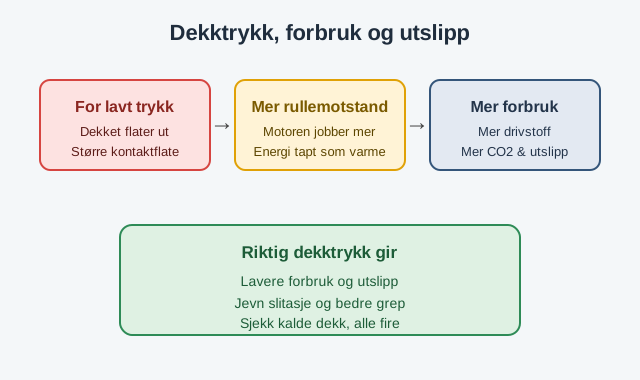
Table of contents
- Why tyre pressure affects consumption
- How much you can save
- How to find the correct pressure
- How to check tyre pressure
- The link to safety and wear
Why tyre pressure affects consumption
When a tyre rolls, the rubber is constantly deformed where it meets the road. This deformation requires energy, and that energy comes from the fuel. A tyre with too low a pressure flattens out more, the contact patch with the road grows larger, and rolling resistance increases. The higher the rolling resistance, the more energy is lost as heat in the tyre instead of moving the car forward.
This is physics that applies regardless of drivetrain. Even an electric car uses more energy with soft tyres, although EVs have no local emissions. For a petrol or diesel car, increased consumption directly means more CO2 and other greenhouse gases out of the exhaust. If you want to understand which gases these are, you can read more about emissions and greenhouse gases from cars .
How much you can save
There is no exact figure that fits every car, but the principle is unambiguous: lower pressure means higher consumption. The table below shows a typical and cautiously estimated relationship between how much air is missing and how it plays out.
| Deviation from recommended pressure | Effect on rolling resistance | Typical extra consumption |
|---|---|---|
| Correct pressure | Normal | 0 % |
| 0.3 bar too low | Slightly increased | A few percent |
| 0.5 bar too low | Noticeably increased | Several percent |
| Clearly under-inflated | Strongly increased | Substantially higher |
The extra consumption may seem small on a single trip, but over a whole year of daily driving it adds up to both litres and money. Correct tyre pressure is therefore part of a larger package of measures. Have a look at how you can reduce fuel consumption and how general eco-friendly driving ties in with your driving style.
How to find the correct pressure
The correct air pressure is not a random number, but specified by the car manufacturer. You usually find it on a sticker in the driver-side door frame, on the inside of the fuel filler flap or in the owner’s manual. The pressure is given in bar or kPa, and there are often different values for front and rear, as well as for full load.
Be aware of the following:
- Load increases the recommended pressure. For a full car or trailer, a higher pressure is often used.
- Front and rear axle can have different values.
- Summer and winter may have separate recommendations from some manufacturers.
- Pressure drops as it gets cold, so a tyre that was correct in autumn may be too low in winter.
If you are going to drive with a trailer, remember that the load affects both tyre pressure and handling. Read more about load distribution and noseweight before you load up.
How to check tyre pressure
Tyre pressure should always be checked on cold tyres, that is, before you have driven far. When the tyres get warm from driving, the pressure rises, and the measurement becomes inaccurate. So preferably do not drive more than a couple of kilometres before checking, or account for the warming.
- Unscrew the valve cap and press the gauge firmly onto the valve.
- Read off the pressure and compare it with the manufacturer’s value.
- Fill air to the correct level, or release some if it is too high.
- Check all four tyres, and do not forget the spare wheel if you have one.
Many newer cars have a TPMS, a system that warns of low pressure. It is a nice safety margin, but it does not replace manual checks. You can read more about how this works in the article on tyre pressure and TPMS . A regular check fits well alongside other checks of fluid levels in the car .
The link to safety and wear
Lower consumption is just one of the benefits. Too low pressure also gives poorer handling, longer braking distance and uneven wear, often most on the tyre’s outer edges. Too high pressure gives a smaller contact patch, more wear in the middle and poorer grip. Correct pressure is therefore a balance that serves the environment, your finances and road safety.
The condition of the tyre is closely linked to the pressure. A worn tyre with correct pressure is still unsafe, so always check the tread depth too. You will find more on this in the article on tyres and tread depth . If you want to think long term about what running a car costs, tyres and fuel are a big item, and that is covered in the article on car finances and ownership .
This is typical material on the class B theory test, where you must understand the link between tyres, the environment and safety. If you want to practise such questions, you can take a free theory test and keep training in the Eteo app until you are ready for the theory test.
Next step
Continue with free car questions
Go straight from the article to free car questions and check what actually sticks before you keep reading more theory.
Try for free