Emissions and greenhouse gases from cars
What are CO2, NOx and particulates – and how do you reduce emissions?
When you drive a car with a combustion engine, you release gases and particulates that affect both the climate and the air we breathe. Emissions and greenhouse gases from cars are an important topic both in the class B theory and in everyday driving. In this article we explain what CO2, NOx and particulates are, where they come from, and what you can do yourself to drive more cleanly.
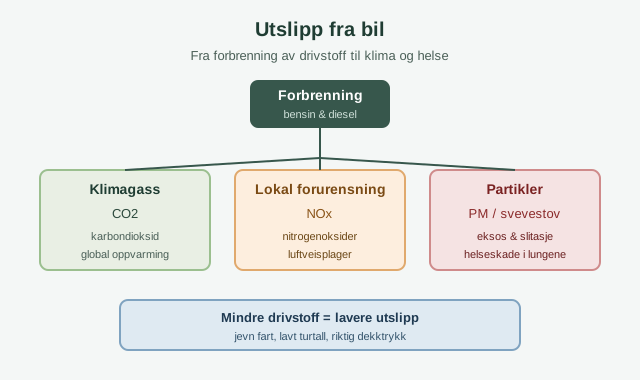
Table of contents
- The main emissions from cars
- What are greenhouse gases, and why is CO2 special?
- Local pollution: NOx and particulates
- What affects how much your car emits?
- How to reduce your emissions
The main emissions from cars
The exhaust from a petrol or diesel car contains several substances. Some affect the climate of the whole planet, while others mainly pollute the local air where you drive. It helps to distinguish between these two types.
| Emission | Type | Main source | Effect |
|---|---|---|---|
| CO2 (carbon dioxide) | Greenhouse gas | All fuel combustion | Global warming |
| NOx (nitrogen oxides) | Local pollution | High combustion temperature, especially diesel | Respiratory problems, acid rain |
| Particulates (PM) | Local pollution | Exhaust, tyres, brakes, road wear | Lung damage |
| HC (hydrocarbons) | Local pollution | Unburnt fuel | Contributes to ground-level ozone |
| CO (carbon monoxide) | Harmful gas | Incomplete combustion | Toxic at high concentrations |
What are greenhouse gases, and why is CO2 special?
Greenhouse gases are gases that trap heat in the atmosphere and contribute to the greenhouse effect. The most important greenhouse gas from road traffic is CO2 (carbon dioxide). CO2 is formed when the carbon in the fuel burns with oxygen, and the amount is directly linked to how much fuel you use.
An important point is that you cannot clean away CO2 with a catalytic converter the way you partly can with other substances. The only way to reduce CO2 emissions is to use less fuel or switch to a fuel type with lower emissions. That is why fuel consumption and greenhouse gas emissions are closely connected: drive economically, and you emit less CO2.
An electric car has zero local CO2 emissions because it does not burn fuel. How climate-friendly it is overall depends, among other things, on how the electricity is produced.
Local pollution: NOx and particulates
While CO2 affects the whole planet, it is NOx and particulates that primarily worsen air quality in towns and cities.
- NOx (nitrogen oxides) form when nitrogen and oxygen in the air react at high temperatures inside the engine. Diesel cars have traditionally emitted more NOx than petrol cars. NOx can cause breathing difficulties and contributes to acid rain.
- Particulates (airborne dust) come both from exhaust and from wear on tyres, brakes and the road surface. The smallest particles penetrate deep into the lungs and can cause serious health problems. Studded tyres increase the amount of airborne dust, which you can read more about in our article on studded tyres and airborne dust .
To limit local pollution, many cities use measures such as an environmental speed limit and a low-emission zone in the urban environment . Modern cars clean the exhaust using a catalytic converter, particulate filter and AdBlue, which you can read more about in the article on emission control with catalytic converter, DPF and AdBlue .
What affects how much your car emits?
Emissions depend on several factors that you as a driver can partly control yourself:
- Fuel type – petrol, diesel, hybrid or electric give very different emission profiles. See our overview of fuel types: petrol, diesel and electric .
- Driving style – hard acceleration and high speed sharply increase consumption.
- Maintenance – proper engine maintenance and clean filters keep emissions down.
- Idling – letting the engine idle produces emissions without getting you anywhere. The rules are described in the article on idling and regulations .
- Load and tyre pressure – heavy loads and low tyre pressure raise consumption.
How to reduce your emissions
Almost everything comes down to using less fuel. A more eco-friendly driving style cuts both CO2 and local pollution while saving you money:
- Keep a steady speed and look far ahead to avoid unnecessary braking and acceleration.
- Shift up early and drive at low engine revs.
- Switch off the engine during longer stops.
- Check tyre pressure regularly, and remove unnecessary load and roof racks.
- Plan your trip to avoid congestion and detours.
If you want to dig deeper, we have dedicated articles on driving and the environment and on practical eco-friendly driving .
Once you understand the link between fuel, CO2 and local pollution, you are well prepared for the environmental part of the theory. Test yourself with a free theory test , and keep practising in the Eteo app so you are confident and ready for the theory exam.
Next step
Continue with free car questions
Go straight from the article to free car questions and check what actually sticks before you keep reading more theory.
Try for free