Using your own car for the driving test – requirements and rules
Requirements and rules for using your own car for the class B driving test.
Many learners wonder if they can save money by using their own car for the driving test instead of renting a school car. It is usually allowed, but the car must meet several requirements, and the examiner decides on the spot whether the vehicle can be approved. Choose wrong, and you risk the test being cancelled and the fee being lost. Here we go through the rules for mirrors, pedals, insurance and technical condition, and when a school car is still the safer choice.
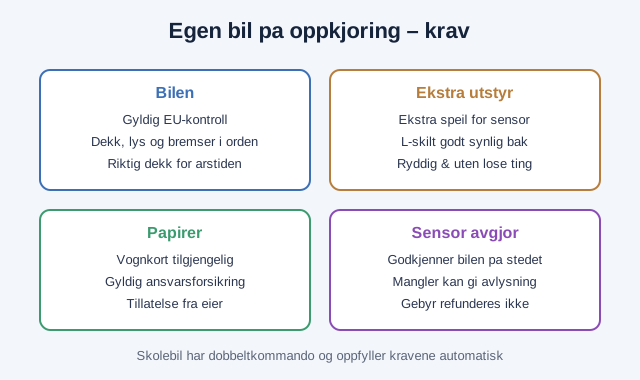
Table of contents
- Is it allowed to use your own car?
- Requirements for the car
- Requirements for extra equipment
- Insurance and documents
- Own car or school car?
Is it allowed to use your own car?
Yes, in principle you can use your own car – or a borrowed one – for the class B driving test, as long as it is a passenger car in the same class as the licence you are taking. The car can be automatic or manual, but remember that automatic gives a restricted licence. If you want to understand this difference before deciding, read more about automatic versus manual transmission .
The most important thing to know is that the examiner has the final say. Even if the car is legally registered and in order, the examiner can refuse to use it if it lacks necessary safety equipment or appears technically unsafe. The test is then cancelled, and the fee is usually not refunded. So it pays to check everything in good time, and ideally clear it with the test centre in advance.
Requirements for the car
The car must be in proper condition and suitable for performing the tasks the examiner asks for, such as reversing, parking and controlled braking. A simple daily vehicle check before driving catches most faults.
| Requirement | What the examiner looks for |
|---|---|
| Valid roadworthiness test and registration | The car is approved and legal on the road |
| Lights and indicators | All working, no bulbs out |
| Tyres and brakes | Sufficient tread depth, even braking |
| Wipers and washer fluid | Good visibility in all conditions |
| Clean windscreen and mirrors | No cracks in the field of view |
| Correct tyres for the season | Winter tyres when the conditions require it |
If you take the test in winter, the car must have proper winter tyres. If you are unsure when to switch, see when to switch to winter tyres .
Requirements for extra equipment
The biggest practical difference between your own car and a school car is the safety equipment. An approved school car has dual controls, meaning extra pedals on the passenger side so the examiner can intervene. An ordinary private car does not have this.
Requirements often placed on a private car for the test:
- An extra mirror for the examiner, so they can follow the traffic behind and to the side.
- An L sign (red L on a white background) clearly visible at the back of the car.
- An extra interior mirror is a minimum requirement at many test centres.
- The car should be tidy and free of loose objects that could be thrown around during braking.
The rules for the extra mirror and sign can vary somewhat between test centres, so call and confirm exactly what is required where you will take the test. A missing mirror is one of the most common reasons a private car is rejected on the spot.
Insurance and documents
The car must have valid liability insurance, and you as the learner must be allowed to drive it. A useful overview of the paperwork is in the article on driving licence, registration card and insurance .
Check this before the test:
- The registration card should be available, ideally in the car.
- The insurance must cover the driver and be valid on the test day.
- If you do not own the car yourself, you must have the owner’s permission to use it.
- Confirm that the insurance has no terms that exclude practice driving or the test.
Remember that you are still considered to be under training right up until the licence is in order. Until the test is passed, you drive according to the rules for practice driving, with an accompanying driver where required.
Own car or school car?
Your own car can save you the cost of renting a school car, but it is not always the smartest move. You may know your own car well, but an unfamiliar school car with dual controls gives extra safety, and the driving school handles all the practical details. The table below sums it up:
| Factor | Own car | School car |
|---|---|---|
| Price | Saves rental | Rental added |
| Familiar vehicle | Yes | No |
| Dual controls | No | Yes |
| Extra mirror/L sign required | You arrange it | Already in place |
| Risk of cancellation | Higher | Lower |
Many choose a school car precisely to avoid the risk of their own car being rejected. If you want to work out the total cost, see what the class B driving test costs and use a driving test checklist so nothing is forgotten. If you wonder how the day itself unfolds, the driving test step by step gives a good picture.
Whether you use your own car or a school car, theory is the foundation. Test yourself with a free theory test and keep practising in the Eteo app, so you are well prepared for the theory test and the driving test.
Next step
Continue with free car questions
Go straight from the article to free car questions and check what actually sticks before you keep reading more theory.
Try for free