Priority road – where does it begin and end?
How a priority road is signed, where it ends and what applies at the junctions.
A priority road is a road where you, as the driver, have right of way over vehicles coming from intersecting roads. This right is not something you keep forever – it begins at a specific sign and lasts until another sign cancels it. Many theory questions are about exactly where the right of way starts, where it ends, and what happens at the junctions in between. Here we cover what you need to know for the class B theory test.
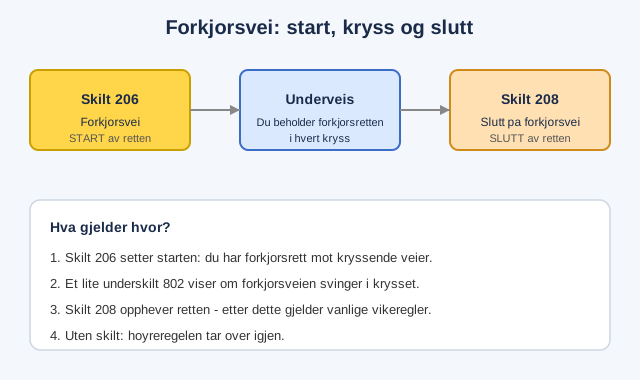
Table of contents
- Where does the priority road begin?
- What applies at the junctions along the way?
- Where does the priority road end?
- Common misunderstandings
- How to remember the rules
Where does the priority road begin?
The priority road begins at sign 206 “Priority road” – a yellow square with a black border, set on its point. From this point you have right of way over traffic coming from the side roads. The drivers on the intersecting roads meet a give-way sign or a stop sign and must wait for you.
It is important to understand that the sign applies only to the road it stands on. If you are on a side road and are about to enter a priority road, you must give way – not the other way around. So the signs tell you who has the right relative to whom. You can read more about this in the article on give-way and priority signs .
Even when you have right of way, it never releases you from the basic rule for all traffic : you must always be attentive and adjust your speed. Right of way is a right, not a duty to drive on regardless.
What applies at the junctions along the way?
When you drive on a priority road, you keep the right of way through every junction until it ends. You normally do not need to brake for traffic from the side roads, because they must give way to you. But the priority road does not always follow a straight line.
Sometimes the priority road turns at a junction. In that case a sub-sign 802 is placed under the sign showing the main direction with a thick line and the side roads with thin lines. If the priority road turns and you intend to follow it, you must watch this sub-sign – because if you continue straight ahead while the priority road bends to the side, you may actually have to give way to traffic on the turning priority road.
| Situation | What happens to the right of way |
|---|---|
| You go straight ahead, ordinary junction | You keep the right of way |
| The priority road turns, you follow it | You keep the right of way (see sub-sign 802) |
| The priority road turns, you go straight ahead | You may have to give way to the turning road |
| You come from a side road onto a priority road | You must give way |
Priority rules at junctions can be complex. If you want to go deeper into how give-way works in practice, see the walkthrough of the give-way rules in detail .
Where does the priority road end?
The priority road ends at sign 208 “End of priority road” – the same yellow square, but with a grey diagonal stripe across it. From this point on you no longer have right of way, and the ordinary give-way rules take over again.
In practice this usually means that the right-hand rule applies: you must give way to traffic coming from the right at the next junctions, unless other signs or road markings say otherwise. The transition from priority road to ordinary road is a classic place to be caught out, because many drivers keep behaving as if they still have the right.
The priority road can also end without its own “end” sign – for example when you reach a roundabout, a traffic-light junction or a junction with its own signing. Then the rules posted right there apply. The markings on the road help you read the situation; see how marking signs and the parts of the road connect to the signing.
Common misunderstandings
- “I’m on a big road, so I have right of way.” Wrong – it is the sign, not the road width, that decides. A wide road without sign 206 is not a priority road.
- “Right of way means I don’t need to look out.” Wrong – you always have a duty of care and must be able to stop for unexpected obstacles.
- “The right of way lasts until I turn off.” It lasts as long as you follow the signed priority road; if it turns, you must follow the sub-sign to keep the right.
- “After the end sign the right of way still applies for a while.” No – the right ends immediately at sign 208.
How to remember the rules
Think of the priority road as a stretch with a clear start and end:
- Sign 206 = the right of way begins.
- Sub-sign 802 = the priority road turns; follow the thick line.
- Sign 208 = the right of way ends; ordinary rules, often the right-hand rule, take over.
The best approach is to practise concrete junction situations until you recognise the signs instantly. Take a free theory test and practise in the Eteo app with questions on priority roads and give-way, so you feel confident when you meet them on the theory test and in real traffic.
Next step
Continue with free car questions
Go straight from the article to free car questions and check what actually sticks before you keep reading more theory.
Try for free