Where exactly should you stop at a stop sign?
How to know exactly where and how long to stop at a stop sign.
A stop sign (sign 204, the red octagonal sign) means you must yield and that you always have to come to a complete halt, whether or not there is any traffic. Slowing to a near-standstill is not enough. But how far forward should you stop, and how long must you wait? Many people fail the theory test precisely because they confuse the stop line, the crosswalk and the point where you actually have enough visibility. Here is the answer.
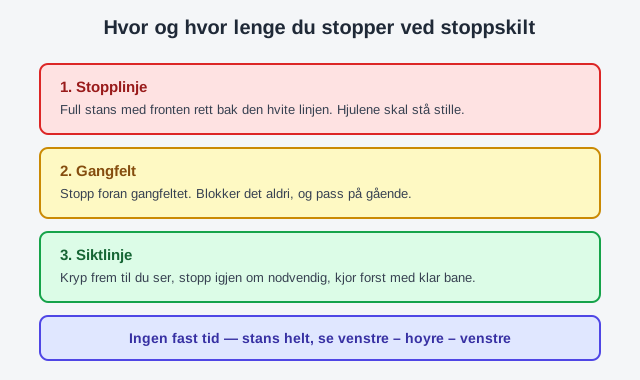
Table of contents
- What the stop sign actually requires
- Where should you stop?
- How long must you wait?
- Stop signs without a painted stop line
- Common mistakes at stop signs
What the stop sign actually requires
The stop sign combines two duties in a single sign:
- A complete stop. The car must be fully stationary. The wheels must not roll. A brief but genuine halt is enough, but it has to be real.
- Yielding. You must yield to all crossing and oncoming traffic, including pedestrians and cyclists. The stop sign therefore imposes a stronger duty than an ordinary yield sign, where you may continue without stopping if the road is clear.
The difference between the two signs is a classic theory topic. For the full comparison, see the article on stop sign versus yield sign . For a deeper walk-through of the yielding duty itself, read about yielding rules in detail .
Where should you stop?
The stopping point depends on what is present at the junction. The rule of thumb is: stop at the first of these markings you reach, then creep forward until you have visibility.
| Situation | Where you stop |
|---|---|
| Painted stop line | With the front of the car just behind the stop line |
| Crosswalk before the junction | In front of the crosswalk, so you do not block it |
| Neither line nor crosswalk | At the edge of the junction, where you can stop safely |
After the first mandatory halt the job is not done. If you cannot see well enough from where you are, you must creep slowly forward to the sight line and stop again if necessary. Never pull out into the junction before you have a full overview of traffic from both sides. Reading the sight lines at a junction is closely tied to this; see safe distance and the three-second rule for how to judge gaps in traffic.
The line itself is part of the road markings. To understand how lines on the asphalt are used, you will find more in the article on road markings and on stop line and bike box .
How long must you wait?
There is no fixed minimum time in seconds. The requirement is that the car genuinely stands completely still for a moment, so that you have time to look properly. In practice this means:
- Stand completely still until the wheels have stopped rolling.
- Look left, right and left again.
- Watch for pedestrians and cyclists who may approach from sidewalks and bike lanes.
- Only drive on when the road is clear and you have full visibility.
So there is no point in counting to three. An examiner is looking for a genuine stop and proper observation, not a set amount of waiting time. On the practical driving test, failing to make a complete stop is a typical fail reason, because it reveals that the driver has not understood the duties at the junction.
Stop signs without a painted stop line
On smaller roads the white stop line is often missing or has worn away. The same duty still applies: you must stop at the edge of the crossing road, where it is natural and safe to stand. Think of an imaginary line continuing the edge of the crossing road.
If visibility is poor because of hedges, snow, parked cars or buildings, you must make an extra short halt further forward once you can see. This matters especially in winter conditions, where plough banks can hide both signs and crossing traffic; read more in the article on winter road maintenance and salt .
Common mistakes at stop signs
The most frequent mistakes are rarely about not knowing you have to stop, but about how and where:
- Rolling stop: the car slows but never fully halts. This is not accepted.
- Stopping too far forward: you stop in the middle of the crosswalk or out in the junction, blocking others.
- Stopping too far back: you halt but have no visibility, then pull out without a second stop at the sight line.
- Forgetting vulnerable road users: you only look for cars and overlook cyclists and pedestrians.
Confusing the stop sign with the yield sign is also common. The difference is explained in detail in the article on stop sign versus yield sign , and you can see how yielding relates to priority signs in yielding and priority signs .
Want to test whether you have stop signs and the rest of the sign rules under control? Take a free theory test and practise regularly in the Eteo app, so you are confident and ready for the theory exam.
Next step
Continue with free car questions
Go straight from the article to free car questions and check what actually sticks before you keep reading more theory.
Try for free