Safe following distance and the three-second rule
How to use the three-second rule for the right distance to the car in front.
A good safe following distance is one of the simplest and most effective ways to avoid rear-end collisions. The distance to the car in front decides how much time you have to react and brake if something unexpected happens. The easiest way to keep enough distance is the three-second rule, which works no matter how fast you drive. In this article you will learn how to measure the gap, why seconds work better than metres, and how much you need to increase the distance in bad weather and on slippery roads.
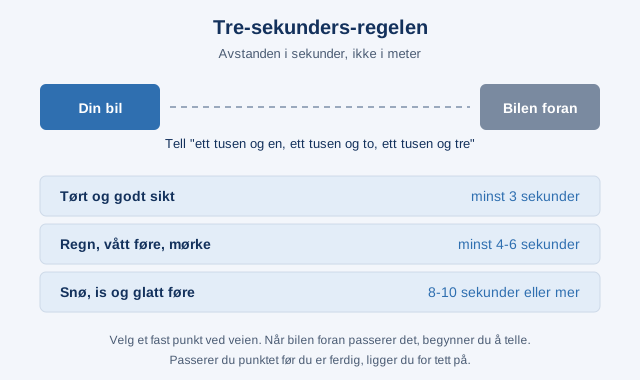
Table of contents
- What is the three-second rule?
- How to measure the distance in practice
- Why seconds beat metres
- When you must increase the distance
- Common mistakes and good habits
What is the three-second rule?
The three-second rule says that at least three seconds should pass from when the car in front passes a fixed point until you pass the same point. Three seconds gives you time to spot a hazard, move your foot to the brake and start braking before you might reach the car in front.
In practice the distance has two parts: the reaction distance (what you travel while perceiving and reacting) and the braking distance (what you travel while the car actually slows down). You can read more about this in the article on reaction time and braking distance . Three seconds normally covers the reaction time with a good margin on a dry road.
How to measure the distance in practice
You do not need to calculate metres while driving. Instead, use a fixed point along the road – a sign, a post, a road marking or a bridge:
- Wait until the car in front passes the point you have chosen.
- Start counting calmly: “one thousand one, one thousand two, one thousand three”.
- If you pass the same point before you finish counting, you are too close. Ease off the accelerator and increase the gap.
- Repeat the measurement now and then, especially when speed or conditions change.
This method is simple, needs no equipment and works at any speed. More about judging speed and distance can be found in the article on speed and distance .
Why seconds beat metres
Many people learn a rule of thumb in metres, but the problem is that the “correct” distance in metres keeps changing with speed. Three seconds, on the other hand, automatically gives a larger gap the faster you drive, because you cover more metres in the same time.
| Speed | Distance over 3 seconds | Approximate gap |
|---|---|---|
| 30 km/h | about 25 metres | short |
| 50 km/h | about 42 metres | urban |
| 80 km/h | about 67 metres | rural road |
| 100 km/h | about 83 metres | motorway |
The table shows how much the distance in metres grows even though the second-rule stays the same. That is why seconds are a more robust way to think than a fixed number of metres. On rural roads at higher speeds this matters especially, which we cover further in the article on rural road driving .
When you must increase the distance
Three seconds is a minimum for good conditions. When visibility, road or vehicle are not optimal, you must add more seconds because the braking distance grows longer and your reaction may come later.
- Rain and wet roads: increase to at least 4-6 seconds. Water reduces grip and can cause aquaplaning.
- Darkness and poor visibility: increase the gap because you spot hazards later.
- Snow and ice: braking distance can become many times longer. Keep 8-10 seconds or more. See how to handle black ice .
- Heavy traffic and queues: short gaps are common here, but then the speed must be low.
- Heavy vehicles and trailers: these need longer distances to stop, so give them extra room.
If you are tired, your reaction time grows longer, and then the distance should be increased further. More about this in the article on fatigue and microsleep .
Common mistakes and good habits
The most common mistakes are “sticking” close to the car in front hoping to get there faster, and forgetting to increase the gap when the weather changes. Both significantly raise the risk of a rear-end collision.
Good habits that help you keep the right distance:
- Ease off the accelerator early instead of braking hard late.
- Look far ahead, not just at the car right in front.
- When someone drives close behind you, increase your distance to the car in front of you – that gives more time for both.
- Always adjust the distance to the worst of visibility, road and driver condition.
This defensive mindset is closely linked to defensive driving as a whole.
Want to test how well you know the rules about distance and safety? Take a free theory test and keep practising in the Eteo app so you are confident and well prepared for the theory test.
Next step
Continue with free car questions
Go straight from the article to free car questions and check what actually sticks before you keep reading more theory.
Try for free