Stop vs give way – the difference between the two signs
The practical difference between the stop sign and the give-way sign and what each requires.
Many people mix up the two most important priority signs in traffic. The crucial difference between the stop sign and the give-way sign is simple: the stop sign requires you to come to a complete halt, while the give-way sign only requires you to yield. Both give you a duty to yield to crossing traffic, but only one forces you to stand completely still. Understand this and you will avoid one of the most common mistakes on the driving test as well as a classic trap on the theory test.
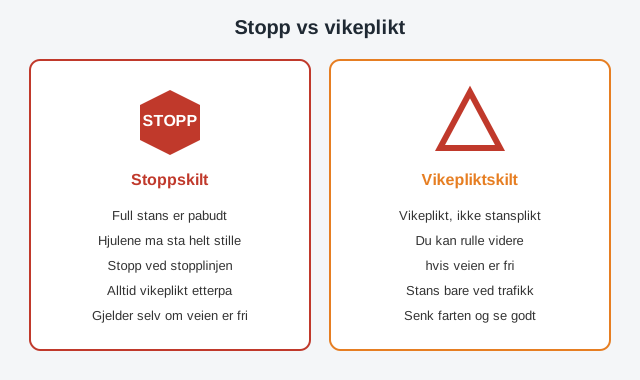
Table of contents
- What do the two signs mean?
- The practical difference
- Where should you stop?
- Common mistakes on the theory and driving tests
- How to practise best
What do the two signs mean?
The stop sign is octagonal and red with the word “STOPP”. It is the only sign in Norway that requires a full stop every single time, whether there is traffic or not. You must stop even if the road is completely clear and you have good visibility.
The give-way sign is a white, downward-pointing triangle with a red border. It gives you a duty to yield to traffic on the crossing road, but it does not require you to stop. If the road is clear, you may roll calmly onward without stopping. Both signs belong to the same family as the other rules you learn in the article on give-way and priority signs .
The practical difference
The table below sums up what you actually need to remember behind the wheel:
| Property | Stop sign | Give-way sign |
|---|---|---|
| Shape | Octagon, red | Triangle pointing down |
| Requirement to stop | Always a full stop | Only when traffic is coming |
| Duty to yield | Yes | Yes |
| Wheels must stand still | Yes | No |
| Applies even when road is clear | Yes | No |
The key point: the duty to yield is the same for both signs. You must always let crossing traffic pass. It is only the requirement to stop that separates them. The stop sign is typically used at junctions with poor visibility where it is hard to assess traffic at speed, while the give-way sign is used where you can usually see well enough to merge into traffic.
Where should you stop?
At a stop sign you must halt at the stop line – the wide, unbroken transverse line on the road. If there is no stop line, you stop just before the crossing carriageway, at a point where you have the best possible visibility. The stop must be real: the wheels have to stand completely still for a moment. Rolling slowly past is not enough.
Follow this order at a stop sign:
- Slow down in good time and select the right gear.
- Come to a full stop at the stop line so the wheels stand still.
- Look both ways and assess crossing and turning traffic.
- Move off only when it is safe, and respect the duty to yield.
At a give-way sign you skip step 2 if the road is clear – but you must still be ready to stop immediately. Road markings help you: a wide continuous line means stop, while a dashed give-way line (“shark’s teeth”) means yield. You can read more about these symbols in the article on road markings and lines . The stopping requirement itself is explained further in the guide on the requirements for the stop at a stop sign .
Common mistakes on the theory and driving tests
On the driving test the classic mistake is the “rolling stop” – slowing down without standing completely still at a stop sign. This counts as a serious error because you are ignoring an absolute requirement. The opposite mistake is stopping unnecessarily at a give-way sign when the road is clear, which disrupts the flow of traffic behind you.
On the theory test these traps often appear:
- Questions testing whether you know that the stop sign always requires a full stop, even when there is no traffic.
- Questions that mix up the shape and the meaning of the two signs.
- Situations at a T-junction where priority must be assessed correctly.
- Tasks about where the priority road starts and ends, which you will find explained in the article on where a priority road starts and ends .
Remember that both signs build on the same basic rule of traffic about considerate and careful driving. If you want to dig deeper into priority and interaction, the article on give-way rules in detail gives a thorough walkthrough.
How to practise best
The best approach is to combine theory with actual junctions you know. Notice which junctions have a stop sign and which have a give-way sign, and practise the stop itself. As your test day approaches, it can also be wise to know how the theory test at the traffic station works in practice.
If you want to test what you actually know, take a free theory test and see how the sign questions are phrased. Practise regularly in the Eteo app so the difference between stop and give way is firmly in place before you show up for the theory test.
Next step
Continue with free car questions
Go straight from the article to free car questions and check what actually sticks before you keep reading more theory.
Try for free