Right of way in a roundabout – who yields to whom
How to handle yielding, lanes and indicators correctly in a roundabout.
Right of way in a roundabout follows one simple rule: if you are entering, you yield to those already driving around. In practice it gets harder when the roundabout has several lanes, when indicators are missing, or when you have to choose the right lane before entering. This article explains who yields to whom, how to use your indicators, and which mistakes are most common on the theory test and in real traffic.
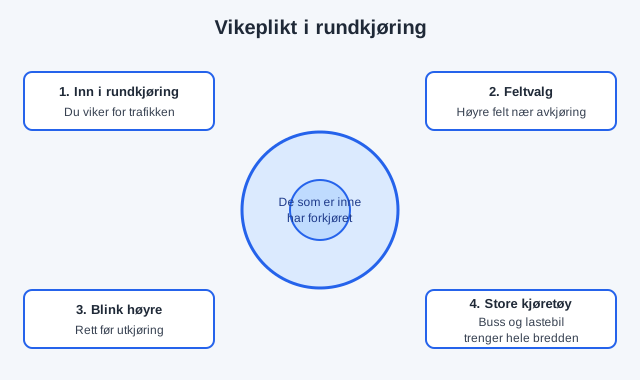
Table of contents
- The basic yielding rule
- Lane choice before and inside the roundabout
- Indicators and interaction
- Multi-lane roundabouts
- Common mistakes
- How to practise
The basic yielding rule
As you approach a roundabout, you must yield to vehicles already inside the circle. This applies whether they come from your left or have driven almost all the way around. The roundabout is normally signed with yield signs at every entry, and the circle itself works as a priority road.
Once inside the roundabout, you have no new duty to yield to those entering. You keep priority all the way until you exit. This keeps the flow smooth as long as everyone respects that those already inside come first.
| Situation | Who must yield | Practical advice |
|---|---|---|
| You are entering the roundabout | You, coming from outside | Wait until the conflict zone is clear all the way |
| You are already inside the circle | The one entering yields to you | Keep a steady speed and lane position |
| Two cars enter from different approaches | Neither yields to the other directly | Relate to the traffic in the circle, not to each other |
Lane choice before and inside the roundabout
Correct lane choice makes yielding easier to handle. The main rule in a multi-lane roundabout is:
- For the first or second exit (straight ahead or right), you normally choose the right lane.
- To go far around (later exits or back the way you came), you normally choose the left lane.
- Always follow any arrows in the carriageway and signs, which may override the main rule.
Position yourself in the correct lane well before entering. That way you avoid having to cross lanes inside the circle, where others may sit in your blind spot. Read more about road markings and lane marking and about driving in a multi-lane roundabout .
Indicators and interaction
Indicators are key to good interaction, but they never give right of way on their own. Use them like this:
- Entering the roundabout: You usually do not need to indicate on entry if going straight ahead, but indicate left if you are going far around.
- Leaving the roundabout: Always indicate right just before the exit you are taking.
- Never rely blindly on others’ indicators. Wait until you see the vehicle actually turning off before you enter.
A clear right indicator before exiting helps those waiting to enter. Remember, though, that you who are inside the circle keep priority until you have left it.
Multi-lane roundabouts
In large roundabouts with two or more lanes the risk of misunderstandings increases. You must watch for cars in the adjacent lane, because they may sit where you cannot see them well. Keep a good safety distance and avoid changing lanes unnecessarily inside the circle.
Large vehicles such as buses and trucks need extra room and may have to use both lanes through the curve. Give them space, and never pull up alongside a large vehicle that is turning. This is often why buses in roundabouts create dangerous situations: they can cover much of the carriageway and have poor sideways visibility.
Common mistakes
- Believing that indicators give the right to enter or exit.
- Choosing the wrong lane and having to cross over inside the circle.
- Forgetting the right indicator before exiting, so others cannot read your intention.
- Entering before the conflict zone is clear all the way around.
- Pulling up alongside a large vehicle that needs the full width.
For a more thorough walkthrough of the rules, see entering a roundabout and who has right of way and right of way and roundabouts . It is also useful to understand how a priority road starts and ends .
How to practise
Right of way in a roundabout is one of the topics that comes up often on the theory test. Practise systematically on both the rules and lane choice, and train on practical driving in a roundabout so that you recognise the situations quickly.
Test yourself with a free theory test and keep practising in the Eteo app, so you are confident and well prepared for the class B theory test.
Next step
Continue with free car questions
Go straight from the article to free car questions and check what actually sticks before you keep reading more theory.
Try for free