Give way to the right – examples and exceptions
How the right-hand rule works in practice, with concrete intersection examples and exceptions.
Give way to the right, often called the right-hand rule, is one of the most fundamental rules in Norwegian traffic. It states that you must give way to traffic coming from your right when you approach an equal intersection without signs or traffic lights. The rule sounds simple, but on the class B theory test it is precisely the exceptions and misconceptions that trip many people up. In this article we go through when the rule applies, when it does not, and how to think correctly at the intersection.
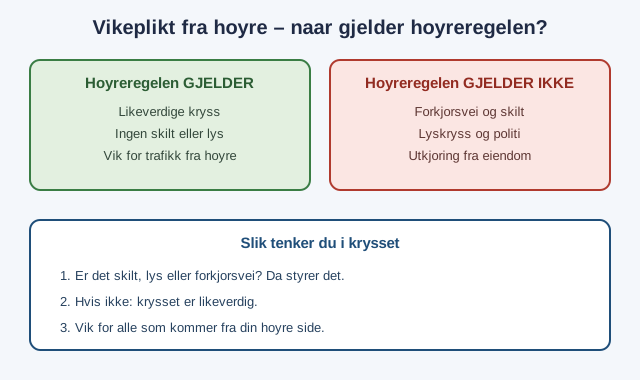
Table of contents
- What the right-hand rule actually says
- When the right-hand rule applies
- When the right-hand rule does not apply
- Concrete intersection examples
- Common misconceptions on the theory test
What the right-hand rule actually says
The right-hand rule is a default rule that takes effect when nothing else regulates the intersection. The key point is that at an equal intersection – meaning one where no road is a priority road and there are no signs or traffic lights – you must give way to whoever comes from your right.
Giving way does not mean you always have to stop. It means you must adjust your speed and be ready to stop, so that the road user you must yield to does not have to brake, swerve or change speed because of you. You can read more about this in the article on the basic rule of traffic , which underpins all interaction on the road.
When the right-hand rule applies
The right-hand rule applies only when the intersection is equal. In practice this means:
- There is no priority road through the intersection.
- There are no give-way signs or stop signs that regulate who must yield.
- There are no traffic lights in operation and no officer or police directing traffic.
- The roads are of comparable type, so that neither is clearly superior.
When all of these conditions are met, you give way to everyone coming from your right – including cyclists and moped riders in the same carriageway. This applies regardless of how large or small the crossing road appears, as long as it is not an exit from a property.
When the right-hand rule does not apply
Most mistakes involve applying the right-hand rule in situations where something else actually governs. The table below shows the most common exceptions.
| Situation | What applies instead |
|---|---|
| You are driving on a priority road | Crossing traffic must give way to you |
| There is a give-way sign facing you | You must give way regardless of direction |
| There is a stop sign facing you | You must come to a full stop and then yield |
| The intersection has traffic lights | The light decides, not the right-hand rule |
| You are exiting a car park, yard or private road | You must give way to all traffic on the road |
| You are turning and crossing a pedestrian or cycle crossing | You give way to pedestrians and cyclists |
| Traffic in a roundabout | Separate rules, often give way on entry |
An important point: when exiting a property the right-hand rule does not apply at all. In that case you must always give way to the traffic on the road you are entering, no matter which side they come from. This is explained thoroughly in exiting a private road and car park and in the article on the right-hand rule in a car park .
Concrete intersection examples
Let us look at some typical situations as they might appear both in traffic and on the test.
- Equal four-way intersection without signs: You are driving straight ahead. A car approaches from the right. You must give way and let it through.
- T-junction without signs: Even if you are driving on the “continuous” arm, the right-hand rule applies if no road is a priority road. If someone comes from the right, you yield. More on this in giving way at a T-junction .
- Priority road: You are driving on a road marked with priority road signs. Then the car from the right must give way to you, not the other way around. The signs are explained in give-way and priority road signs .
- You are turning right into the intersection: You must still give way to crossing traffic from the right and to vulnerable road users you cross. See also driving to the right in intersections .
For a complete walkthrough of all the give-way situations, we recommend give-way rules in detail .
Common misconceptions on the theory test
Many answer incorrectly because they think a wider or busier road is automatically a priority road. It is not the size of the road that decides, but whether it is actually signed as a priority road. A narrow gravel road and a wide asphalt road can be entirely equal in the eyes of the law.
Another classic is forgetting that the right-hand rule also applies towards cyclists. If a cyclist comes from the right at an equal intersection, you must give way just as you would for a car.
Also remember the difference between giving way and a stop obligation: a stop sign requires you to come to a full stop, while the right-hand rule and an ordinary give-way sign only require you to adapt and yield. When visibility is reduced in a tunnel or speed is high, it can also relate to hazards covered in tunnel vision and high speed .
Want to practise exactly these kinds of questions? Take a free theory test and keep training in the Eteo app until you are confident with both the right-hand rule and its exceptions before the class B theory test.
Next step
Continue with free car questions
Go straight from the article to free car questions and check what actually sticks before you keep reading more theory.
Try for free