Right of way at a T-junction – who goes first?
How to determine right of way at a T-junction based on signs, markings and road type.
A T-junction is a road junction where one road ends at another, so that the three arms form a T. Many believe that right of way at a T-junction always follows the give-way-to-the-right rule, but that is not true. Who goes first is decided by a fixed order: first signs and traffic lights, then road markings, and finally – if nothing else applies – the right-hand rule. Here we go through how to read a T-junction correctly, so you are confident both on the road and for the class B theory test.
Contents
- The order that decides right of way
- When the right-hand rule applies at a T-junction
- When signs or markings override it
- The classic T-junction trap
- Step-by-step examples
The order that decides right of way
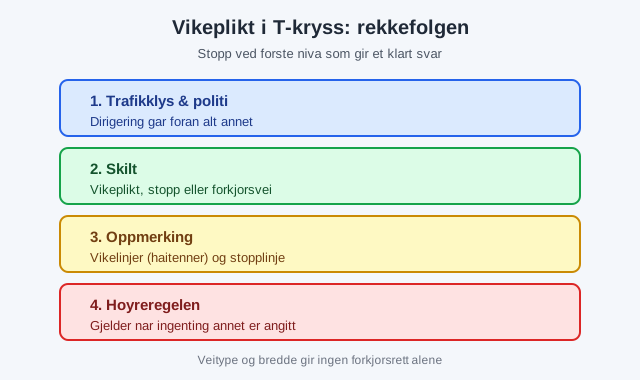
At a T-junction you always assess who must yield in a fixed order. You stop at the first level that gives a clear answer:
- Traffic lights and police – direction takes precedence over everything else.
- Signs – give-way signs, stop signs or priority-road signs.
- Markings – give-way lines (shark’s teeth) or stop lines in the road.
- The right-hand rule – the default rule that applies when nothing else is specified.
This is exactly the same principle as at any other junction. For a thorough walk-through of the system itself, see the give-way rules in detail .
When the right-hand rule applies at a T-junction
Many T-junctions have no signs and no markings. Then the right-hand rule applies: you must yield to traffic coming from your right. This is the main rule in built-up areas on equal, minor roads with no priority regulation.
An important point: at a T-junction there is often not traffic from both sides for everyone. The driver turning out from the “stem” of the T (the side road) typically faces traffic from the left along the main road, but still has to yield if someone comes from the right. Read more about how this works in practice with examples of give way to the right .
When signs or markings override it
As soon as there are signs or markings, the right-hand rule is set aside. The most common cases at a T-junction:
| What you meet | What it means | What you do |
|---|---|---|
| Give-way sign (triangle pointing down) | You must yield to crossing traffic | Adjust speed, yield, drive when clear |
| Stop sign | Yielding and a full stop are mandatory | Stop completely at the stop line, yield, drive |
| Priority-road sign | You are on a priority road | Others yield to you, but stay alert |
| Give-way line (shark’s teeth) | Yielding marked in the road | Yield even without a sign |
It is important to know the difference between the two most common signs: see stop sign vs. give-way sign . How the markings in the road itself are read is found under road markings and in the overview of give-way and priority signs .
The classic T-junction trap
The most common mistake is to assume that a wide, through road is automatically a priority road. Road type and width give no priority by themselves – it must be signed or marked. If there are no signs, the right-hand rule applies, even if one road is clearly the “main road”.
The second trap concerns the left turn. If you turn left at a T-junction, you cross the oncoming lane and must yield to oncoming traffic in addition to any duty from signs or the right-hand rule. This requires extra planning – read more about left turns at busy junctions .
Remember too that right of way does not only concern cars. You must always consider vulnerable road users and keep good distance. The basis for all of this is the basic rule of traffic .
Step-by-step examples
Example 1 – unregulated T-junction: You come along the main road and a car comes from the side road to your right. No signs. The right-hand rule applies: you must yield to the car from the right.
Example 2 – T-junction with a give-way sign on the side road: You drive on the main road. The car on the side road has a give-way sign. It yields to you, no matter which side it comes from.
Example 3 – T-junction with a stop sign: You are on the side road with a stop sign. You must come to a full stop at the stop line, then yield to all traffic on the main road before pulling out.
How to read a T-junction safely:
- Look for traffic lights and direction first.
- Look for signs on your own and the crossing roads.
- Check the markings in the road.
- Use the right-hand rule only when nothing else applies.
Want to test that you have understood right of way at different junctions? Practise with a free theory test and keep training in the Eteo app until you are confident with the rules and ready for the theory test.
Next step
Continue with free car questions
Go straight from the article to free car questions and check what actually sticks before you keep reading more theory.
Try for free