Giving Way to Rail Vehicles – Trams, Trains and Light Rail
When and why you must give way to trams, light rail and trains in traffic.
Giving way to rail vehicles is a basic rule you need to know for the theory test and in everyday driving. Trams, light rail and trains can neither steer aside nor brake as quickly as a car, so as a rule they have right of way wherever road and track meet. Once you understand why the rule exists, acting correctly becomes simple.
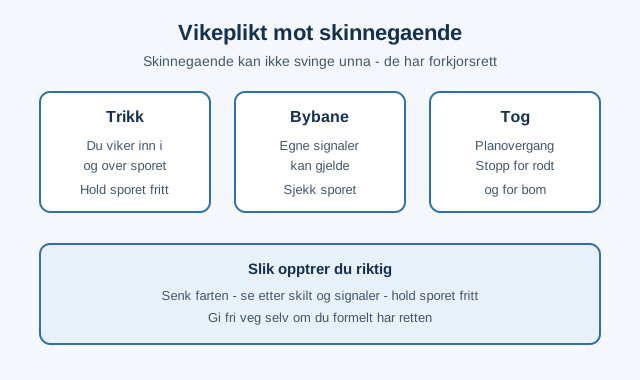
Table of contents
- Why rail vehicles have right of way
- Trams and light rail in city traffic
- Trains and level crossings
- How to act correctly
- Common mistakes and misunderstandings
Why rail vehicles have right of way
A rail vehicle is bound to the track. It cannot steer around an obstacle, and its braking distance is many times longer than that of a passenger car because of its great weight and the low friction between steel wheel and rail. A full train may need several hundred metres to stop. For these reasons the main rule is that you as a driver must give way to trams, light rail and trains.
The rule applies even when you would otherwise have right of way. If, for example, you approach from the right at an intersection but a tram is crossing, you must still wait. The physical reality – that rail vehicles cannot give way – is the foundation of the rule.
| Vehicle | Can steer aside | Typical braking distance | Your duty |
|---|---|---|---|
| Tram / light rail | No | Long | Give way and keep the track clear |
| Train | No | Very long | Give way, never pull out in front |
| Passenger car | Yes | Short | Adapt to rail vehicles |
Trams and light rail in city traffic
In cities, trams and light rail often share lanes or intersections with cars. Key points:
- You must give way when driving into or across the track, for example when turning or changing lane.
- Never stop with your wheels on the rails in an intersection or in a queue – you may block an approaching tram.
- The tram may have its own signals (white A-signals) that apply to it, while you follow the normal traffic lights. Even on green, check that the track is clear.
- At stops, passengers may cross the road right in front of or behind the tram.
For more on signals, stops and interaction, see the article on trams in traffic . When passing a tram that has stopped, special considerations apply, described in passing buses and trams in the city .
Trains and level crossings
A level crossing is where a road and railway cross at the same level. The train always has right of way, and a collision with a train almost always ends seriously. The rules are therefore strict:
- Slow down and be ready to stop in good time.
- Stop for a red flashing light or when the barriers come down – never try to beat them.
- Never drive onto the crossing unless you are sure you can get all the way across.
- If you are in a queue, wait until there is room on the other side before pulling out.
- If you see or hear a train, wait – distance and speed are hard to judge.
Many level crossings are unprotected, meaning they have no barrier or light signal. Then the entire responsibility rests on you. Read more about the practical execution in level crossing – safe crossing .
How to act correctly
Think ahead every time you approach tracks:
- Look for signs and signals that warn of trams, light rail or railway.
- Reduce your speed so you can stop if something approaches.
- Keep the track clear – never pull out where you might end up stranded.
- Give rail vehicles a clear path even when you formally have right of way, because they cannot give way.
Giving way to rail vehicles is one of several basic rules. It connects with the other give-way rules in detail .
Common mistakes and misunderstandings
| Misunderstanding | Correct understanding |
|---|---|
| I came from the right, so I have priority over the tram | Rail vehicles usually have right of way regardless |
| The light is green, so the track is safe | Always check that the tram has actually stopped |
| The barrier is coming down, I can make it | You should never pull out – wait for the next passing |
| I can stop in the intersection on the tracks | Never stop on the track, you block the tram |
Extra vigilance is needed at intersections where track and road merge, and where you must weigh the ordinary rules such as entering a roundabout and who must give way .
If you want to practise exactly this kind of question, take a free theory test and keep training in the Eteo app until you are confident and ready for the theory test.
Next step
Continue with free car questions
Go straight from the article to free car questions and check what actually sticks before you keep reading more theory.
Try for free