Right of way at road narrowings and narrow roads
Who must yield when the road narrows or an obstacle blocks your lane.
On narrow roads and where the carriageway suddenly narrows, many uncertain situations arise. Right of way at a road narrowing is about who must stop and let oncoming traffic through when there is not room for two vehicles side by side. The rules depend on whether the narrowing is signed or not, and on whether there is an obstacle in your own lane. Below we go through the practical rules, the signs and how to interact safely and politely.
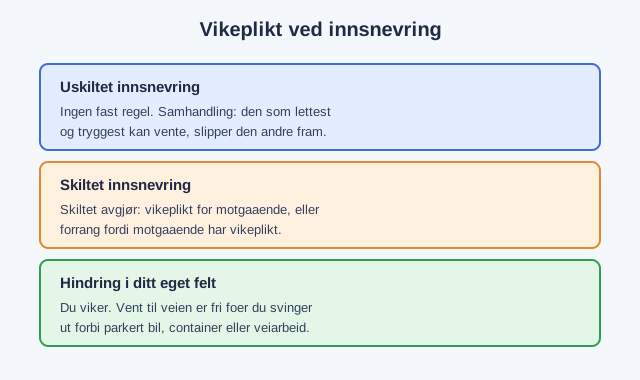
Table of contents
- The main rule at a narrowing
- When it is signed
- An obstacle in your own lane
- Narrow roads without passing places
- Interaction and practical advice
The main rule at a narrowing
When a road narrows so that there is room for only one vehicle at a time, road users must adapt to one another. The starting point builds on the basic rule of traffic: show consideration, be attentive and careful, and behave so that no danger or harm arises. This means that whoever can stop or wait most easily and safely should do so, even if no one formally has to yield.
If the narrowing is not signed, there is no automatic give-way-to-the-right rule or other fixed rule that decides who has priority through the narrowing itself. Interaction then applies: whoever is closest to the narrow section, or who has the best room to wait, gives the other priority. You can read more about the general principles in the article on the basic rule of traffic and in the detailed review of the right-of-way rules .
When it is signed
Many narrowings are regulated with signs, and then the answer is clear. There are two opposite signs you must know the difference between:
| Sign | Meaning | Who yields |
|---|---|---|
| Give way to oncoming traffic | You must yield and must wait | You, before the narrowing |
| Oncoming traffic must give way | You have priority through the narrowing | The driver meeting you |
These signs are placed on each side of the narrowing, so that it is always clear who should let the other through. If you face the sign “give way to oncoming traffic”, you must stop in good time and let oncoming traffic pass the narrow section before you continue. If, on the other hand, you face the sign that gives you priority, you may drive, but you still have a duty of care if a driver on the other side has already begun to pass.
Narrowings are often also warned with danger signs for a narrowed road, so that you have time to slow down.
An obstacle in your own lane
A common situation is that something blocks your lane - a parked car, road works, a container or a refuse truck. To get past it you must cross into the oncoming lane. A clear main rule then applies:
- Whoever has the obstacle in their own lane must give way to oncoming traffic.
- You must wait until the road is clear, and only then move out past the obstacle.
- Oncoming traffic has priority because they are driving in their own, free lane.
This is logical: you are asking to use part of the carriageway that belongs to the other direction. The same principle also applies when you pass obstacles in narrow residential streets , where parked cars often force you to swap sides. Think of it the same way as when you cross into another driver’s lane - whoever crosses into another’s path yields.
Narrow roads without passing places
On narrow gravel and mountain roads there is often no room to pass except at dedicated passing places. Here are some practical driving rules:
- Plan ahead: look far ahead and judge where the next passing place is.
- Whoever has the passing place nearest on their side usually pulls into it and waits.
- If the passing place is only on the left side in your direction, it may be safest to stop by it and let oncoming traffic pass.
- On steep stretches you often let the driver going uphill through, since it is harder to set off again on an incline.
- Use eye contact, a flash of the lights or a calm hand gesture to clarify who goes first.
Learn more about the technique by reading how to pull into and wait at a passing place .
Interaction and practical advice
Even when the rules are clear, it is good interaction that makes narrowings safe. Slow down in good time, show clearly through your driving what you intend to do, and do not force your way through just because you “have the right”. A driver who is already inside the narrow section should be allowed to finish even if you formally have priority. Also keep a good eye on vulnerable road users, who can appear between parked cars.
Remember the difference between an unsigned and a signed narrowing, and that an obstacle in your own lane always means you must yield. These situations come up often on the class B theory test. If you want to practise exactly these questions, take a free theory test and keep training in the Eteo app until you feel confident and ready for the theory test.
Next step
Continue with free car questions
Go straight from the article to free car questions and check what actually sticks before you keep reading more theory.
Try for free