Right of way when you turn onto a road with traffic
The give-way rules for when you turn onto a road that already has traffic.
When you turn onto a road that already has traffic, the main rule is simple: the traffic already driving on the road you are turning into usually has the right of way. As the driver who is turning, you must judge both the speed and the distance of the other vehicles before you complete the manoeuvre. This applies whether you come from a side road, a driveway or are changing roads in a junction, and it is a topic that comes up often on the theory test.
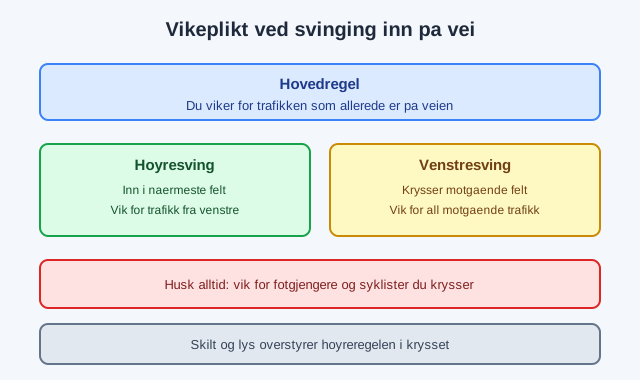
Table of contents
- The main rule when turning
- Right turns onto a road
- Left turns and crossing the oncoming lane
- When signs change the picture
- Common mistakes and how to practise
The main rule when turning
A driver who turns onto a road must normally give way to the traffic that is already on the road. This means you should not force your way into a gap or expect others to brake for you. You must wait until it is safe enough to turn in without hindering or disturbing the through traffic.
This is closely tied to the basic rule for all traffic , which requires you to act considerately, attentively and cautiously. Even when you formally have the right of way, you must never drive in a way that creates danger. For a deeper look at how the rules are ranked against each other, see give-way rules in detail .
Right turns onto a road
When making a right turn you turn into the nearest lane and cross no oncoming traffic. The manoeuvre is therefore simpler, but you must still give way to vehicles already coming along the road from the left, and to vulnerable road users in the pedestrian and cycle crossings you pass over.
Think through the order before you turn:
- Check mirrors and blind spot, and position yourself correctly in the lane in good time.
- Use your indicator so others understand what you intend to do.
- Reduce speed and look for vehicles coming on the road you are entering.
- Give way to pedestrians and cyclists crossing the junction.
- Complete the turn smoothly, without blocking the lane you are leaving.
You can read more about positioning and technique in the article on driving right in a junction .
Left turns and crossing the oncoming lane
A left turn is more demanding because you must cross the oncoming lane before you reach the road. You then have to give way to all oncoming traffic, in addition to the traffic in the lane you are entering and any crossing vulnerable road users. This is one of the situations where many drivers misjudge speed and distance.
Wait for a gap that is large enough to clear without forcing oncoming vehicles to brake. If you are waiting in the middle of the junction, keep your front wheels pointing straight ahead until you actually turn, so that a rear-end collision does not push you into the oncoming lane. Read more in the article on left turns at a busy junction .
| Manoeuvre | Who you must give way to |
|---|---|
| Right turn from a side road | Traffic on the road from the left, vulnerable road users you cross |
| Left turn from a side road | Oncoming traffic, traffic in the lane you enter, vulnerable road users |
| Exiting from a driveway/garage | All traffic on the road and the pavement you cross |
| Turning over a pavement or cycle path | Pedestrians and cyclists first |
If you are exiting from a private driveway or crossing a pavement, you have a particularly strict duty to give way. This is explained further in giving way when exiting across a pavement .
When signs change the picture
In an ordinary junction without signs or lights, the right-hand rule applies: the driver coming from the right has the right of way. But when you turn in from a side road that has a give-way sign or stop sign, you must give way to all crossing and oncoming traffic regardless of which side it comes from.
- With a give-way sign (inverted triangle), you must give way, but you do not need to stop completely if it is clear.
- With a stop sign, you must always stop fully before you turn in.
- If you turn in from a side road onto a priority road, all traffic on the priority road has the right of way.
To see how the various signs are ranked against the right-hand rule, read about right of way at a T-junction . Remember that the right-hand rule can also apply against you when you yourself are turning; see examples in give way to the right .
Common mistakes and how to practise
The typical mistakes are underestimating the speed of an oncoming car, rolling out into the junction too early, and forgetting vulnerable road users in the crossing. A good rule is to rather wait for one more gap than to force a manoeuvre that makes others brake hard.
If you want to test whether you have a handle on giving way when turning, you can practise with our free theory test . By training regularly in the Eteo app, you become confident with exactly these situations and well prepared for the theory test.
Next step
Continue with free car questions
Go straight from the article to free car questions and check what actually sticks before you keep reading more theory.
Try for free