Giving Way When Crossing a Pavement or Footpath
The rules for giving way when you cross a pavement or footpath as you drive out.
When you are about to drive out from a property, a car park or a pedestrian-street area and your route crosses a pavement or footpath, one basic rule applies: you must always give way when crossing a pavement. That means you have to wait for pedestrians, cyclists and all other traffic – not the other way around. This topic comes up often in the theory test, and it is one of the most common situations where beginners make mistakes in practice.
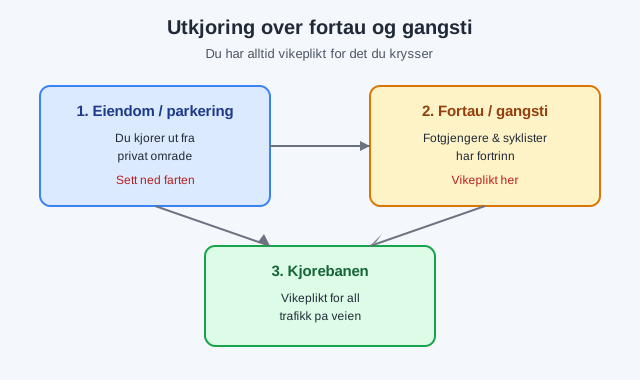
Table of contents
- Why you always give way over a pavement
- What counts as “exiting a property”?
- Giving way in pedestrian streets and home zones
- How to cross the pavement safely
- Common misunderstandings
Why you always give way over a pavement
A pavement and a footpath are first and foremost for people on foot. When you as a driver have to cross such an area to reach the carriageway, you are the one “entering” a situation where others already have their natural place. That is why the traffic rules say that you must give way to both pedestrians and cyclists moving along or across the pavement.
The key thing to understand is that this is not a duty that only applies when there is a sign. It follows directly from the fact that you are crossing an area meant for vulnerable road users. So even without any signs, you must give way. This differs from an ordinary road junction, where priority is often decided by signs or the give-way rules .
Once you have crossed the pavement, you must also give way to the traffic in the carriageway itself. So you often face two give-way situations right after each other: first the pedestrians, then the vehicles. Read more about how this fits together in the article on exiting a private road and car park .
What counts as “exiting a property”?
The term is broader than many people think. It is not just a private driveway. The following situations all count as driving out where you cross a pavement or pedestrian area:
- You drive out from a garage or private driveway.
- You leave a car park or parking garage onto the street.
- You drive out from a petrol station or a retail area.
- You leave a courtyard, a construction site or a property.
What they all have in common is that you are moving from an area that is not an ordinary road, out into traffic. The table below shows who you must give way to in each case.
| Situation | You give way to | Do you cross a pavement? |
|---|---|---|
| Out of a private driveway | Pedestrians, cyclists, drivers | Usually yes |
| Out of a car park | Pedestrians, cyclists, drivers | Often |
| Out of a petrol station | Pedestrians, cyclists, drivers | Often |
| Out of a pedestrian street/home zone | Everyone, especially pedestrians | Yes, the whole area is “walking space” |
For driving out from a larger area with heavy pedestrian traffic, see the article on exiting a petrol station and retail area .
Giving way in pedestrian streets and home zones
In a pedestrian street or a home zone, pedestrians take priority over all vehicle traffic. Where driving is permitted at all, you must keep a very low speed and constantly give way to people on foot. When you leave such an area and cross a pavement to reach an ordinary road, you therefore have a double reason to be careful: both because you are leaving a walking space, and because you are crossing the pavement.
The same applies over a pedestrian crossing located right next to your exit. You must never push out in front of people about to step into the crossing. You can read more about this in the article on pedestrian crossings and giving way .
How to cross the pavement safely
The technique itself is just as important as the rule. As you approach the pavement:
- Reduce your speed before you reach the kerb, so you can come to a complete stop.
- Look carefully both ways – pedestrians and cyclists can appear quickly from either direction.
- Pay special attention to cyclists on the pavement or cycle path, who often travel faster than people walking.
- Stop completely before the pavement if visibility is poor due to hedges, parked cars or buildings.
- Only move out into the carriageway once you have made sure both the pavement and the road are clear.
It is often wise to split the manoeuvre in two: stop first to let the pedestrians pass, then find a gap in the vehicle traffic. The difference between the various parts of the road – pavement, footpath and carriageway – is explained further in the article on the parts of the road .
Common misunderstandings
Many people think the duty to give way only applies to pedestrians, but it also applies to cyclists and other drivers on the road you are joining. Another common mistake is believing you have right of way if there is no sign. When crossing a pavement on your way out, it is always you who must give way, regardless of any signs.
For more practice on giving way in situations where direction decides priority, you can read about giving way when turning into a road and about how important a good safety distance is when you merge into traffic.
Want to test how well you know the rules? Take a free theory test and keep practising in the Eteo app, so you are well prepared for the theory test.
Next step
Continue with free car questions
Go straight from the article to free car questions and check what actually sticks before you keep reading more theory.
Try for free