Warning Signs for Children, Pedestrians and Cyclists
How to read warning signs for children, pedestrians and cyclists and drive safely.
Warning signs for children, pedestrians and cyclists are among the most important alert signs you meet in class B. They are placed where vulnerable road users move close to the roadway, and they require you to slow down and be prepared for the unexpected. What these signs share is the red triangle with a black symbol on a white background, warning of a hazard a little further ahead. Reading them correctly is not only about knowing what the symbol means, but about how you adapt your driving.
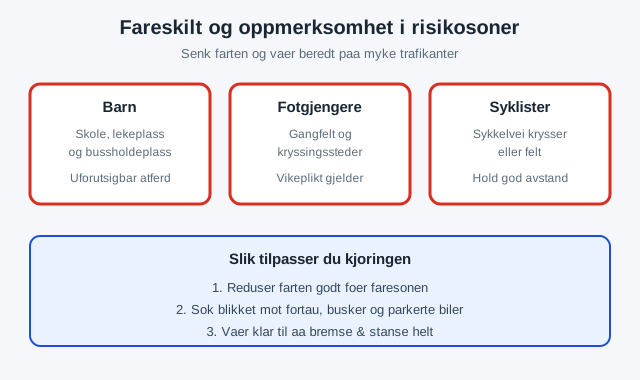
Table of contents
- The children sign
- The pedestrian crossing sign
- The cyclist sign
- How to adjust speed and attention
- Common pitfalls on the theory test
The children sign
The warning sign showing two walking children alerts you to places where children often gather or cross the road. It is typically placed near schools, kindergartens, playgrounds and bus stops. Children are unpredictable road users: they have limited overview, short reaction time and may run into the road without looking. A child chasing a ball rarely notices your car in time.
When you see this sign, assume that someone might appear from behind parked cars, bushes or a bus stop. Slow down noticeably, cover the brake, and be especially attentive around the start and end of the school day. You can read more about driving safely in school routes and school zones .
The pedestrian crossing sign
The warning sign showing a walking person alerts you to a pedestrian crossing or a place where pedestrians often cross the road. Do not confuse it with the blue, square information sign that marks the crossing itself. The warning sign stands some distance before it, preparing you for an approaching crossing point.
As a driver you must give way to pedestrians who are in or about to enter the crossing. This means you have to regulate your speed so that you can stop completely if necessary. Be aware that a pedestrian may be hidden behind a queue, a bus or another vehicle. The rules for who must give way are explained in the article on pedestrian crossings and giving way .
The cyclist sign
The warning sign showing a cyclist alerts you to places where cyclists cross or move close to the carriageway, for example where a cycle path meets the road. Cyclists often travel faster than pedestrians and can arrive from the side more quickly than you expect. They are also easy to overlook, especially in darkness or poor visibility.
As you approach such a zone, be ready to give way and keep a good lateral distance. Overtaking cyclists has its own requirements of care, which you find in the article on overtaking cyclists . A good deal of the risk comes down to how well you actually see vulnerable road users, which you can read about in the article on the sense of sight in traffic .
How to adjust speed and attention
What all these warning signs have in common is that they require caution and a lower, steadier speed. The table below sums up what each sign warns of and what you should do:
| Warning sign | Warns of | Action by driver |
|---|---|---|
| Children | School, playground, bus stop | Slow down, cover the brake, expect unexpected behaviour |
| Pedestrian crossing | Crossing point for those on foot | Be ready to give way and stop completely |
| Cyclists | Crossing or nearby cycle traffic | Keep a good distance, be ready to give way |
A simple rule of thumb in risk zones:
- Reduce speed well before you reach the hazard zone, not in it.
- Actively scan towards pavements, bushes, parked cars and stops.
- Be physically ready to brake and stop completely.
- Expect the unexpected, especially from children.
Adequate speed adaptation also gives you the necessary safety distance to react in time.
Common pitfalls on the theory test
On the theory test, these warning signs are often mixed up with other sign types. A common question is the difference between the warning sign (red triangle, alerts) and the information sign (blue square, marks the crossing itself). Remember that warning signs never impose a specific action the way prohibitory signs do, but they raise the demand for caution. You find a thorough overview of the categories in the article on warning signs .
It also helps to understand how different road users have different needs, the topic of road user groups and consideration . If you want to know how many questions the test has and the pass threshold, read about the number of questions and pass mark .
The best preparation is practising on realistic questions. Take a free theory test and keep practising in the Eteo app, so you are well prepared for the theory test.
Next step
Continue with free car questions
Go straight from the article to free car questions and check what actually sticks before you keep reading more theory.
Try for free