Warning signs for bends and dangerous curves
How to read the warning signs for bends and adjust your speed and road position.
Warning signs for a dangerous bend alert you to a curve, or a stretch of road with several curves, where you need to slow down and adjust your road position well in advance. Like all Norwegian warning signs, they are triangular with a red border and a yellow background, and they are among the most common signs you meet on rural roads and in hilly terrain. Understanding the difference between the various bend signs is a topic that often comes up on the class B theory test.
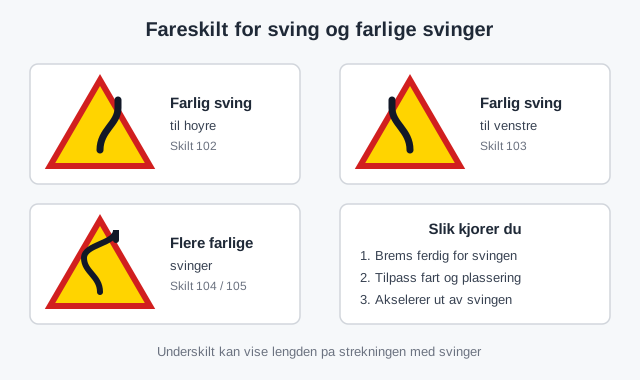
Table of contents
- The different bend signs
- What the sign actually tells you
- How to adjust speed and position
- Common misreadings
The different bend signs
There are several variants of the bend warning sign, and they differ in the direction of the bend and the number of bends. A warning sign for a dangerous bend can show a single curve or a series of curves one after another. The symbol on the sign points in the direction the first bend goes, so a sign that curves to the right means the road bends to the right.
| Sign | Meaning | When you meet it |
|---|---|---|
| 102 Dangerous bend (right) | Sharp or blind curve to the right | Single bend that requires speed adjustment |
| 103 Dangerous bend (left) | Sharp or blind curve to the left | Single bend that requires speed adjustment |
| 104 Dangerous bends (first to the right) | Two or more successive bends | Winding stretch, often in terrain |
| 105 Dangerous bends (first to the left) | Two or more successive bends | Winding stretch, often in terrain |
For successive bends there may be a supplementary plate below the warning sign stating how long the winding stretch is, for example 2 km. Then you know you have to keep a low and steady speed over a longer section, not just through a single curve.
What the sign actually tells you
A warning sign is placed where the bend is sharper or more obscured than the driver would otherwise expect from the road. The sign is therefore a warning that you need to be extra alert here, reduce speed and be prepared for what might come out of the curve: oncoming vehicles, pedestrians, animals or a sudden narrowing.
It is important to remember that the sign does not state a specific speed limit. You must judge the right speed yourself based on how tight the bend is, visibility, road conditions and the characteristics of your vehicle. If a lower speed than the normal one applies, there will be a separate speed limit sign in addition. The bend warning sign is part of the family of warning signs that all warn about conditions you must take into account.
How to adjust speed and position
Good cornering technique is about doing the work before you are in the curve. When you see the sign, you should follow a simple sequence:
- Finish braking before the bend. Get the speed down while the car is still travelling straight, so you have good grip when you steer in.
- Position yourself correctly in the lane. In a right-hand bend you can move slightly towards the centre for better visibility, but never over the centre line. In a left-hand bend you keep well to the right.
- Maintain steady throttle through the curve. Avoid braking in the middle of the bend; it makes the car unstable and can cause you to run off the road.
- Accelerate gently out of the bend once you see the road straightening and the view is clear.
For successive bends you repeat this pattern, but generally keep a lower and steadier speed because you rarely get a good view between the curves. You can read more in the article on cornering technique and throttle control , and about how to handle the most demanding bends in mountain road driving and hairpin bends .
Remember also that a slippery road surface increases the danger in a bend. On exposed stretches you must therefore expect a much longer stopping distance and build in an even larger margin in your speed.
Common misreadings
- The sign does not mean you have to stop. It is a warning, not an order to halt.
- The direction of the symbol matters. A sign that curves to the left warns of a left bend first, not a right one.
- Low speed often has to be kept longer than the bend itself. Especially on rural roads, an oncoming car or a narrowing may appear right after the curve, so keep your following distance up.
On open rural roads, bend signs are often combined with high speed, and then it is extra important to keep a good following distance and use the three-second rule . Read more about how to read the road ahead in the article on rural road driving . After a winding stretch there is often an end of speed limit sign once conditions become clear again.
Want to practise how bend signs and other warning signs appear in the exam setting? Take a free theory test and keep training in the Eteo app until you are confident and ready for the theory test.
Next step
Continue with free car questions
Go straight from the article to free car questions and check what actually sticks before you keep reading more theory.
Try for free