No entry and no motor vehicles signs
The difference between no entry and no motor vehicles, and what applies.
No entry and no motor vehicles are two of the most common prohibitory signs you meet in traffic, and they are easily confused. Both are round signs with a red border, but they regulate different things: one bans driving into a particular direction, the other bans a particular type of vehicle. If you are preparing for the class B theory test, it is important to tell them apart and understand how supplementary plates change what they say.
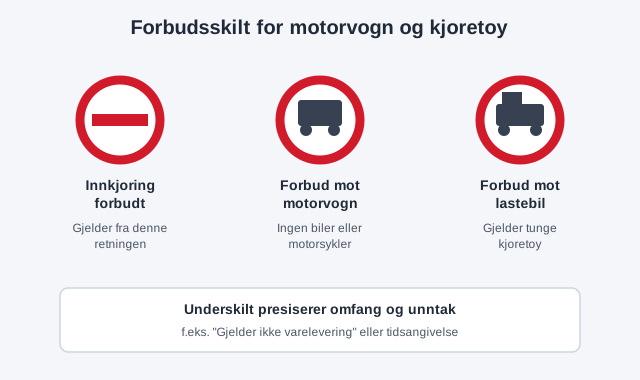
Table of contents
- What no entry means
- No motor vehicles and other vehicle types
- How to tell the signs apart
- Supplementary plates that change the ban
- What applies to you in class B
What no entry means
The no entry sign is a red, circular sign with a wide, horizontal white bar across the middle. It means you may not drive into the direction the sign faces. The sign very often stands at one end of a one-way street: where the traffic exits, you see no entry, while at the other end you see the one-way sign.
The ban applies from where the sign stands and beyond it. It does not mean the whole street is closed – you may well drive in the street, but only in the legal direction. A common beginner mistake is to think no entry applies to all vehicles without exception. That is true in principle, but scheduled buses, emergency vehicles and others may have special permission, and supplementary plates can create exceptions. Read more about the connection in the article on one-way driving and lane choice .
No motor vehicles and other vehicle types
No motor vehicles is also a round sign with a red border, but here both a car and a motorcycle are pictured inside it. It means that neither cars nor motorcycles may drive past the sign. Unlike no entry, this sign is about which type of vehicle is prohibited, not about the direction of travel.
There is a whole family of prohibitory signs aimed at specific vehicles:
- No motor vehicles – applies to cars and motorcycles
- No lorries – applies to heavy goods vehicles over a stated weight
- No motorcycles and mopeds
- No tractors and motorised equipment
- No cyclists or no pedestrians
A separate sign, no motorised traffic, closes the road to all motorised vehicles at once. These signs belong to the large group of prohibitory signs that you should know well for the theory test.
How to tell the signs apart
The fastest way to tell the signs apart is to look at the content of the red circle. The table below sums up the most important differences:
| Sign | Symbol | What it bans | Typical location |
|---|---|---|---|
| No entry | Wide white bar | Driving into this direction | End of a one-way street |
| No motor vehicles | Car + motorcycle | Cars and MC in any direction | Pedestrian street, green street |
| No lorries | Lorry | Heavy goods vehicles | Residential road, bridge, tunnel |
| No motorised traffic | Car + cycle/MC | All motorised vehicles | Trail, recreation area |
The main rule is simple: if there is a bar, it is about direction. If there is a vehicle symbol, it is about which type of vehicle may not pass. The ban starts where the sign stands and applies until the next junction or an end sign, unless a supplementary plate says otherwise.
Supplementary plates that change the ban
Many prohibitory signs have a supplementary plate that specifies or limits the ban. The plate is a rectangular board beneath the main sign and is always binding together with it. Common examples are:
- Time indication – the ban applies only during certain hours or on certain days.
- “Does not apply to deliveries” – one vehicle group may still drive.
- “Does not apply to buses” or “Does not apply to access to properties”.
- An arrow showing that the ban applies to a particular direction or stretch.
Without reading the supplementary plate you can misread a sign and drive illegally. This is a topic that often appears on the test – see more in the article on supplementary plates . A neighbouring example is driving where buses have their own rules, as explained in driving in bus lanes and public transport lanes .
What applies to you in class B
As a driver of a passenger car in class B you must obey both no entry and no motor vehicles where they apply. Your car is a motor vehicle, so at a no motor vehicles sign you must find another route. At no lorries, on the other hand, you may drive, because the passenger car is not a heavy goods vehicle – unless you are towing a large trailer that pushes the total weight over the limit.
Remember too that some vehicles with special tasks may have exceptions, as explained in traffic rules for special vehicles . If you bring a trailer, you should have control over trailer weight and the class B licence so you know whether weight limits on signs affect you.
Sign knowledge is tested thoroughly on the theory test, and prohibitory signs are among the most central. If you want to practise exactly this type of question, you can take a free theory test and then keep training in the Eteo app until you are confident and ready for the theory test.
Next step
Continue with free car questions
Go straight from the article to free car questions and check what actually sticks before you keep reading more theory.
Try for free