No-turn and no-U-turn signs – turning bans at junctions
How to read no-turn and no-U-turn signs and plan your route.
No-turn and no-U-turn signs are a group of prohibition signs that tell you that you cannot choose a particular direction at a junction. The most common are no left turn, no right turn and no U-turn. These signs are tied to keeping traffic flowing safely, and they often force you to plan your route a little further ahead than the junction you are sitting in.
Once you understand where a sign starts to apply and how long it lasts, you avoid both dangerous last-second manoeuvres and unnecessary fines. This article goes through the three signs, where they are placed and how to think as a driver.
Contents
- The three signs and what they mean
- Where and for how long the ban applies
- How to plan your route
- Common mistakes and misunderstandings
- Practise for the theory test
The three signs and what they mean
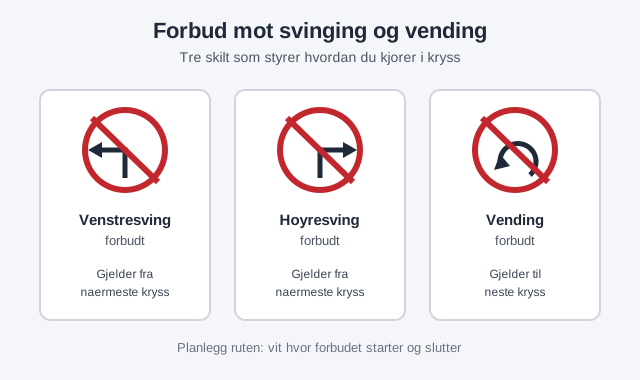
These signs belong to the prohibition signs, which are round with a red border. The symbol inside shows which manoeuvre is banned. It is important to tell them apart from mandatory signs, which instead require you to follow a specific direction you must take.
| Sign | Meaning | Typical placement |
|---|---|---|
| No left turn | You cannot turn left at the junction | Just before the junction |
| No right turn | You cannot turn right at the junction | Just before the junction |
| No U-turn | You cannot make a U-turn | A stretch or a junction |
An important point is that a sign banning a left turn generally also bans a U-turn at the same junction, because a U-turn begins as a left turn. If you want to be sure of the rules around the U-turn itself, you can read more about the rules for U-turns and U-turn bans .
For a broader walkthrough of the whole sign group, see the article on prohibition signs and what they mean .
Where and for how long the ban applies
A turning ban applies to the nearest junction after the sign. The sign is placed just before the junction, and you must have managed to read it in good time. If the sign is set up late, or you notice it too late, you should still not make a dangerous manoeuvre to turn somewhere else – choose a safe detour instead.
A no-U-turn ban can apply:
- At a specific junction, in the same way as the turning bans.
- Over a stretch, where it usually lasts to the next junction or to an end-of-restriction sign.
Right-of-way rules always apply on top of the sign. Even where a turn is allowed, you must always work out who goes first. It is worth revising how you handle giving way when turning into a road and giving way to the right .
How to plan your route
When a turn is banned, you have to find another way to your destination. This is pure route planning, and it is one of the reasons good drivers read signs early:
- Read the sign well in advance and decide before you are inside the junction.
- Choose the right lane early, so you do not have to change lane at the last second. This ties in closely with one-way driving and lane choice .
- Do not brake or swerve suddenly if you notice the ban late.
- Use the next junction to turn around or correct your route instead.
In busy urban areas, one-way streets and turning bans often work together to keep traffic flowing. If you are practising a demanding left turn, it helps to see how you safely perform a left turn at a busy junction where it is actually allowed.
Common mistakes and misunderstandings
| Mistake | Consequence | Correct action |
|---|---|---|
| Making a U-turn where a left turn is banned | Fine and a dangerous situation | Drive on and turn at a legal spot |
| Noticing the sign too late and turning anyway | Sudden manoeuvre and collision risk | Choose a safe detour |
| Thinking the sign applies to the whole road | Unnecessarily long detour | The ban usually applies only to the nearest junction |
| Forgetting the duty to give way | Conflict with crossing traffic | Always work out right of way before turning |
If you need to turn around because a turn is banned, it is important to do it safely. Read how to perform a turn in the road without creating danger.
Practise for the theory test
No-turn and no-U-turn signs often appear on the class B theory test, frequently combined with questions about lanes and right of way. The best way to learn them is to practise realistic questions until you recognise the signs instantly.
Take a free theory test to test yourself, and keep practising in the Eteo app so you are ready for the actual theory test. If you want to know what it takes to pass, check the number of questions and pass mark on the theory test .
Next step
Continue with free car questions
Go straight from the article to free car questions and check what actually sticks before you keep reading more theory.
Try for free