No stopping vs no parking – the difference between the signs
The difference between the no stopping and no parking signs, and what each one allows.
Two of the most common prohibition signs in Norway are no stopping and no parking. They look almost identical – a round sign with a red border – but they mean very different things. The difference is about how much you are actually allowed to do with your car along the road. On the class B theory test this is a classic question that many people get wrong because they mix up the two terms.
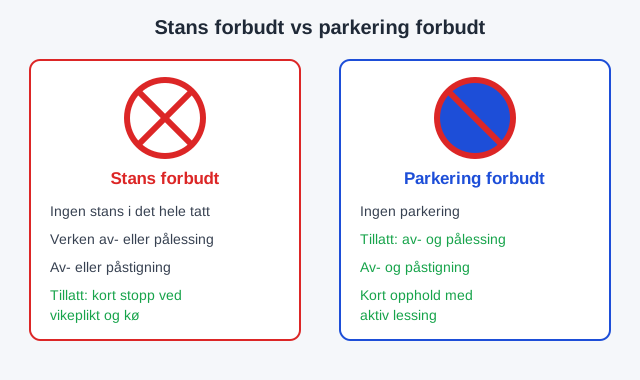
Table of contents
- What does no stopping mean?
- What does no parking mean?
- How to tell the signs apart
- How supplementary plates change the rules
- Where do the signs apply?
What does no stopping mean?
The no stopping sign is the stricter of the two. It is shown as a blue circle with a red border and two red crosses. When this sign is up, you may do very little: you may not stop the car to drop off or pick up passengers, and you may not load or unload goods.
The term stopping means any voluntary halt of the vehicle. That means even a brief stop to let out a passenger is forbidden where this sign applies. The only exception is a stop you are forced to make by traffic conditions – for example if you must wait because of a give-way obligation, a queue or a red light. Such involuntary stops do not count as “stopping” in the legal sense.
The sign is often used where a stationary vehicle would be directly dangerous or a serious obstruction, such as in tunnels, on narrow roads, at junctions and in front of emergency stations.
What does no parking mean?
The no parking sign is less strict. It is shown as a blue circle with a red border and a single red diagonal stroke. Here it is parking – leaving the car standing – that is forbidden. But you are still allowed to stop in order to do something active.
That means under a no parking sign you can:
- Drop off and pick up passengers
- Load and unload goods as long as you keep working actively
- Stand for a short moment while loading, without leaving the vehicle for any length of time
The difference between stopping and parking is therefore decisive. Parking means the car is left standing – often without a driver, or for more than a short moment without active loading. As soon as you leave the car or stand still without doing anything, it changes from “stopping” to “parking”.
How to tell the signs apart
The simplest rule of thumb is the number of red lines:
| Sign | Appearance | Brief stop | Loading/unloading | Parking |
|---|---|---|---|---|
| No stopping | Two crosses (X) | No | No | No |
| No parking | One diagonal stroke (/) | Yes | Yes | No |
In other words: two lines = strictest. If there are two crosses, you must keep moving unless the traffic forces you to stop. If there is only one line, you may stop briefly, but not leave the car to park.
How supplementary plates change the rules
Both signs can have a supplementary plate that specifies or limits where and when the prohibition applies. A supplementary plate can, for example, state:
- A time period, so the prohibition only applies at certain times of day
- A stretch with arrows showing how far the prohibition reaches
- Exemptions for certain groups, such as people with a disabled parking permit
It is easy to make a mistake if you only see the main sign and overlook the supplementary plate. Always read the whole sign combination before you decide. You can read more about how additional information works in the article on parking signs with supplementary plates and time limits and the general overview of supplementary plates and what they mean .
Where do the signs apply?
A prohibition sign normally applies from where the sign stands until the next junction, unless a supplementary plate says otherwise. The prohibition applies only on the side of the road where the sign is placed.
Even without a sign there are many places where stopping or parking is forbidden under the general traffic rules – for example at junctions, on pedestrian crossings and in front of driveways. The signs come in addition to these basic rules. It therefore pays to know both the traffic rules on stopping and the traffic rules on parking . If you want a practical overview of prohibition zones without signs, see the article on where parking is forbidden . The signs belong to the family of prohibition signs , which is worth going through together before the test.
Once you understand the difference between the two signs, you avoid both fines and typical pitfalls on the theory test. Want to test yourself? Take a free theory test and keep practising in the Eteo app to be well prepared for the theory test.
Next step
Continue with free car questions
Go straight from the article to free car questions and check what actually sticks before you keep reading more theory.
Try for free