Mandatory direction of travel – arrows and what they mean
What the arrows on mandatory signs mean and how to follow the required direction of travel.
A round, blue sign with a white arrow is a mandatory sign, and the arrow tells you which way you must drive. Many people confuse these with warning or prohibitory signs, but the principle is simple: a mandate is a duty, not a suggestion. In this article we look at what mandatory direction of travel means, how to tell it apart from a mandatory lane, and how to follow the arrows correctly at junctions and narrowings.
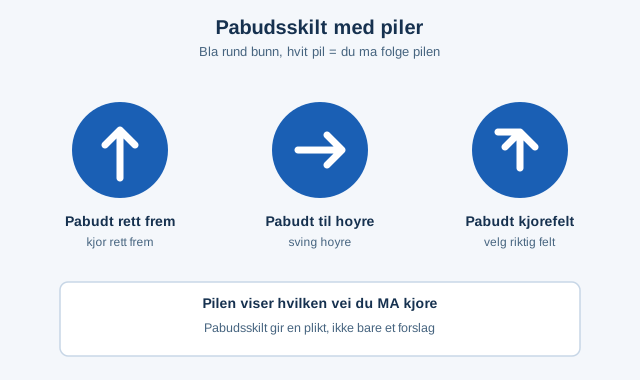
Table of contents
- What is a mandatory sign?
- Mandatory direction of travel – the arrows explained
- Mandatory lane – the hooked arrow
- How to follow the arrows at junctions
- Common mistakes and how to avoid them
What is a mandatory sign?
Mandatory signs are round with a blue background and a white symbol. They place an active duty on you: you must do exactly what the symbol shows. That separates them from prohibitory signs, which are round with a red ring and tell you what you are not allowed to do, and from warning signs, which are triangular and only alert you to something ahead.
When the symbol is one or more arrows, the mandate is about direction. The sign is usually placed right in front of the junction or the point where the duty begins, so you have time to choose correctly. Compare it with the wider system in mandatory signs in general to see the whole family of blue signs.
Mandatory direction of travel – the arrows explained
The sign for mandatory direction of travel uses an arrow to show which way you must drive. The arrow can point straight ahead, to the right, to the left, or be a combination. You have no choice: if the arrow points right, you must turn right.
| Arrow direction | What you must do |
|---|---|
| Arrow straight up | Drive straight ahead |
| Arrow to the right | Turn right |
| Arrow to the left | Turn left |
| Curved arrow (passing) | Pass on the side the arrow shows |
| Two arrows | Choose one of the permitted directions |
A common variant is the curved arrow placed at traffic islands and obstacles. It tells you to pass on the side of the arrow – typically keeping to the right around an island. This is a real mandate, not a recommendation, and breaking it can result in a fine.
Mandatory direction of travel is closely linked to one-way streets and lane choice , because many one-way streets use arrow signs to guide traffic safely.
Mandatory lane – the hooked arrow
It is easy to mix up mandatory direction of travel with a mandatory lane. The difference lies in the shape of the arrow:
- Mandatory direction of travel: a straight or curved arrow pointing in the direction you must drive.
- Mandatory lane: an arrow that bends with a hook, telling you which lane to be in to reach your destination.
Mandatory lane signs are often used ahead of junctions with several lanes, where each lane leads to a different direction. You then need to position yourself in the correct lane in good time. Read more about how to choose a lane based on signage and about practical lane sorting with directional arrows to avoid late and dangerous lane changes.
How to follow the arrows at junctions
In practice, you follow the arrows best by reading the signs early and planning ahead. A simple routine:
- Look for a blue, round sign as you approach the junction.
- Interpret the arrow: a straight arrow means direction, a hooked arrow means lane choice.
- Position yourself in the right lane while there is still plenty of distance.
- Check mirrors and blind spot before any lane change.
- Follow the arrow – do not improvise if you picked the wrong lane; obey the mandate and correct later.
An early, calm lane change is safer than a sudden one. It requires that you have read the signs and understand overtaking and lane changes . Remember too that mandatory direction can be combined with a duty to give way, for example at T-junctions , where the arrow controls direction while the give-way rules control who goes first.
Common mistakes and how to avoid them
Most mistakes happen because the driver reacts too late:
- Spotting the sign too late and ending up in the wrong lane – read far ahead.
- Confusing a mandate with a recommendation – an arrow on a blue sign is always a duty.
- Changing lanes right before the junction – dangerous and often too late; position yourself early.
- Following a curved arrow on the wrong side of a traffic island – the arrow shows exactly which side.
Once you understand the system, arrow signs become easy to read. If you want to practise signs and direction of travel before the theory test, take a free theory test and keep training in the Eteo app until you are confident with both mandatory signs and lane choice.
Next step
Continue with free car questions
Go straight from the article to free car questions and check what actually sticks before you keep reading more theory.
Try for free