Zone signs – speed zone, parking zone and environmental zone
How zone signs for speed, parking and the environment apply to whole areas.
Zone signs differ from ordinary traffic signs because they apply to a whole area – not just a single point or a short stretch of road. When you pass a zone sign, the rule applies continuously until you pass a matching end sign. Many people get this wrong on the class B theory test, because you have to remember the rule long after the sign itself is out of sight.
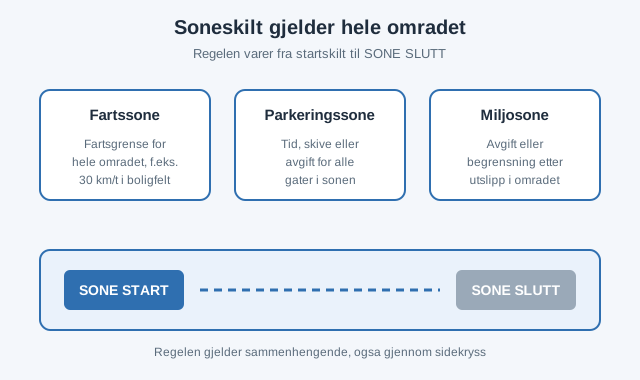
Table of contents
What is a zone sign?
A zone sign has the word “SONE” (zone) at the top. This means the rule applies to all roads within the area, not only the road you happen to be driving on right now. So you do not need to keep the sign in sight – the rule follows you until the zone is cancelled.
Each zone has a start sign and an end sign. The end sign looks like the start sign but has a diagonal line across it and the text “SONE SLUTT” (zone ends). Between these two signs the rule applies continuously, no matter how many junctions you drive through.
| Property | Ordinary sign | Zone sign |
|---|---|---|
| Applies | From the sign and a stretch ahead | The whole area until the zone ends |
| Cancelled by | A new sign or a junction | Its own end sign (“SONE SLUTT”) |
| Affected by side junctions | Yes, can be cancelled | No, applies through junctions |
| Typical use | Single stretch | Residential area, town centre, district |
Speed zone
A speed zone sets a speed limit that applies to the whole area, for example a residential area with 30 km/h. The difference from an ordinary speed limit sign is important: in a speed zone the limit keeps applying even if you turn into side roads inside the zone.
With an ordinary speed limit sign, the limit is often cancelled when you enter a junction, and you must then revert to the general speed limit. That does not happen in a speed zone – here the limit applies until you pass the “SONE SLUTT” sign. To refresh the basics, you can read more about speed limits in Norway and how an environmental speed limit works.
Remember too that a separate end of speed limit for ordinary speed limit signs should not be confused with the zone’s “SONE SLUTT” sign.
Parking zone
A parking zone sets parking rules that apply to a whole area. The start sign often shows a parking symbol or a prohibition, and usually carries supplementary signs with time limits, a requirement for a parking disc, or a charge. The rules apply to every street within the zone.
Typical examples of what a parking zone can regulate:
- Time-limited parking – for example a maximum of 2 hours on weekdays.
- Parking disc requirement – you must set your time of arrival.
- Paid parking – payment is required within the stated period.
- A ban on parking across the whole zone, where parking is only allowed in marked bays.
It is easy to forget the rule once you have driven far into a parking zone looking for a space. That is why it is important to read the supplementary signs carefully on entry. To understand how the supplementary signs are interpreted, take a closer look at parking signs with supplementary plates and the general parking rules . The difference between a ban on stopping and a ban on parking is also useful knowledge in parking zones.
Environmental zone
An environmental zone is an area where restrictions or charges can be introduced to reduce local air pollution, especially from the most polluting vehicles. The aim is cleaner urban air and lower emissions in densely populated areas. Such zones are typically used in larger cities and are linked to the effort against particulate matter and greenhouse gases.
Inside an environmental zone the rules may, among other things, involve:
- Differentiated charges based on the vehicle’s emissions or fuel.
- Restrictions on heavy or older, polluting vehicles.
- Time-dependent measures that only apply during high air pollution.
For class B the most important thing is to know what an environmental zone is, and that it – like other zones – applies to the whole area until the end sign. The specific rules vary from city to city and may change, so always follow the local signing.
How to remember the zone rules
The simplest rule of thumb is: a zone sign switches off the mindset of “the sign is gone, the rule is gone”. In a zone the rule applies until you see “SONE SLUTT”. This differs from many prohibitory signs that are cancelled in other ways.
| Zone type | Regulates | Applies until |
|---|---|---|
| Speed zone | Speed limit | “SONE SLUTT” for speed |
| Parking zone | Parking, time, charge | “SONE SLUTT” for parking |
| Environmental zone | Emissions, charge, access | The zone’s end sign |
The zone rules are closely connected to the concept of a built-up area , where speeds are often lower and the rules stricter. Once you master the difference between point signs and zone signs, you have a solid foundation both in practice and on the theory test.
Want to test how well you have understood zone signs? Take a free theory test and keep practising in the Eteo app, so you are confident and well prepared for the class B theory test.
Next step
Continue with free car questions
Go straight from the article to free car questions and check what actually sticks before you keep reading more theory.
Try for free