Clutch wear and clutch technique – how to save your clutch
Correct clutch technique and how to avoid wearing out the clutch.
The clutch is the wear part most often sacrificed by bad habits on a manual car. Wear rarely comes from how far you drive, but from how you use the pedal in the few seconds the clutch plate slips against the flywheel. With the right clutch technique a clutch can last well beyond 200,000 km, while careless use can wear out the clutch in a fraction of that.
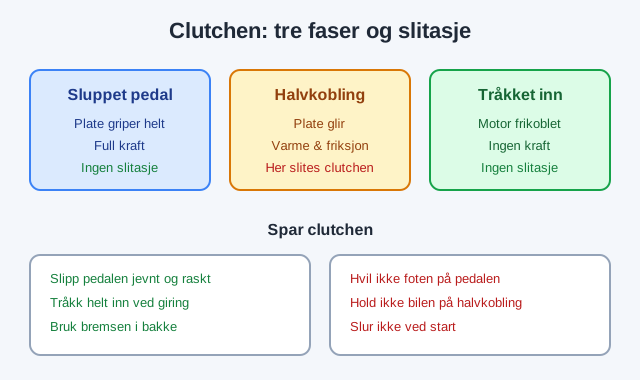
Table of contents
- How the clutch works
- Habits that wear out the clutch
- Correct clutch technique
- Signs of a worn clutch
- Hill starts without burning the clutch
How the clutch works
The clutch connects the engine to the gearbox. When the pedal is fully released, the clutch plate is pressed firmly against the flywheel and transfers all power without slipping. When you press the pedal all the way in, the engine is disconnected from the wheels. The critical zone is in between – the friction point – where the plate slips in a controlled way against the flywheel.
All slipping creates heat and friction, and it is precisely in this slipping phase that the clutch wears. A little slipping is necessary every time you pull away from a standstill. The problem arises when the slipping lasts too long or happens when it is not needed.
Habits that wear out the clutch
Many bad habits feel harmless but cost clutch life. The most common are:
- Resting your foot on the clutch pedal while driving. Even light pressure causes partial slipping and constant wear.
- Holding the car still on the friction point on a hill instead of using the brake.
- Slipping the clutch for a long time when pulling away, especially with high revs.
- Changing gear with the pedal only half in instead of pressing it all the way down.
- Resting your palm on the gear lever, which can put side load on the selector over time.
| Habit | What happens | Consequence |
|---|---|---|
| Foot on pedal | Light slipping all the time | Steady, hidden wear |
| Slipping on a hill | Plate slips without gripping | Heat and rapid wear |
| Slipping when starting | Long slipping phase | Burnt smell, short life |
| Half-pressed when shifting | Incomplete disengagement | Wear and harsh shifting |
Learn more about economical use of revs in the article on revs and gear changing , which is closely linked to gentle clutch use.
Correct clutch technique
Good technique is about minimising the time the clutch slips and giving enough throttle so the engine does not stall.
- Release the pedal smoothly until you feel the clutch bite, then add a little throttle and release the rest in a controlled way.
- Press the pedal all the way in when you change gear, and release it fully afterwards – do not let your foot linger.
- Use the shortest possible slipping phase: when the car is rolling, the clutch should be fully released.
- Take your foot off the pedal as soon as you have finished engaging.
- Combine it with the right gear choice, so you do not have to slip in too high a gear.
The right interplay between gear, throttle and clutch is described in more detail in gears and gear choice . If you are wondering whether a manual suits you at all, read the comparison in manual vs automatic .
Signs of a worn clutch
A clutch rarely dies suddenly. It usually warns you well in advance:
- The clutch slips: the revs rise without the speed following, especially uphill or when accelerating in a high gear.
- A burnt smell after demanding driving or many hill starts.
- A high friction point: the clutch bites only right at the top of the pedal travel.
- Jerking or vibration when you engage.
- A heavy or sluggish pedal.
If you suspect wear, test gently: select a high gear on a flat road at low speed and add throttle. If the revs rise quickly without a matching increase in speed, the clutch is slipping. A workshop should then assess it.
Hill starts without burning the clutch
Hill starts are where beginners most often burn the clutch. The key is to use the brake to hold the car, not the clutch:
- Hold the car with the foot brake or handbrake.
- Find the friction point with the clutch while adding a little throttle.
- Release the brake as the clutch bites, and continue releasing the pedal smoothly.
Many cars have a hill-start assistant that holds the brake pressure for a moment, so you do not have to balance on the clutch. Detailed technique is covered in the article on hill starts and engine braking .
For general car know-how it can also be useful to master basic maintenance such as jump leads and jump starting .
Summary
The clutch wears from slipping, not from distance driven. Release the pedal smoothly, press it all the way in when shifting, keep your foot off the pedal otherwise, and use the brake on hills. That saves both the clutch and your wallet.
Want to test your theory knowledge? Take a free theory test and keep practising in the Eteo app to be well prepared for the theory test.
Next step
Continue with free car questions
Go straight from the article to free car questions and check what actually sticks before you keep reading more theory.
Try for free