Four-wheel drive vs front-wheel drive – what it means for driving
How front-, rear- and four-wheel drive affect grip and driving.
Which wheels actually receive power from the engine matters a great deal for how the car behaves on the road. Four-wheel drive and front-wheel drive give different behaviour in corners, downhill, on slippery surfaces and when you accelerate. As a new driver it helps to understand the differences so you can adapt your driving to the car you are actually sitting in.
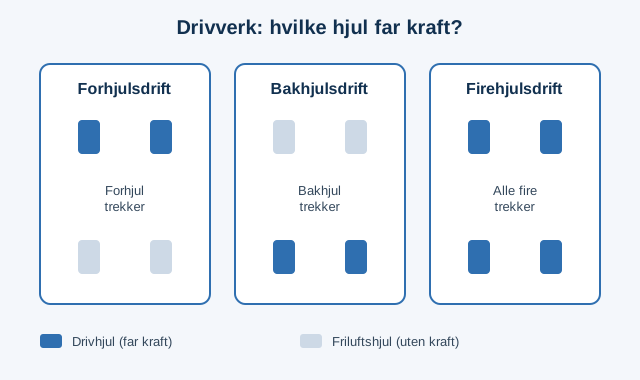
Table of contents
- What does the drivetrain mean?
- Front-wheel drive: characteristics
- Rear-wheel drive: characteristics
- Four-wheel drive: characteristics
- Comparison and what it means on slippery roads
- Fuel use, weight and what you should choose
What does the drivetrain mean?
The drivetrain decides which wheels drive the car forward. On a passenger car there are three main types: front-wheel drive, rear-wheel drive and four-wheel drive (often called 4WD or AWD). The driven wheels must handle both drive force and part of the grip at the same time, while the wheels without power simply roll freely.
An important point is that the drivetrain does not change how much total grip the tyres have. The friction between tyre and road is the same regardless of which wheels pull. What the drivetrain does affect is how the car reacts when you accelerate, use engine braking and steer. To understand grip itself better, read more in the article on grip and friction .
Front-wheel drive: characteristics
Front-wheel drive is the most common solution on small and mid-size cars. The engine sits at the front and drives the front wheels, which also steer.
Advantages:
- Good weight over the driven wheels, giving solid grip when accelerating on flat and lightly rolling roads.
- Predictable behaviour: at too high a speed in a corner the car tends to understeer, sliding slightly straight ahead. This often feels safe and is easy to correct by easing off the throttle.
- Cheaper to produce and usually gives more cabin space.
Disadvantages:
- The front wheels do a lot at once (steer, pull and take much of the braking), which can give weaker grip on steep slippery hills.
- Less “sporty” driving feel than rear-wheel drive.
Rear-wheel drive: characteristics
Rear-wheel drive is often used on larger cars, sports cars and many electric cars. The front wheels steer, while the rear wheels pull.
Advantages:
- The tasks are split: front wheels steer, rear wheels pull. This gives precise steering and good balance.
- Often better for heavy loads and trailers, because the weight at the rear presses the driven wheels down.
Disadvantages:
- On slippery roads the rear can lose grip more easily under throttle, and the car may oversteer (the rear slides out). This calls for gentler throttle use in winter.
- Modern cars usually have electronic stability control (ESC) that dampens such slides considerably.
Four-wheel drive: characteristics
Four-wheel drive spreads the power across all four wheels. Some systems are always engaged (AWD), while others engage the rear wheels automatically or manually when needed.
Advantages:
- Best traction when pulling away and on hills, especially on snow, ice and loose gravel.
- Power is split across more wheels, so each individual wheel keeps grip more easily during acceleration.
- Safe and stable when pulling out of a slippery parking spot or a steep driveway.
Disadvantages:
- Four-wheel drive helps you get going, but not to stop. Braking distance and cornering grip are roughly the same as on a two-wheel-drive car with the same tyres.
- Heavier, more expensive and higher fuel consumption.
It is exactly this misunderstanding that puts many four-wheel-drive cars in the ditch every winter: the driver builds up speed easily and overestimates the grip. Remember that braking still depends on the tyres and systems such as the anti-lock braking system ABS .
Comparison and what it means on slippery roads
| Trait | Front-wheel drive | Rear-wheel drive | Four-wheel drive |
|---|---|---|---|
| Traction on hills/snow | Good | Medium | Best |
| Cornering behaviour | Understeer (safe) | Oversteer possible | Most neutral |
| Fuel consumption | Lowest | Medium | Highest |
| Weight and price | Lowest | Medium | Highest |
| Braking distance | Equal | Equal | Equal |
The most important thing to remember: no drivetrain type replaces good tyres and low speed. The right choice between studded and studless winter tyres and knowing when to switch to winter tyres matters far more for safety than the number of driven wheels. On ice, extra calm driving applies regardless of drivetrain, as described in starting and driving on ice .
Fuel use, weight and what you should choose
Four-wheel drive adds weight and more mechanics, and therefore uses a little more fuel or electricity than an equivalent two-wheel-drive car. If you rarely drive on snow or loose surfaces, a good front-wheel-drive car with the right tyres can be both cheaper and more than enough. If, however, you will tow a trailer within class B or drive a lot on winter roads in steep terrain, four-wheel drive may be worth the extra consumption.
To read more about how the fuel choice affects economy and the environment, there is an overview of fuel types and tips on how to reduce fuel consumption .
Whatever drivetrain your car has, safe driving comes mostly down to understanding how the car reacts. Test your knowledge with a free theory test and keep practising in the Eteo app, so you are well prepared for the theory test.
Next step
Continue with free car questions
Go straight from the article to free car questions and check what actually sticks before you keep reading more theory.
Try for free