Jump leads and jump starting – the correct order
The safe order for jump leads and jump starting when the battery is flat.
A flat battery is one of the most common reasons a car will not start, especially on cold winter days. With a pair of jump leads and a car with a charged battery you can usually solve the problem in a few minutes. But the order in which you connect the leads matters: the wrong order can cause sparks, damage to sensitive electronics or, in the worst case, an explosion of battery gas. This article shows you the safe way to jump start a car.
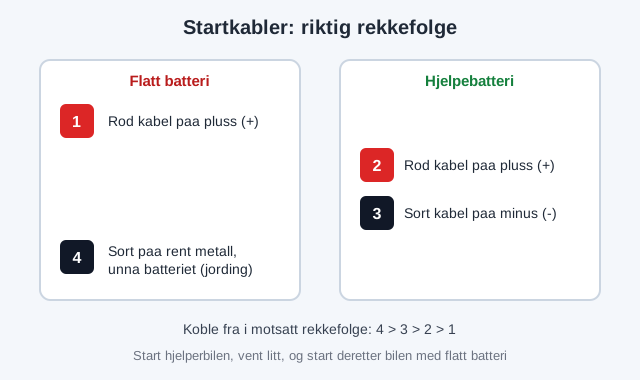
Table of contents
- Before you start
- The correct connection order
- How to disconnect again
- Common mistakes and dangers
- Electric cars and modern vehicles
Before you start
Begin by parking the two cars close together without letting them touch. Put both in neutral (manual) or P (automatic), apply the handbrake and switch off the ignition on both cars. Take off any loose jewellery and check that the jump leads are intact with no damaged insulation.
Make sure both batteries have the same voltage, normally 12 volts on a passenger car. A completely discharged or frozen battery should not be jump started, as it may crack. A weak battery in winter is a sign you should keep an eye on things, and you can read more about how to keep the battery healthy in the article about a car battery that gets weak in winter .
| You need | Why |
|---|---|
| Jump leads with a good core | Thin leads cannot handle the starting current |
| A donor car with a charged 12 V battery | The source of power |
| Gloves | Protect against sparks and acid |
| A clean earthing point | A safe spot for the final connection |
The correct connection order
The red lead is plus (+), and the black lead is minus (–). Follow this order exactly:
- Connect the red lead to plus (+) on the flat battery.
- Connect the other end of the red lead to plus (+) on the donor battery.
- Connect the black lead to minus (–) on the donor battery.
- Connect the last black clamp to a clean, unpainted metal point (earth) on the engine or body of the car with the flat battery – not directly on the negative terminal.
The reason the final connection is made at an earthing point some distance from the battery is that a small spark can occur when the circuit is completed. A flat battery can release flammable hydrogen gas, and you want the spark well away from it. Then start the donor car, let it run for a minute or two, and try to start the car with the flat battery.
How to disconnect again
Once the car has started, let both engines run for a short while. Then disconnect in the reverse order of the connection:
- Black clamp from the earthing point.
- Black clamp from the donor battery’s minus.
- Red clamp from the donor battery’s plus.
- Red clamp from the previously flat battery’s plus.
Make sure the clamps do not touch each other or the bodywork while the other end is still connected. Let the car that had the flat battery keep running, or drive a longer trip, so the alternator can recharge the battery. A well maintained battery is the key to avoiding the problem again, and you will find practical advice in the guide on 12 V battery maintenance .
Common mistakes and dangers
Most damage happens because of small mistakes. Avoid these:
- Wrong polarity: red on minus or black on plus can destroy electronics and cause a strong spark.
- Final clamp straight on the negative terminal: increases the risk of a spark near the battery gas.
- Clamps touching each other: causes a short circuit.
- Thin or damaged leads: can become red hot.
- Jump starting a frozen battery: can cause the battery to crack.
It is also wise to keep jump leads or a jump booster among the permanent equipment in the car. See what else should be included in the overview of emergency equipment in the car . In winter you should also carry winter preparedness in the car in case you get stranded.
Electric cars and modern vehicles
An electric car has its own high-voltage battery for propulsion, but also an ordinary 12 V battery for lights and electronics. You must never use the EV’s high-voltage system to jump start others, but an EV’s 12 V battery can in many cases be jump started itself – always check the car’s manual first. On modern cars the earthing point and battery may be in different places, and some have dedicated jump points under the bonnet.
If the car still will not start after several attempts, the fault may lie somewhere other than the battery. If warning lights are on, it can be useful to read about what they mean in the article on engine and engine indicators . If you also cannot unlock or start with the key, it could be due to key battery and keyless faults .
Knowledge about the car’s technical condition and simple troubleshooting is part of the syllabus for the class B theory test. Want to test what you know? Take a free theory test and practise regularly in the Eteo app, so you are well prepared for the theory test.
Next step
Continue with free car questions
Go straight from the article to free car questions and check what actually sticks before you keep reading more theory.
Try for free