Boat trailer and launching – driving and ramp technique
Drive with a boat trailer and reverse safely down a launching ramp.
Driving with a boat trailer and launching at a ramp places its own demands on both technique and preparation. The trailer is often long and low, and you have to reverse down a slippery ramp while keeping control of both car and boat. This article explains how to drive safely with a boat trailer, how to reverse down a launching ramp, and how to secure the boat during transport.
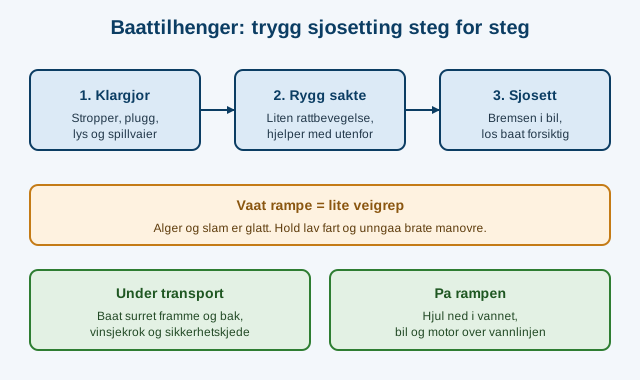
Table of contents
- Before you drive: checks and securing
- Driving with a boat trailer on the road
- Reversing down the ramp
- Grip on a wet ramp
- The launch itself
- Loading out and driving home
Before you drive: checks and securing
A boat trailer usually carries a wider and heavier load than an ordinary cargo trailer, and the load sits high. Good load distribution and nose weight are therefore crucial for the combination to drive stably. Place the centre of gravity correctly over the wheel axle, and check that the nose weight is suitable – neither too low nor too high.
Check the following before departure:
- The winch wire and winch hook are tightened and locked so the boat cannot slide backwards.
- Securing straps hold the boat firmly both at the bow at the front and at the stern at the rear.
- The safety chain between trailer and boat is in place.
- Trailer lights and brake lights work – test them before you set off.
- The drain plug in the boat: remember to bring it, but do not fit it before the boat is on the water if you are draining rainwater on the way.
Read more about how to attach the trailer correctly in the article on how to connect a trailer to the car and on tow bars and trailer lights .
Driving with a boat trailer on the road
On the road the same principles apply as for all other trailer driving: gentler pull-away, longer braking distance and good space ahead. A tall boat catches more wind, so crosswinds and being overtaken by large vehicles can create movement in the combination.
Pay particular attention to trailer sway. If the trailer starts to snake, ease off the throttle calmly and keep the wheel straight – you should not steer against it or brake hard. Read how to prevent this in the article on trailer sway and its causes .
Remember that separate speed limits apply with a trailer. The table below shows typical considerations when driving with a boat trailer:
| Factor | What to keep in mind |
|---|---|
| Speed | Follow the speed limits that apply with a trailer |
| Distance | Increase your following distance, longer braking distance |
| Crosswind | A tall boat catches wind, keep a firm grip on the wheel |
| Turns | Takes up more room, swing slightly wider |
| Hills | Lower speed downhill, use a lower gear uphill |
General technique for driving calmly and predictably can be found in driving with a trailer .
Reversing down the ramp
Reversing is the hardest part of launching. The trailer turns the opposite way to what you are used to, and a long boat trailer reacts slowly to steering input. Use small steering movements and straighten up early.
Good advice when reversing:
- Place your hand at the bottom of the wheel – then the trailer turns the same way you move your hand.
- Reverse slowly and stop often to assess your position.
- Use a helper outside the car to direct you, ideally with agreed signals.
- Aim for the middle of the ramp, and straighten the combination before you start the descent.
You will find more thorough technique in reversing with a trailer .
Grip on a wet ramp
A launching ramp is often covered with algae, silt and a wet surface below the waterline, which gives very little grip – much like driving on ice. Many cars lose traction when the rear wheels reach the slippery section.
- Drive slowly and avoid sudden throttle or hard braking.
- Consider four-wheel drive if the car has it – it gives better traction back up.
- Do not drive further down than necessary; keep the engine and exhaust above the waterline.
- Apply the handbrake and put it in park or a low gear when the car is stationary.
The principles for handling low friction resemble what you practise when driving on a gravel road , where the surface also gives less grip than dry asphalt.
The launch itself
When the combination is straight on the ramp, bring the car to a stop with the brake on. Loosen the rear securing straps, but let the winch wire hold the boat until it is ready to float. Reverse calmly far enough that the trailer wheels go into the water and the boat begins to lift. Then you can release the winch hook and let the boat slide gently off.
Make sure no one stands between car and boat, and that the boat is moored or held by a helper before it floats free. Once the boat is off the trailer, drive calmly back up the ramp and park the trailer so others can get through.
Loading out and driving home
When loading out you do the opposite: reverse the trailer down, winch the boat into place, check that it sits correctly in the keel support and lock the winch hook. Check lights and straps again before driving home, and let any water drain out. Good securing prevents the load from shifting – read more in securing cargo in class B .
Much of this appears in the theory syllabus on load and trailers. Want to test what you know? Take a free theory test and keep practising in the Eteo app until you are ready for the theory exam.
Next step
Continue with free car questions
Go straight from the article to free car questions and check what actually sticks before you keep reading more theory.
Try for free